
The vocabulary of “entrepreneur” originally came from French economics, which means someone undertakes a significant project or activity. Jean Baptiste Say indicates that entrepreneurs especially be used to describing venturesome individuals who advanced economic progress using new and better ways of doing things. Joseph Schumpeter identifies entrepreneurs are change agents in the economy, who drive the process of capitalism. Both Say and Schumpeter regard entrepreneurs as someone engaged in new, profit-seeking business ventures, through which serving its responsibilities. While contemporary management and business hold a broader view of entrepreneurs. According to Drucker, entrepreneurs are those who search for change, responds to it, and exploits it as an opportunity. Howard Stevenson says entrepreneurs do not only see and pursue opportunities but also have the capability to mobilize the resources of others to achieve their entrepreneurial goals. Thus, the definition of entrepreneurs is not limited to business start-ups, and it can be Continue reading
Management Concepts
Confidence and Success
Confidence is a funny thing — sometimes it’s difficult to imagine why someone doesn’t feel confident about their ability to handle a situation when we know they could easily do it. A key issue to understand is that inside all of us there’s a voice which determines how we react to many of life’s situations. It’s a voice which tells us which things we’re good at and which things we’re likely to fail at. It’s a voice we generate ourselves based on many years of experience of life. Very often it can be helpful but it can also be a great handicap. Never underestimate the power of positive thinking. Every day we hear about human achievements which initially, people probably scoffed at and said ‘You’ll never do it!’ However when someone really believes in their ability to deliver, they often make it. Most people go through their Continue reading
The Difference Between Efficiency and Effectiveness
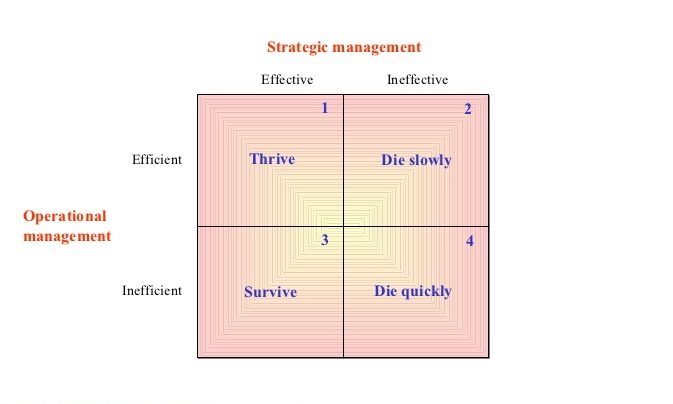
Efficiency and Effectiveness as stated by Peter Drucker “Efficiency is doing things right; Effectiveness is doing the right thing.” An organization survives based on the efficiency and effectiveness of a manager/management. Efficiency is the use of financial, human, physical and information resources such that output is maximized for any given set of resource inputs, or input is minimized for any given quantity and quality of output. An efficient manager might be doing the right job but not the job right. Doing the right job does not require much time or resource. A job can be done very quickly and efficiently within time. In this case, the manager’s main aim is to get the job done within the allocated time using the given resources. But doing a job effectively involves time and planning the right strategy. In this case the manager concentrates more on the outcome rather than just the input. Continue reading
Case Study Method in Management

Management education is mainly aimed at developing managerial skills in students. Amongst the various methods adopted in teaching management and management functions, the case study method developed in 1910 in U.S.A. and is now being propagated during the last decade or so, providing opportunities to both the teacher and the taught to promote managerial I understanding and competence, since it helps in contemplation and discussion of an actual situation. It is a wrong notion that the case studies are confined to management students. Cases may pertain lo any discipline, where skills for solving complex unstructured problems or preparing plans are required. The origin of case study methods itself can be traced to Harward Lawyers. Cases may describe problems facing individuals, groups, institutions or even Nations. Through a case study one learns a broad range of skills and has many alternatives. Case studies encourage the practice and attainment of analytical and Continue reading
Innovation Culture in Organizations

Growth creates a need for structure and discipline, organization changes which can strain the culture of creativity that is so vital to future success. To sustain competitive advantage, companies need to institutionalize the innovation process; they need to create an internal environment where creative thinking is central to their values, assumptions and actions. Innovation is the engine of growth. It is also a mindset – meaning it is influenced by beliefs, values, and behavior. Company culture therefore has a huge influence on innovation, being able to either facilitate it or restrain it. Realizing this, many companies have attempted to put systems and processes into place that encourage an innovation culture. However, while such measures are often viewed as the panacea, they are really just the beginning. To shape a truly innovation culture, the top people in a company need to develop a mindful approach where their every action and word Continue reading
Different Approaches to Industrial Relations

The industrial relations scenario has been perceived differently by different practitioners and theorists. Some have viewed it in terns of class conflict; some have viewed it in terms of mutuality of interest of different groups; some have viewed it as a consequence of interaction of various factors both within an organization and outside it. Based on these orientations, several approaches to industrial relations have been developed. One researcher has stated industrial relations in his research report as, “An economist tries to interpret industrial conflict in terms of impersonal markets forces and laws of supply demand. To a politician, industrial conflict is a war of different ideologies — perhaps a class-war. To a psychologist, industrial conflict means the conflicting interests, aspirations, goals, motives and perceptions of different groups of individuals, operating within and reacting to a given socio-economic and political environment”. Most important approaches to industrial relations are discussed as follows: Continue reading