Agency theory is often described in terms of the relationships between the various interested parties in the firm. The agency theory examines the duties and conflicts that occur between parties who have an agency relationship. Agency relationships occur when one party, the principal, employs another party, called the agent, to perform a task on their behalf. Agency theory is helpful in explaining the actions of the various interest groups in the corporate governance debate. For example, managers can be seen as the agents of shareholders, employees as the agents of managers, managers and shareholders as the agents of long and short-term creditors, etc.
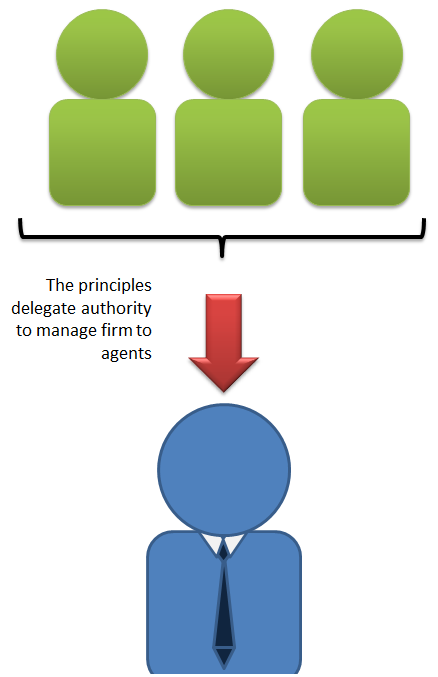
In most of these principal-agent relationships conflicts of interest is seen to exist. It has been widely observed that the conflicts between shareholders and managers and in a similar way the objectives of employees and managers may be in conflict. Although the actions of all the parties are united by one mutual objective of wishing the firm to survive, the various principals involved might make various arrangements to ensure their agents work closer to their own interests. For example, shareholders might insist that part of management remuneration is in the form of a profit related bonus. The agency relationship arising from the separation of ownership from management is sometimes characterized as the agency problem. For example, if managers hold none or very little of the equity shares of the company they work for, what is to stop them from: Working inefficiently? Not bothering to look for profitable new investment opportunities? Giving themselves high salaries and perks?
Agency theory suggests that, in imperfect labor and capital markets, managers will seek to maximize their own utility at the expense of corporate shareholders. Agents have the ability to operate in their own self-interest rather than in the best interests of the firm because of asymmetric information (e.g., managers know better than shareholders whether they are capable of meeting the shareholders’ objectives) and uncertainty (e.g., myriad factors contribute to final outcomes, and it may not be evident whether the agent directly caused a given outcome, positive or negative). Evidence of self-interested managerial behaviour includes the consumption of some corporate resources in the form of perquisites and the avoidance of optimal risk positions, whereby risk-averse managers bypass profitable opportunities in which the firm’s shareholders would prefer they invest. Outside investors recognize that the firm will make decisions contrary to their best interests. Accordingly, investors will discount the prices they are willing to pay for the firm’s securities.
Agency costs are defined as those costs borne by shareholders to encourage managers to maximize shareholder wealth rather than behave in their own self-interests. There are three major types of agency costs:
- Expenditures to monitor managerial activities, such as audit costs;
- Expenditures to structure the organization in a way that will limit undesirable managerial behavior, such as appointing outside members to the board of directors or restructuring the company’s business units and management hierarchy; and
- Opportunity costs which are incurred when shareholder-imposed restrictions, such as requirements for shareholder votes on specific issues, limit the ability of managers to take actions that advance shareholder wealth.
One power that shareholders possess is the right to remove the directors from office. But shareholders have to take the initiative to do this, and in many companies, the shareholders lack the energy and organization to take such a step. Even so, directors will want the company’s report and accounts, and the proposed final dividend, to meet with shareholders’ approval at the Annual General Meeting. Another reason why managers might do their best to improve the financial performance of their company is that managers’ pay is often related to the size or profitability of the company. Managers in very big companies, or in very profitable companies, will normally expect to earn higher salaries than managers in smaller or less successful companies. Perhaps the most effective method is one of long-term share option schemes to ensure that shareholder and manager objectives coincide. Management audits can also be employed to monitor the actions of managers.
In addition to the agency conflict between stockholders and managers, there is a second class of agency conflict between creditors and stockholders. Creditors have the primary claim on part of the firm’s earnings in the form of interest and principal payments on the debt as well as a claim on the firm’s assets in the event of bankruptcy. The stockholders, however, maintain control of the operating decisions (through the firm’s managers) that affect the firm’s cash flows and their corresponding risks. Shareholder-creditor agency conflicts can result in situations in which a firm’s total value declines but its stock price rises. This occurs if the value of the firm’s outstanding debt falls by more than the increase in the value of the firm’s common stock.
Creditors commonly write restrictive covenants into loan agreements to protect the safety of their funds. These arrangements involve time and money both in initial set-up, and subsequent monitoring, these being referred to as agency costs.