SWOT is an acronym for internal Strength (S) and Weakness (W) of an organization, and external Opportunities (O) and Threats (T) facing that organization. A merging of the organization’s resources with the opportunities in the environment results in an assessment of the organization’s opportunities. This merging is frequently called SWOT analysis because it brings together the organization’s Strengths, Weakness, Opportunities, and Threats in order to identify a strategic niche that the organization can exploit. SWOT analysis provides information that is helpful in matching the firms’ resources and capabilities to the competitive environment in which it operates and is therefore an important contribution to the strategic planning process. Having completed the SWOT analysis, the organization reassesses its mission and objectives.
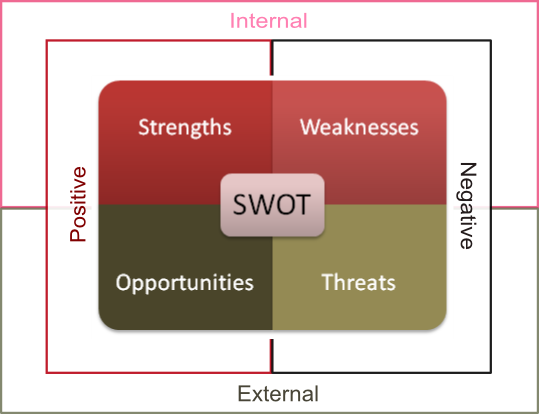
In the light of the SWOT analysis and identification of the organization’s opportunities, management reevaluates its mission and objectives. Are they realistic? Do they need modification? If changes are needed, in the organization’s overall direction, that is where they are likely to originate. On the other hand, if no changes are necessary, management is ready to begin the actual formulation of strategies.
- Strength: Strength (internal) is a resource, skill, or other advantages relative to competitors. It is distinctive competence that gives the organization a comparative advantage in the market place. Market leadership, public image, experience, financial and human resources, organization network and alliances, etc., is examples of organizational strength.
- Weakness: A weakness (internal) is a limitation or deficiency in resources, skills, and capabilities that seriously affect performance. Lack of facilities, resources, management capabilities, marketing skills, etc. are sources of weakness.
- Opportunities: An opportunity (external) is a major favorable situation in the organization’s environment. The example of an opportunity could be new market, reduction in compaction, higher economic growth rate, technological changes, and so on.
- Threats: A threat (external) is a major unfavorable situation in the organization’s environment. The entry of a new competitor, increased bargaining power of the suppliers and buyers, major changes in technology and government regulations, slow market growth, etc are some examples of organizational threats.
Strengths and weaknesses are the internal factors that influence the individual or organizational objectives. They are internal to the individual or organization and are within their control. They are classified as strengths or weaknesses depending upon the impact that they have on the objective. The attribute that may be seen as strength in the context of one particular objective may prove to be a weakness in a different decision-making context. For example, aggressiveness is normally considered a weakness in an individual’s personality. But when we consider it in the context of soldiers who are trained for combat, aggression is regarded as their strength. On the other hand, opportunities and threats are the external factors that propel the individual or organization towards growth or impede its progress respectively. They are external to the individual or organization and are beyond their control. Thus, the main object of SWOT analysis is to recognize the major internal and external factors that are crucial to achieving the desired personal or business objective.
How is SWOT Analysis Done?
SWOT analysis is not a quick fix tool as one may deem it to be. Though it looks like a simple, easy-to-use model, it requires time, sincere efforts and significant sources of information, if one has to derive serious inferences through its application. SWOT analysis may be used to draw quick conclusions in certain contexts and later on the same summaries can be used to arrive at a much more comprehensive understanding and analysis of a situation.
Gathering information using the template of the SWOT model as the basis is just the first step of the process. It is something akin to data collection. The next step is to classify the data on the basis of its relevance and prioritize the options taking into account the personal/organizational goals. Then once we have all the requisite information, analysis follows. Thus, SWOT is not an analysis in itself. It is a framework for analysis. The SWOT model when applied is far more complex than it appears to be.
One can use different templates for SWOT analysis depending on the situation under scrutiny, the nature of the information involved in the study and the objective to be accomplished therewith. The layout and the details to be mentioned in the analysis will depend on the particular context in which it is to be applied. Basically, SWOT analysis is carried out either on-
- A simpler level – using a four box grid or using each element of the SWOT model as a heading under which the relevant data is grouped in the form of phrases or brief pointers, or
- A more detailed level – using each element of the SWOT model as a heading under which the relevant information is stated in the form of sentences or paragraphs.
SWOT analysis provides a useful framework for making the best strategic choice. A business strategy can be seen as an optimal match between the external opportunities and threats, and the organizational strengths and weakness. This process of optimal matching is essential for developing appropriate course of action
|
Internal Aspect External Aspect |
Strengths (S) | Weakness (W) |
| Opportunities (O) | SO Strategies | WO Strategies |
| Threats (T) | ST Strategies | WT Strategies |
- SO: This is the most favorable situation. The organization has several environmental opportunities and has numerous strengths. The organization in this situation has to adopt and aggressive strategy to take advantage of the opportunities.
- WT: This is the least favorable situation. The organization faces environmental threats and also has relative weakness. This situation calls for a defensive strategy. The organization has to reduce the involvement in existing products and markets, and sustain itself until situation improves.
- WO: This is a situation in which the organization faces impressive market opportunities but is constrained by several internal weaknesses. The only strategy in this situation is to eliminate internal weaknesses to exploit market opportunities.
- ST: This is a situation in which the organization’s key strengths face an unfavorable environment. The strategy in this situation is to use current strengths to build long-term opportunities and diversity the business.
In actual situation, it is not easy to identify and visualize the position of a business as shown above. There could be multiple of combination of these positions. Hence, matching the internal strengths and weakness with external opportunities and threats is not always easy. This needs a thorough analysis of the overall position of the organization in terms of the strategy to be pursued. The goal is to then develop good strategy that exploits opportunities and strengths, neutralize threats, and avoid weakness. As a guideline, some relevant question for SWOT analysis are given in Table below:
| Potential Strengths | Potential Opportunities | Potential Weakness | Potential Threats |
|
|
|
|
To sum up, SWOT analysis model gives a systematic approach to self-assessment as well as to objective evaluation of persons and situations and the conclusions that we draw from it lead to personal as well as organizational development and progress. Both the individuals as well as the organizations greatly benefit from it as it helps them to plan better and to make better decisions.
Scope, Advantages and Limitations of SWOT Model
When is the SWOT model used? SWOT analysis is useful not only for the business organizations but it can also be used in any decision-making situation by non-profit organizations, governmental organizations, and even individuals. SWOT analysis may be used to avert crisis situations and also to resolve the crises. It can be used for planning, problem-solving, product evaluation, competitor analysis, self-development, decision-making, etc. It may also be used in feasibility studies/surveys conducted by business houses to evaluate the potential impact or the chances of success of their proposed business plan before they actually implement it.
How does SWOT analysis help? SWOT analysis helps an individual/organisation to understand its strengths and weaknesses. It promotes strategic thinking. It enables one to focus on strengths, to create or recognize opportunities and to use them to his advantage. It enables one to foresee the possible threats and to take measures to prevent or diminish their impact. It is a simple model that has no rigid structure. It can be adapted to suit the particular context in which it is to be used. Thus, its flexible framework is a significant factor that has contributed to its popularity and its success.
What are the possible limitations of SWOT analysis? One must remember that SWOT analysis is only one of the methods of categorization and has its own drawbacks. A person may inadvertently use erroneous assumptions or may oversimplify the data used for SWOT analysis and this may have a damaging effect on the decision-making process. It is very time-consuming when performed to deal with complex situations involving huge amount of data. It does not have a detailed structure so the user may miss out on certain significant information which can affect the final analysis and its reliability can be rendered questionable.
Sometimes, SWOT analysis may simply result in the compilation of lists of positive and negative attributes and may not translate into the formulation or implementation of the strategies that are essential for the achievement of the objective. SWOT analysis can be very subjective. Thus, it may present an imbalanced or a very biased picture of the situation under investigation if the person does not take proper care to be objective, critical and have clear priorities with regard to the purpose of such an analysis.
SWOT Analysis For Organizations and Individuals
SWOT analysis is an effective tool which aids strategic planning both for individual as well as organizational growth and development. With the help of SWOT analysis, one can specify the personal/organizational objective, can identify the various favorable and/or unfavorable internal as well as external factors that may influence the accomplishment of that objective and on the basis of these one can develop effective strategies that would help in achieving the objective. SWOT analysis can be done on the organizational level as well as on the individual level.
SWOT Analysis For Organizations
Business firms undertake SWOT analysis before formulating or implementing new business plans/projects or before launching new business products to assess their internal and external environment. It is used in the initial stages of the decision-making process. With the help of it, they weigh the strengths and weaknesses of an organization/a product as against the opportunities and threats that it has to confront in the world outside. This helps to them identify the ways to surpass their competitors by focusing on their own strengths, minimizing their weaknesses and capitalizing on the opportunities that they have. Based on the conclusion of the SWOT analysis, business firms determine certain effective organizational strategies that help them to maximize their opportunities by making the best use of their strengths and counterbalancing the threats by minimizing the effect of their weaknesses on their decision-making ability. Thus, the SWOT analysis model proves to be very helpful to the business firms in formulating the correct strategies that would lead to the achievement of their organizational objective/s.
SWOT analysis by itself does not yield the desired results. It has to be a part of an overall strategy with regard to a particular context or situation. Firstly, the business firm should have a clearly defined objective. With that objective in mind, it should carry out SWOT analysis. The conclusion that it reaches with the help of SWOT analysis should help it in evaluating strategies that would help achieve success. And finally, it should implement those strategies that would give true measure of the success of that particular SWOT analysis.
SWOT Analysis For Individuals
For a person to become successful in his endeavors, it is very essential for him to analyze his own characteristics, both positive and negative. SWOT analysis is a tool that helps an individual to recognize his strengths and limitations, thereby acquainting him with the resources available to eliminate his fears that arise due to his shortcomings. It also enables him to capitalize on his strengths and make the most of the opportunities that are available to him. SWOT analysis can be loosely described as some kind of introspection, but it is much more systematic and result-oriented as compared to it. Introspection- i.e. self-analysis of one’s thoughts, beliefs, feelings, motives, etc.- is something that all self-aware individuals do, knowingly or unknowingly, on a regular basis. It is very subjective and it rarely has an ulterior motive, except the desire to become a better person. But when an individual is at the crossroads in his personal, academic and/or professional life- e.g. while selecting which course to pursue for higher studies, what job to take up after that, at the time of preparing the resume for job application, while contemplating job change, before starting a business, etc. — and has to make certain important decisions that may influence the very course of his life, then introspection alone is not sufficient. What he needs is a calculated, deliberate method with which to introspect, to analyse the external situation and to decide what needs to be done in order to achieve the personal, academic and/or professional objective. The SWOT analysis model is useful at such critical stages of an individual’s life where important decisions have to be made.