
In this era of globalization for today’s workplace, people always like to say that “A manager may be a leader; a manager may not be a leader, but a leader may emerge who is not a manager.” So what its means of this phrase? It means that a leader and a manager could be different. For example, an outstanding leader may have superior management skills, but not all managers could possess true leadership skills. In short, it is possible for the role of manager and leader not to be connected at all. This phrase is important to prove that having both talented managers and dedicated leaders make the business success.… Read the rest
Management Concepts
Risk Management in Business
Kaplan and Garrick (1981, p. 12) provide a simple equation for risk, which is “risk = uncertainty + damage”. They believe that it is irrelevant as to what context risk exists in, and that the same equation can always be used to identify and manage risk. However, risk can still be categorized differently depending on what facet of the organization it is affecting.
Before a risk management strategy can be decided upon, the risk event must first be identified. An organization should conduct three steps before deciding on the best risk management strategy to use. As risk management can use a substantial amount of resources, clarification and direction should be decided upon before conducting risk management.… Read the rest
Situational Leadership Model

The situational theory of leadership is becoming increasingly popular in the context of modern organizational leadership. Situational leadership revolves around job-related maturity. Job maturity refers to an individual’s ability in performing a job and this is a key factor determining a leader’s behavior. The situational leadership model puts it that effective leadership is dependent on both the acts of management and leadership and that these enhance an organization’s match to current global trends. The model emerged from the realization and understanding that not all individuals within a group or community being led compare in terms of maturity level and that the need for a leadership style differ with situations.… Read the rest
The Competing Values Framework
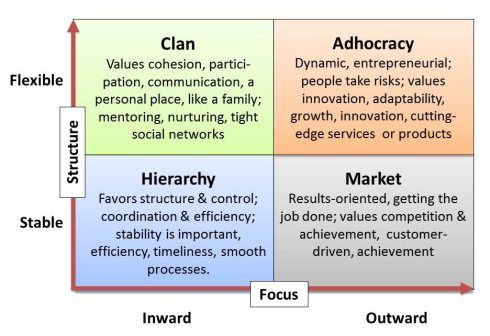
Competing models of management refer to those models that attempt to explain the competing value framework of organizational management. The organizational management sometimes faces the management challenge of balancing between two or more important processes that affect the operation of an organization. The competing values framework is a model that was developed by Robert Quinn and Kim Cameron to assess the organizational culture. The theory of competing values framework, in essence, shows the interrelationship between processes that enable the organization to focus on the internal environment or external environment. The area of focus of an organization leads to the development of the organizational culture and often results in a balancing of two or more competing value factors.… Read the rest
The Business Applications and Benefits of Business Intelligence

Business Intelligence or BI is a computer-based system which is used by organizations for decision making purpose. It consist of huge data warehouse or data marts of business data, from which it performs mining, spotting, digging or analyzing operations to produce appropriate results or reports. BI applications include a wide range of activities for statistical analysis, Data mining, querying and reporting, business performance analysis, benchmarking, Online Analytical Processing (OLAP), Decision Support System (DSS), forecasting and predictive analysis. It provides organizations with meaningful information regarding employees, customers, suppliers and other business associates, which can be used in effective decision making.
Applications of Business IntelligenceThe implementation of business intelligence helps organizations to achieve their goals in an effective way.… Read the rest
The Role of Leadership in Shaping Organizational Culture
Leadership is realized in the process whereby one or more individuals succeeds in attempting to frame and define the reality of others. Many around the world who call themselves leaders are in fact only managers, to be a leader you must have a clear vision and a goal to achieve your desired outcome. Leaders help themselves and others to make the correct choices. They set direction, build an inspiring vision, and create something that’s never been created before. Leadership is about planning out where you need to go to succeed as a team or an organization; and it is strong, exhilarating, and motivating.… Read the rest