Case Study on Business Strategies: Kodak’s Transition to Digital

Kodak is one of the oldest companies on the photography market, established more than 100 years ago. This was the iconic, American organization, always on the position of the leader. Its cameras and films have become know all over the world for its innovations. Kodak’s strength was it brand — one of the most recognizable and resources, that enabled creating new technologies. Since the formation of Kodak, the company has remained the world’s leading film provider with virtually no competitors. That is until the arrival of Fuji Photo Film, which now surpasses Kodak in earnings per share and is viewed as the industries number two. It is evident that there has been a significant shift from the use of traditional film cameras to a market fully fledged and saturated with modern and updated digital cameras and digital photographic tools. However over the time, the situation started to change for Kodak, Continue reading
International Trade and Investment

Today, business is acknowledged to be international and there is a general expectation that this will continue for the foreseeable future. International business may be defined simply as business transactions that take place across national borders. This broad definition includes the very small firm that exports (or imports) a small quantity to only one country, as well as the very large global firm with integrated operations and strategic alliances around the world. Within this broad array, distinctions are often made among different types of international firms, and these distinctions are helpful in understanding a firm’s strategy, organization, and functional decisions (for example, its financial, administrative, marketing, human resource, or operations decisions). One distinction that can be helpful is the distinction between multi-domestic operations, with independent subsidiaries which act essentially as domestic firms, and global operations, with integrated subsidiaries which are closely related and interconnected. These may be thought of as Continue reading

Corporate Finance – Concept and Meaning

Business firms and government organizations do need to implement various programs to achieve their goals. Implementing programs require resources such as natural resources, human resources and financial resources. Effectiveness in the management of financial resources is key to optimize the use of natural and human resources. In the case of individual, management of financial resources or funds is known as personal finance. The same is called by public finance in government organizations. Corporate finance is used to refer to the management of funds in the context of business firm. Thus, finance as a discipline is classified into three domains: public finance, business finance and personal finance. Public finance is the management of funds for governments: both local government and central government. Traditionally, it deals with the management of revenue and expenditure of government. Personal finance refers to the management of funds of and individual. Generally, business finance, corporate finance and Continue reading

Knowledge Management Cycle

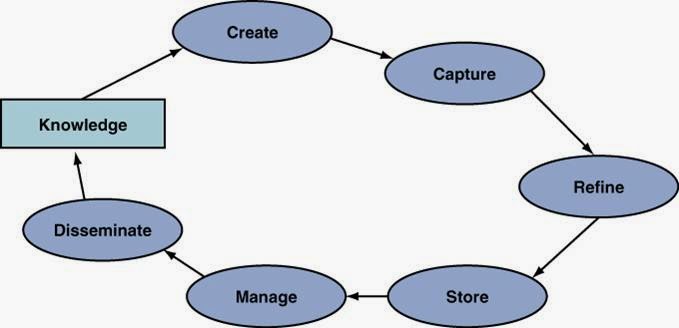
In today’s business scenario where there is lot of competition, only source of lasting is Knowledge. It is argued that knowledge management is a necessity due to changes in the environment such as increasing globalization of competition, speed of information and knowledge aging, dynamics of both product and process innovations, and competition through buyer markets. Knowledge management promises to help companies to be faster, more efficient, or more innovative than the competition. Also, the term ‘‘management” implies that knowledge management deals with the interactions between the organization and the environment and the ability of the organization to react and act Various researchers then gave the various definitions on Knowledge Management and still it’s the buzzword today. Knowledge management is the process through which we can manage human centered assets efficiently and effectively. The function of knowledge management is to guard and grow knowledge owned by individuals, and where possible, transfer Continue reading

Value Analysis – Definition, Mechanism and Process

Value Analysis (VA) was established by Lawrence D. Miles of General Electric in America. The basic fundamental of value analysis can be implemented in any product to optimize its value. In more details, value analysis is actually a process of systematic review that is applied to existing product designs in order to compare the function of the product required by a customer to meet their requirements at the lowest cost by eliminating unnecessary costs that consistent with the specified performance and reliability needed. First of all, value analysis (and value engineering) is a formal and organized process of analysis and evaluation which required management activities including planning, control and coordination. These analysis concerns the function of a product such as utility, guarantee, or safety performance to meet the demands needed or required by a customer. Thus, to meet this functional requirement the review process must include an understanding of the Continue reading

Implications of Asset Securitization

Asset securitization can be defined as the partial or complete segregation of a specific set of cash flows from a corporation’s other assets and the issuance of securities based on these cash flows, i.e exchanging one asset for another. The types of financial assets involved in asset securitization transactions are often receivables. The practice of securitization originated with the sale of securities backed by residential mortgages, but the framework of asset securitization has rapidly expanded from its initial root of mortgages and receivables to other more variable cash flows in home equity loan markets, commercial loan markets, credit card receivables, auto loans, small-business loans, corporate loans, state lottery winnings, and litigation settlement payments and other types of loans. Asset securitization is the transformation of a mix of illiquid individual loans that are combined into relatively similar pools and transformed into highly liquid bonds traded in securities markets and usually, when Continue reading