Human resource cost analysis is the study of behavior of cost in relation to one or more HR criteria. Controlling manpower costs has now become important for organizations, particularly when we are required to look within for cost savings to sustain organizational growth and profitability. To enforce control on HR costs, it is essential to develop a check-list at the outset. This requires grouping of activities under different cost heads and then Identifying the individual cost elements under each head. By developing an HR costs spreadsheet, we can understand the magnitude of HR costs in an organization. Element-wise cost trend over the years facilitates regular monitoring and operational control. At the macro-level, net value added per employee is an indicator of cost efficiency. Developing an HR Costs Checklist HR costs checklist varies from organization to organization due to obvious differences in their practices. Here we have mentioned about those cost Continue reading
Human Resource Management
Human Resource Management (HRM) is branch of management that deals with people at work, it is concerned with the human dimensions of management of the organization. As organization consists of people, therefore acquiring them, developing their skills, providing them motivation in order to attain higher goal and ensuring that the level of commitment is maintained are the important activities.
Performance Management Process
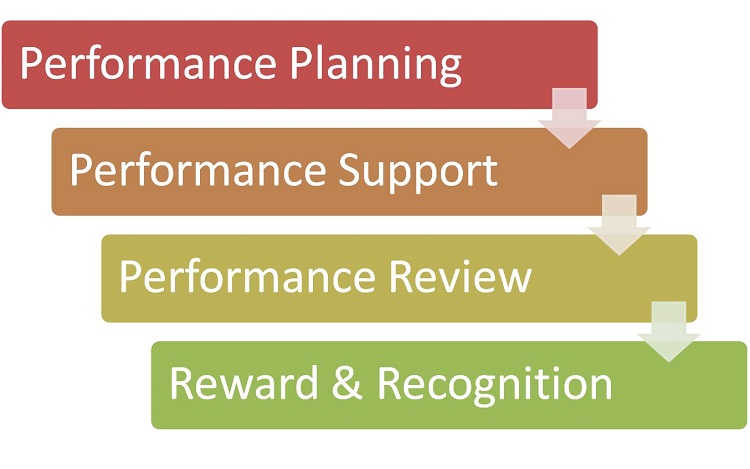
Various authors propose various steps for performance management process. The typical performance management process includes some or all of the following steps, whether in performance management of organizations, subsystems, processes, etc. Note that how the steps are carried out can vary widely, depending on the focus of the performance efforts and who is in charge of carrying it out. For example, an economist might identify financial results, such as return on investment, profit rate, etc. An industrial psychologist might identify more human-based results, such as employee productivity. Performance management process is composed of four main stages: Planning Performance Managing Performance Reviewing Performance Rewarding Performance 1. Planning Performance As with the introduction of any process, there first needs to be clarity about the primary reason for introducing performance management and a clear view about what it is expected to deliver in terms of results. There also needs to be strong commitment Continue reading
Learning Styles

Learning style refers to the ability of an individual to learn. A manager’s long-term success depends more on the ability to learn than on the mastery of the specific skills or technical knowledge. Kolb’s Learning Styles Model Kolb’s model of learning styles is one of the best-known and widely used learning style theories. Kolb’s learning theory sets out four distinct learning styles (or preferences), which are based on a four-stage learning cycle. Much of Kolb’s theory is concerned with the learner’s internal cognitive processes. “Learning is the process whereby knowledge is created through the transformation of experience. Knowledge results from the combination of grasping experience and transforming it.” (David A. Kolb, 1984). These four learning styles are: accommodation, divergence, assimilation and convergence. The four learning styles are based on dimensions: feeling versus thinking and doing versus observing. Accommodator: An accommodator learns by doing and feeling. He tends to learn primarily Continue reading
Common Team Problems
In today’s organizations, people work in teams that have either a leader or a self-driven team member to lead. While these teams provide support mechanism in the office environment and are used to improve productivity and results, they are also a source of competition. It is this team building scenario that is envisioned to promote the productivity of the employees, and at the same time the organization. In any team there is a difference of opinions, this is beneficial as it provides the building blocks to ideas for their team and organization as a whole. At the same time these opinions do raise the emotions and feelings of the team players. There arises conflict within the group that either improves the team’s performance or the breaks down of the team and consequently hampering the achievement of the organizations goal. The most common team problems are; Floundering: This problem occurs in Continue reading
Human Resource Audit – Definition, Objectives, Scope, and Importance
Human Resource Audit or HR audit is a systematic survey and analysis of different HRD functions with a summarized statement of findings and recommendations for correction of deficiencies. It examines and evaluates policies, procedures and practices to determine the effectiveness of HRD function in an organization. HRD audit ensures that sound and cost-effective policies are implemented. Human resource audit refers to the checking of the performance of the enterprise in its management of human resources. Human resource audit reveals how the management is doing in getting things done through the efforts of its people. It undertakes a systematic research of the effectiveness of the human resource programmes. It evaluates personnel activities of an organization. It acts as an overall quality control, check on human resource function. During the conduct of audit if any deficiency is discovered, steps are taken to remove it. It reviews the effectiveness of management relating to Continue reading
Morale and Productivity
The satisfaction and comfort an employee experiences at the workplace is termed morale. Morale is a widely used term in organizations. But in general, it refers to esprit de corps, a feeling of enthusiasm, zeal, confidence in individuals or groups that they will be able to cope with the tasks assigned to them. The result of high morale generally results in the high efficiency of the organization. Morale directly impacts the working of an individual in a team towards the realization of common objectives. Morale therefore is individual specific as well as general. Unfortunately building of morale is not a mechanical problem that could be solved by either rewards or punishments. The best way to manage it is to proactively do a lot of employee related interventions that will together impact morale positively. Morale can also be understood as the spirit and confidence with which the employee performs his job. Continue reading