Methods of Job Evaluation
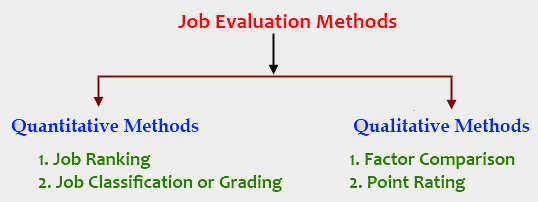
For fixing compensation to different jobs, it is essential that there is  internal equity and consistency among different job holders. Job evaluation is the process of determining the relative  worth of different categories of jobs by analyzing their responsibilities and,  consequently, fixation of their remuneration.  The basic objective of job evaluation is to determine the relative  contributions that the performance of different jobs makes towards the  realization of organisational objectives. There are four basic methods of job evaluation: ranking method, job  grading method, point method and factor comparison method. Out of these, first  two methods are non-quantitative and also known as traditional, non-analytical  or summary methods. The last two methods of job evaluation are quantitative, also known as  analytical methods, and use various  quantitative techniques in evaluating a job. The basic difference between qualitative and quantitative methods of job evaluation is in terms of; Consideration of the job as a Continue reading

Free Trade Zones – Definition and Meaning

In simple words, free trade means free international trade. The classical economists like Adam Smith, Ricardo and others strongly  favored  free trade and this doctrine held the field for nearly one hundred years. How ever later, the countries all over the world began to adhere to the policy of imposing restrictions in one form or other. History and Development of Free Trade Zones During the last 20 years, the labor charges in developed countries have increased substantially. According to a recent estimate, the labor cost is nearly 1 USD per hour for semi-skilled workers in most European Countries, U.S and Japan. This high labor cost was due to the acute shortage of both skilled and unskilled labor in most of these countries. Countries like Germany, France, Switzerland, Sweden, Austria, Belgium and England even imported laborers from other countries. Therefore, the cost of production involving a considerable  labor  content has become Continue reading

Female or Women Entrepreneurship – Definition, Advantages and Disadvantages

Women constitute around half of the total world population. They are therefore regarded as the better half of the society. In traditional societies, they were confined to the four walls of houses performing household activities. In modern societies they have come out of the four walls to participate in all sorts of activities. The global evidences prove that women have been performing exceedingly well in different spheres of activities like academics, politics, administration, social work and so on. Now they have started plunging into industry also and running their enterprises successfully. Although small businesses owned by women have traditionally focused on fashion, food and other services sector, but recently women entrepreneurs have been moving rapidly into manufacturing, construction and other industrial filed. Women owned business are lightly increasing in the economics of almost all countries. The hidden entrepreneurial potential of women have gradually been changing with the growing sensitivity to Continue reading

Case Study on Business Ethics: The Parmalat Scandal

Evolving from a small dairy shop into an international concern, Parmalat appeared to be a gigantic and stable dairy producer. At some point in time, it may well have been gigantic and stable, but in December 2003, shocking news was broken to Parma, Italy, and the world at large. Parmalat was no longer a success as it once may have been, and it was bankrupt, and had been bankrupt for several years without this ugly truth being exposed. The truth had apparently been concealed due to a number of people being at least somewhat aware that something was amiss with transactions on the books, but had not spoken out. Through the years that Parmalat was going bankrupt, there were several events that took place before Parmalat’s condition was finally exposed. To begin with, as early as 1990, there were signs that Parmalat was in debt. In accordance with what has Continue reading

History and Background of FIAT

The foundation of FIAT On July 11th, 1899 few Italian aristocrats founded the “Società Anonima Fabbrica di Automobili – Torino – F.I.A.T” that means translated in English language “Anonymous Society Automotive Factory – Turin”. Giovanni Agnelli was one of the co-owner of the company, he was elected Operational Secretary, but later on he became the most influent figure in the F.I.A.T company with the biggest shared owned. In the following years, thanks to Giovanni Agnelli, F.I.A.T. became profitable and it was listed on the stock exchange. In 1906 F.I.A.T. proceed with acquisition of others Italian industrial firms that permitted the creation of a new company named FIAT, without any dot. In the new company, Giovanni Agnelli could possess a bigger share than in the previous one, getting a dominant position within the firm. The FIAT design and industrial capabilities were concentrated in the production of engines in the first period. Continue reading

Case Study: Nissan’s Successful Turnaround Under Carlos Ghosn

Nissan is a famous automobile manufacturing company which was founded in 1933. After the Second World War, Nissan expanded its operations globally. Nissan was very well known for its advanced engineering and technology, plant productivity and quality management. However, during the previous decade, Nissan management has emphasized on short-term market share growth, instead of profitability or long-term strategic success. Nissan’s designs had not reflected customer opinion. In addition, Nissan managers tended to put retained earnings into keiretsu investing (equity of suppliers), rather than reinvesting in new product designs as other competitors did. These inappropriate strategies combining with the Asian crisis influence on a devaluation of the yen led Nissan to the edge of bankruptcy. Nissan was in need of a strategic partner that could lend both financing and new management ideas to foster a turnaround. Furthermore, Nissan sought to expand into other regions where it had less presence. In order Continue reading