Job evaluation aims to provide this equity and consistency by defining the relative worth of different jobs in an organisation. Job evaluation is a process consisting of several steps. The following are the steps in job evaluation process: 1. Job Analysis Job evaluation process starts with the base provided by job analysis. Job analysis identifies various dimensions of a job in two forms: job description and job specification. Job description provides responsibilities involved in the performance of the job while job specification provides attributes required in the job performer. Both these taken together provide information about various factors involved in different jobs. 2. Appointment of Committee for Job Evaluation As pointed out earlier, job evaluation is a specialized function and is carried on by a committee consisting of members drawn from different line departments of the organisation, outside experts, besides HR personnel. HR person generally acts as committee convener or Continue reading
HRM Functions
The Cultural Web – Johnson and Scholes’s Model of Organizational Culture
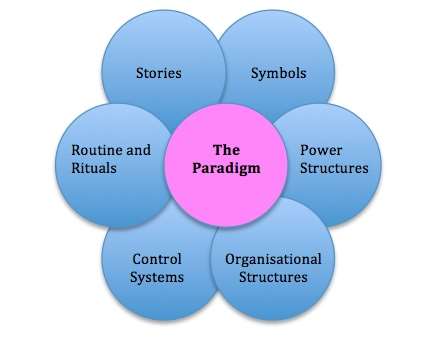
Organizational culture can be simply identified as the own unique personality that the respective organization practices. The group of people who works for the organization shares a system of Assumptions, Beliefs, and Values which governs them both individually and with the organizational needs. The cultural web model developed by Johnson and Scholes in 1993 is an important one, in which six dimensions of the organization culture are defined. The corporate culture consists of six major components, as structure, power structure, symbols, stories, rituals and control systems. They provide clear guidelines for the employees, about how things are performed within the organizational context; providing influences for the better change management. Cultural elements can be organized in the company to achieve productivity is described accordingly. Structure – Mainly refers to the structure of the company, in terms of the management layers and supervisory control. Modern organizations is thereby advised in adjusting to more flat type organization, Continue reading
What is a Salary Survey?
The salary survey is the vehicle for relating the organisation’s salaries to those for similar jobs in other organisations. Salary survey information provides the raw material for translating job sizes into currencies, that is, for job pricing. The survey gives information on base salaries and benefits. This can be used by the human resource manager to calculate the organisation’s competitive position and to plan any corrective actions required. As a first step in this process the human resource manager must identify the organisations for labor. In other words, does the organisation want to compare itself with: organisations in the same or related industries organisations in the same geographical area progressive Australian organisations multinationals organisations of a similar size in terms of sales, number of employees and so on the general community private sector companies only mix of private and public sector organisations? By answering such questions, the human Continue reading
Concepts of Compensation and Compensation Management

Concept of Compensation The literal meaning of compensation is to counter-balance. In the case of human resource management, compensation is referred to as money and other benefits received by an employee for providing services to his employer. Money and benefits received may be in different forms-base compensation in money form and various benefits, which may be associated with employee’s service to the employer like provident fund, gratuity, insurance scheme and any other payment which the employee receives or benefits he enjoys in lieu of such payment. Cascio has defined compensation as follows: “Compensation includes direct cash payments, indirect payments in the form of employee benefits and incentives to motivate employees to strive for higher levels of productivity” Based on above description of compensation, we may identify its various components as follows: Wage and Salary: Wage and salary are the most important component of compensation and these are essential irrespective of Continue reading
Professionalism in Human Resources Planning
Human resource planning determines the human resources required by the organization to achieve its strategic goals. Human resource planning is the process for ensuring that the human resource requirements of an organization are identified and plans are made for satisfying those requirements. In human resource planning people are the most important strategic resource for an organization. Whereas HR Planning generally concerned with matching resources to business needs in the longer term, although sometime address shorter-term requirements as well. HR Planning also looks at broader issues relating to the ways in which the people are employed and developed in order to improve organizational effectiveness. So HR Planning plays an important role in strategic human resource management. Professionalism in HR planning The first part of professionalism in HR Planning is understanding the customer, the customer requirements and providing customer satisfaction. HR is increasingly viewed as a service; a service both to employees Continue reading
Key Factors that Contribute to Organizational Performance
Human Resource Management plays an important role in the enhancing the performance of employees in an organization. The efficient HRM policies are being designed in an organization to enhance the performance level to its maximum. Human resource management (HRM) is the process of linking the human resource functions with the strategic objectives of the organization in order to improve performance. We may call in the way that human resource management holds the central live blood role in any organization. An important aspect of an organization’s business focus and direction towards achieving high levels of competency and competitiveness would depend very much upon their human resource management practices to contribute effectively towards profitability, quality, and other goals in line with the mission and vision of the company. Talent Management One of the key for the organization success depends on its managing, attracting and retaining best people. Companies view the ability to Continue reading