Every organisation is responsible for the environment that it creates. The organisation’s operation and structure all directly affected by the environment. Organisation’s environment impacts on resources and opportunities that how they can be treated? It is primary objective of the organisation to take care of the company’s operations that how they are affecting the environment. For the successful growth and development of business it is important to develop such a strategies those can be assist operate the business operations. To understand the environmental scanning it is important to identify the business and how it can affect the environment business around. The definition of environmental scanning is “a process of gathering, analyzing, and dispensing information for tactical or strategic purposes. The environmental scanning process entails obtaining both factual and subjective information on the business environments in which a company is operating or considering entering”. Environment scanning is most commonly done on Continue reading
Management Concepts
Why Bureaucracy is No Longer Relevant in Today’s Business Environment
In the competitive business environment of the 21st century, managers must concentrate and focus all their efforts on ensuring their organizations retain a competitive advantage in the market. Failure to adhere to this basic principle means failure for the organization. As such, many conscientious and assiduous managers are dumping traditional approaches of running organizations in favor of more conventional approaches that guarantee the concentration of synergies and addition of value in all organizational endeavors. One traditional management approach that is fast fading into oblivion is bureaucracy. A bureaucracy is an organizational structure with inflexible hierarchy of officeholders, regulated by impersonal uniform rules, protocols, and procedures. In most occasions, all the personnel within the organization have well defined positions and titles. he rules and procedures specify the type of duties that each worker must perform, and organizational functions are structured into set offices, which are holistically organized into a vertical hierarchy that Continue reading
Successful Change Management: Principles and Processes
Managing the changes in an organization requires a broad set of skills like political skills, analytical skills, people skills, system skills, and business skills. Having good analytical skills will make you a good change agent. You should evaluate the financial and political impacts of the changes that can take place. You should know that following a particular process at that instant would fetch you immediate financial effects and start that process so that the change process is noted by the management. The workflow has to be changed in such a manner to reflect the financial changes that are taking place. Operations and systems in the organization should be reconfigured in such a manner that you get the desired financial impact. Successful management improvement efforts require the active involvement of managers and staff throughout the organization to provide ideas for improvements and supply the energy and expertise needed to implement changes. Continue reading
Managerial Grid Model
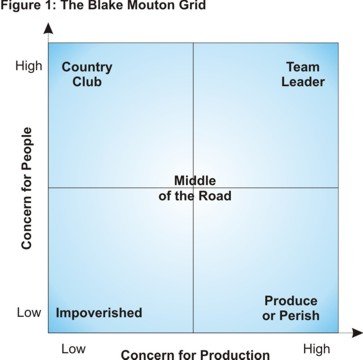
The Ohio studies led to two dimensions of leadership behavior-concern for tasks and concern for relations. Almost in the same style, the Michigan University studies made the distinction between job-centered and production-centered leaders. Blake and Mouton rated these concepts in a framework called the Managerial Grid. They interpreted the concepts in a broad way. Blake and Mouton have used “Concern for Production” and “Concern for People’” in their Managerial Grid on horizontal and vertical axes respectively. Managers may be concerned for their people and they also must also have some concern for the work to be done. The question is, how much attention do they pay to one or the other? Managerial Grid Model is a model defined by Blake and Mouton in the early 1960s.It included Impoverished management Authority-compliance Country Club management Middle of the road management Team management Leadership Grid The Managerial Grid was the original name; the Continue reading
Effective Leadership – Importance and Characteristics
Effective leadership includes achieving the organization’s goal and setting its tone and culture, planning and implementing strategies, acquiring resources, and recognizing and resolving conflicts. Leaders build employees’ strengths, talents and nature dedicated teams for a mutual benefit. Companies and other institutions all around the world have learned that teaching art to others can help to raise living standards. Effective leadership’s benefits to the success of an organization. It is obvious that the company’s leaders are supervisors as well, and they serve an important role in the daily operations and management of a business. To be a good leader, one must develop the leadership skills necessary to successfully deal with opposition as well as adopt the appropriate supervisory style, to understand employees’ abilities and challenges. Importance of Effective Leadership Effective leadership is critical to a company’s success because it offers direction and purpose while also supporting individuals in understanding the company’s Continue reading
History of Management Practices
The history of management is a long-standing one, with human life comes the need to manage and control. Looking back through time, one can easily see from where the idea of management developed, grew, and turned into what people know as the modern form of management. In current time, managers are often thought of as sitting in a cushy office wearing a suit and tie, but little do most know that today’s managers have stemmed from ancient Egypt, China, and even back to the paleolithic times. Management has existed for as long as humanity and it will most likely only continue to further evolve, grow with the time, and fit into more modern aspects of managing. The origins of management are quite a long historical timeline. The earliest recorded occurrence of information related to management dates to the world’s first civilization, Sumer. Sumer was a thriving civilization that created a Continue reading