Change agents are the persons who initiate change and manage change in the organizations. They are specialized in theory and practice of managing changes. The change agent may be a member of organization or an outsider such as a consultant. An internal agent very well knows the organization and have ability, knowledge and experience of directing people for changes. But, internal agent is removed from regular duties to concentrate on the transition. However, external agents view the organization from the system point of view and is much affected by the organization norms. Top managers also prefer hiring specialized consultant change agents as they can offer more objective prospective than insiders. External experts are, however, not well aware of the desires and attributes of the employees, therefore, the changes suggested by them are generally resisted by the employees. Change agents have five set of powers as support of managers is Continue reading
Management Concepts
Multidivisional Organizational Structure
In Multidivisional Organizational Structure, each business unit is placed in a self-contained division and supplied with all support functions. Thus each part essentially operates separately from the other parts of the company. The office of corporate headquarters is created to control and oversee the divisions. Headquarters also provides corporate support functions, such as finance and R&D. Divisional managers have operating responsibility; corporate managers have strategic responsibility. Each division is treated as a profit center and can adopt the structure and control systems that best serve its strategy. A multidivisional structure has several advantages. Enhanced corporate financial control is one advantage of the multidivisional structure. The profitability of the different divisions is very clear, allowing the corporate staff to readily determine the best resource allocation scheme. Enhanced strategic control is another benefit, because corporate staffs are freed from operating responsibilities, and can concentrate on corporate strategy. The structure overcomes limits to Continue reading
Management Control Process
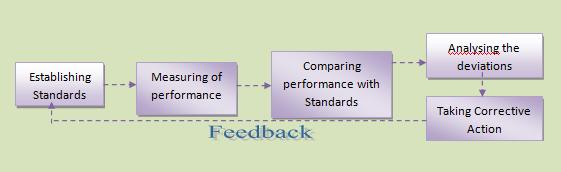
Controlling function of management can be defined as comparison of actual performance with the planned performance. If there is any difference or deviation then finding the reasons for such difference and taking corrective measures or action to stop those reasons so that future thee is match between actual and planned performance. The meaning of controlling makes it clear that controlling function is undertaken for right and timely implementation of plans. Steps Involved in the Management Control Process Management control process is the continuous and ongoing dynamic process of monitoring performance and taking action to ensure desired results. 1. Setting Up of (target) Standards Standards mean target or the yardstick against which the actual performance is measured. The standards must be achievable, high or very high standards which cannot be achieved are of no use. Standards must be set up keeping in mind the resources of the organization and as far Continue reading
Factors that Contribute to Successful Organizations
An organization is said to be effective when it achieves the expected output as by the management. An effective organization earns profit for investors, offers satisfactory service to clients and has a potential for growth and development. Organizations are able to survive chaotic times due to their adaptability to change. The management which provides good leadership experiences employee retention and the workers are more productive than one with a demoralized workforce. An organization has to facilitate training and continuous learning for employees, the organization has contingency methods of operation that is different situations are handled by the different appropriate ways. An organization has to engage the input of its employees in the decision making. The employees being a valuable asset should be motivated for maximum input. Many studies observe that managers should take cognizance of the different values and beliefs held by employees. There should be no discrimination on gender, Continue reading
Value Architecture – Snapshot of the Company’s Business Model

For an entrepreneur is very important organize his key operational activities to make fundamental business decisions with respect to ‘focus’ — the strategic relevance and prioritization of these activities to achieve a developmental milestone; ‘locus’ — where you should geographically conduct these activities; and ‘modus’ — the way in which these different activities are executed. At the business model level, the focus, locus, and modus of the entrepreneur’s activities represent the company’s output, so represents the unique way in which a business executes its strategy to the market. Focus: Focus decisions are related to the strategic importance and allocation of a company’s resources to business activities, like where to invest additional resources or disinvest resources. The entrepreneur has to focus his attention on what business activities demand priority, resources, and attention. The key decision process here is to prioritize which activities to focus on during a specific stage of growth Continue reading
Modern Aspects of Organizational Structure Development
The structure of the organisation can be described as the overall pattern of the relationships between the various roles and responsibilities which allocate to serve the work to sustain the competitive advantage in order to achieve the direct activities and the organisational goals. These structure which resembles the members of the organisation to plan, compromise, organise the various activities to control and uses many principles with the derived classic and as well as the scientific management issues and changes. The overall structure of the organisation which is both architectural and structural which is visible and also invisible which mainly competes with the other entities which mainly defines the various functions and the entities which represent and provides the various useful insights into the underlying design principles in the management section within the organisation. This is a formal structure which not only focuses on the various principles involved in the management Continue reading