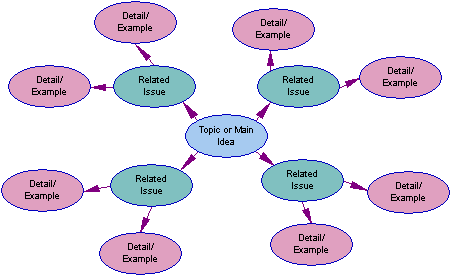
About Concept Mapping “If I had to reduce all of educational psychology to just one principle I would say this: The most important single factor influencing learning is what the learner already knows. Ascertain this and teach him accordingly.” – David Ausubel (1968) Concept mapping emerges directly from David P. Ausubel’s Assimilation Theory of meaningful verbal learning. The underlying basis of the theory is that meaningful (as opposed to rote) human learning occurs when new knowledge is consciously and purposively linked to an existing framework of prior knowledge in a non-arbitrary, substantive fashion. In rote (or memorized) learning, new concepts are added to the learner’s framework in an arbitrary and verbatim way, producing a weak and unstable structure that quickly degenerates. Joseph Novak is widely credited as the creator of concept maps, and has been writing and researching them since the 1970s. “Concept maps are intended to represent meaningful relationship Continue reading
Modern Management Approaches
Paradoxical Thinking

For decades, the management theorists have focused their attention on three types of thinking i.e. magical thinking, modern thinking and postmodern thinking. The latest inclusion is the paradoxical thinking. The main reason that paradoxical thinking has gained importance in the business world is that there were some buzz phrases that were being used by the employees of the organisations such as controlled chaos, getting outside the box, breaking the frame of reference, creative destruction, fuzzy logic and etc. All of these terminologies show that a business can develop something impossible by going beyond the imaginative framework and these old models have less importance in the contemporary world. The primary crux of the paradoxical thinking is that the openness can be anything but it is indecisive, lacks principled convictions and is sometimes passionless as well. Paradoxical thinking implies that problems should be looked from different angles rather than one perspective so Continue reading
Culture as a Normative Control Tool in Organizations
Proponents of corporate culture as an informal control mechanism regard culture as a management tool that can be manipulated though the actions of top management. Culture is a management tool; however, there is a counter-view that corporate culture is a rather complex construct. People argue that culture should be regarded as something that an organization ‘is’, not as something that an organization ‘has’; it is not an independent variable, nor can it be created, discovered, or destroyed by the whims of management. Despite the academic debate surrounding corporate culture as a construct, for practicing managers, caught up with the need to control and recognizing the flaws in the more formal and bureaucratic mechanisms, the lure of cultural control as a management tool is highly seductive. Significance of Cultural and Normative Forms of Control From the last few years, organisations have become interested in organisational control and employees’ self-hood. This control Continue reading
Concept of Organizational Effectiveness
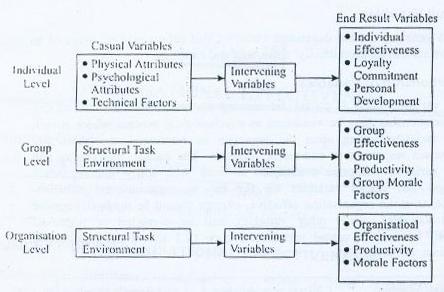
Organizational effectiveness is defined as an extent to which an organization achieves its predetermined objectives with the given amount of resources and means without placing undue strain on its members. Sometimes efficiency and effectiveness are used as synonyms. However, there exists a difference between the two concepts. Therefore, it is important to explain the difference between the concepts of effectiveness and efficiency to understand why organizations may be effective but not efficient, or efficient but not effective. Effectiveness is a broad concept and takes into account a collection of factors both inside and outside an organization. It is commonly referred to as the degree to which predetermined goals are achieved. On the other hand, efficiency is a limited concept that pertains to the internal working of an organization. It refers to an amount of resources used to produce a particular unit of output. It is generally measured as the ratio Continue reading
Market Value Added (MVA)
Economic Value Added (EVA) is aimed to be a measure of the wealth of shareholders. According to this theory, earning a return greater than the cost of capital increase value of company while earning less than the cost of capital decreases the value. For listed companies, Stewart defined another measure that assesses if the company has created shareholder value or not. If the total market value of a company is more than the amount of capital invested in it, the company has managed to create shareholder value. However, if market value is less than capital invested, the company has destroyed shareholder value. The difference between the company’s market value and book value is called Market Valued Added or MVA. From an investor’s point of view, Market Value Added (MVA) is the best final measure of a Company’s performance. Stewart states that MVA is a cumulative measure of corporate performance and Continue reading
Successful Change Management: Principles and Processes
Managing the changes in an organization requires a broad set of skills like political skills, analytical skills, people skills, system skills, and business skills. Having good analytical skills will make you a good change agent. You should evaluate the financial and political impacts of the changes that can take place. You should know that following a particular process at that instant would fetch you immediate financial effects and start that process so that the change process is noted by the management. The workflow has to be changed in such a manner to reflect the financial changes that are taking place. Operations and systems in the organization should be reconfigured in such a manner that you get the desired financial impact. Successful management improvement efforts require the active involvement of managers and staff throughout the organization to provide ideas for improvements and supply the energy and expertise needed to implement changes. Continue reading