Four Levels of Uncertainty – Strategic Planning Under Uncertainty
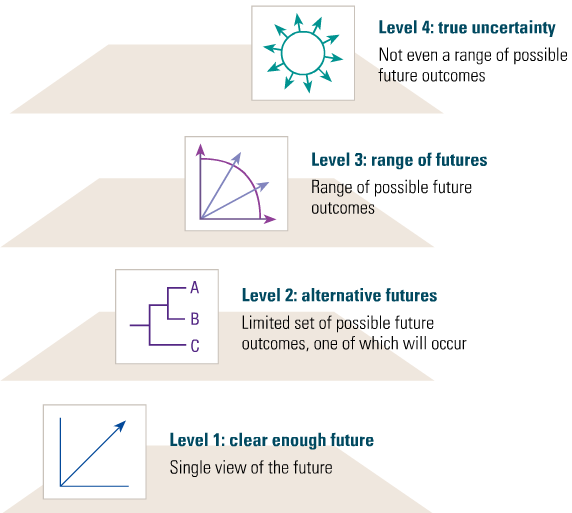
Even the most uncertain business environments contain a lot of strategically relevant information. First, it is often possible to identify clear trends, such as market demographics, that can help define potential demand for future products or services. Second, there is usually a host of factors that are currently unknown but that are in fact knowable-that could be known if the right analysis were done. The uncertainty that remains after the best possible analysis has been done is what we call residual uncertainty. Hugh G. Courtney, Jane Kirkland, and S. Patrick Viguerie  in their article  Strategy Under Uncertainty  have developed a useful framework for dealing with various uncertainties in strategy formulation. Four Levels of Uncertainty The authors present four levels of uncertainty:  1) A predictable future, 2) Alternate futures 3) A range of futures 4) True ambiguity. Level 1: Clear Enough/Predictable Future This would apply to situations where sufficiently precise predictions Continue reading

Fama and French Three Factor Model

Capital Asset Pricing Model (CAPM) is the backbone of modern portfolio theory. According to CAPM, the expected return on stock is a function of its relationship with the market portfolio defined by its beta. However, Eugene Fama and Kenneth French (1992) brought together two more factors and found that stock return is based on a combination of not just market beta but also firm size and value. They came up with a new model known as Three Factor Model  as an alternative to CAPM. What is Fama and French Three Factor Model? Fama and French three factor model expands on the Capital Asset Pricing Model (CAPM) by adding size and value factors in addition to the market risk factor in CAPM. This model considers the fact that value and small cap stocks out-perform markets on a regular basis. Fama and French attempted to approach and measure equity returns in a Continue reading

Hierarchy of Effects Model in Consumer Behavior

Another widely used model in marketing that attempts to  explain consumer decision making process is called the Hierarchy of Effects Model.  Originally conceived to explain how advertising affects  consumer’s purchase decisions, the Hierarchy of Effects Model focuses on consumer learning that takes place as he/she  processes information from the external world. Although different researchers developed  slightly different models, the basic idea is the same: people experience a sequence of psychological stages before purchasing  a product. The origins of the Hierarchy of  effects can be traced all the way  back to 1898 and the hierarchy’s  creator, a salesman named Elias St  Elmo Lewis. Lewis believed that  rather than simply closing a sale,  an effective salesperson actually guided a buyer through a series  of stages. He claimed that a  proper salesman must ensure  Attention, maintain Interest,  create Desire and finally spur  the customer to Action  (purchase).  In 1910, the Hierarchy of Effects Continue reading

Information Systems and Business Forecasting

The business provided support for using Decision Support Systems (DSS) and addressed the following issues: techniques within the DSS, corporation needs and limitations, the forecast cost effectiveness, and the appropriate software system. Sales forecasting is an integral part of marketing DSS. The DSS contains tools to help   the forecaster prepare better forecasts; tools are data, records of previous forecasting, and techniques. Forecasts assist marketing managers improve decision-making. In an organizational design context, forecasting should not be regarded as a self-contained activity, but should be integrated within the planning context of which it is a part. When an organization has its own forecasting expertise (prepares its own forecasts) that expertise should not be separated into a self-contained department. Forecasting and planning functions should be combined. Involvement of the forecasters in planning enables them to select criteria for evaluating forecasting methods that are meaningful within the planning context. Managers must go Continue reading

Benchmarking Analysis

In a complex, dynamic, fast-changing environment, companies must strive for superiority in order to survive. Competitive edge cannot be achieved or maintained by setting goals based on past or even present performance. Benchmarking is a management practice that can be used to pursue excellence. It does this by identifying, comparing and emulating best practice wherever it occurs. Read More:  Benchmarking as a Strategic Business Tool Benchmarking is defined as a continuous systematic process of evaluating companies recognized as industry leaders, to determine business and work processes that represent best practices and establish rational performance goals. It is a search for industry best practices that lead to superior performance. It illustrates how good a company currently is in comparison to its competitors, that is benchmarking analysis demonstrates what others are doing as well as what others are achieving. Benchmarking analysis is an integral part of the organizational improvement process and it Continue reading

Case Study: Corporate Social Responsibility at The Body Shop

The Body Shop (TBS) has developed 2500 stores in 60 countries with a range of over 1,200 products in approximately 30 years, and is the second largest cosmetic franchise in the world. After the first TBS’s outlet founded in 1976, the company has experienced rapid growth and with expanding rate of 50% annually. When its stock first obtained a full listing on the London Stock Exchange, its price increased by more than 500%. In 1999, TBS was even voted as the second most trusted brand in UK by the Consumers Association. The founder, Anita Roddick had received numerous awards including Dame Commander of the British Empire for her contributions. TBS’s success is hard to observe from the extrinsic value but the ethical value which make the success of TBS so legendary and inspiring. Anita Roddick, founder of TBS first entered the industry by using £4,000 to open a small stand-alone Continue reading