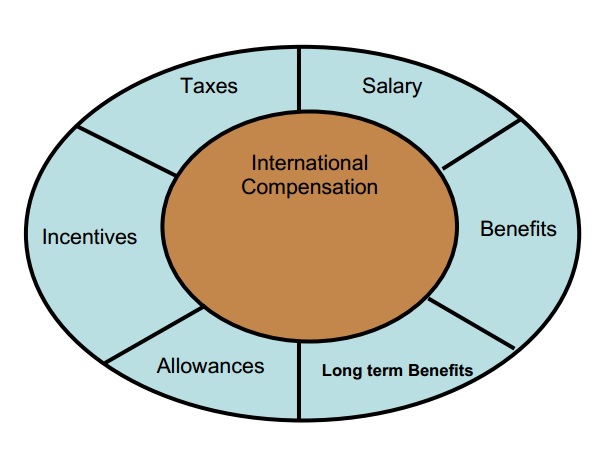
Designing and developing a better compensation package for HR professionals for the international assignments requires knowledge of taxation, employment laws, and foreign currency fluctuation by the HR professionals. Moreover, the socio-economic conditions of the country have to be taken into consideration while developing a compensation package. It is easy to develop the compensation package for the parent country national but difficult to manage the host and third country nationals. When a firm develops international compensation policies, it tries to fulfills some broad objectives: The compensation policy should be in line with the structure, business needs and overall strategy of the organization. The policy should aim at attracting and retaining the best talent. It should enhance employee satisfaction. It should be clear in terms of understanding of the employees and also convenient to administer. The employee also has a number of objectives that he wishes to achieve from the compensation policy Continue reading
HRM Functions
Types and Methods of Employee Counseling
Types of Employee Counseling In attempting to help an employee who has a problem, a variety of counseling approaches are used. All of these counseling approaches, however, depend on active listening. Sometimes the mere furnishing of information or advice may be the solution to what at first appeared to be a knotty problem. More frequently, however, the problem cannot be solved easily because of frustrations or conflicts that are accompanied by strong feelings such as fear, confusion, or hostility. A manager, therefore, needs to learn to use whatever approach appears to be suitable at the time. Flexibility is a key component of the employee counseling process. Directive Counseling: It is full counseling. It is the process of listening to an employee’s problem, deciding with the employee what should be done and telling and motivating the employee to do it. This type of counseling mostly does the function of advice, reassurance Continue reading
Working Across Boundaries

During the last decade, the concept of working across boundaries has become a popular concept. The basic premise is that individuals and organizations need to traverse boundaries if they are to achieve their goals. Essentially earlier concepts of fixed organizational demarcation lines no longer apply in modern-day business concepts. Within the organizational framework, the concept of boundaries can become a reasonably complex issue. There still remains an active debate as to whether the definitions of boundaries are realistic, objective, or imagined. The concept has become more complex with the use of outsourcing and Public/Private partnerships in terms of lines of demarcation and authority. The concept of boundaries within organizations takes on different shapes and forms. Much of this has to do with social and knowledge boundaries. The explosion in technological and communication advances has simplified the concept of working across boundaries. Despite the fact that organizations still are challenged to Continue reading
Introduction to Performance Appraisal

In almost every organization, every employee is subjected to periodic appraisal of his/her performance. This is highly important if the organization’s human resource development objectives are to be realized, if the organization wants to make best use of its human resource available and if the organization wants to have a scientific and retinal compensation system. An effective performance appraisal system brings rationality in management. If an organization wants to maximize its effectiveness then the organization must have tool by which it can discriminate between an effective employee and not so effective employee. Today, appraisal is not something of a choice left to the wishes of the corporate bosses, nor it is a privilege to be enjoyed by few businesses conglomerates. Therefore, it is a must for every organization for its survival and growth. The appraisal practices are in somewhere structured and formally sanctioned and in other instances they are an Continue reading
Appraising Employee Performance

Need for Appraising Employee Performance in Organizations There are several reasons to appraise subordinates performance. First, appraisals play, or should play, an integral role in the employer’s performance management process; it does little good to translate the employer’s strategic goals into specific employees’ goals, and then train the employees. Second, the appraisal lets the boss and subordinate develop a plan for correcting any deficiencies the appraisal might have unearthed, and to reinforce the things the subordinate does correctly. Third, appraisals should serve a useful career planning purpose by providing the opportunity to review the employee’s career plans in light of his or her exhibited strengths and weakness. And, last but not least, the appraisal almost always affect the employer’s salary raise and promotional decisions. In reviewing the appraisal tools we discuss below don’t miss the forest for the trees. It doesn’t matter which tool you use if you’re less than Continue reading
Different Stages of Career Development
The career stage approach is one way to look at career development. One way to characterize a person’s life or career is by identifying common experiences, challenges, or tasks most people go through as their life or career progress. As individuals have different career development needs at different stages in their careers, when an organisation recruits an employee in any of the grades of its cadre for a fairly long tenure, the employer must take interest in and take constructive steps for building up employees’ career from that point of time. Stage views of career development have their limitations. It is applicable to a typical individual. Since all individuals are unique, they may not have the same experiences. Therefore, career development stages differ from individual to individual due to obvious difference in perceived internal career. However, keeping in view of general requirements of people career development may be grouped under Continue reading