
VIRGIN ATLANTIC Virgin Atlantic was born in the 1980s. Richard Branson, the British entrepreneur, had already created a successful brand with Virgin Group, particularly in the music business. He had founded the group when he was 20 as a mail-order record company and shortly after opened a music shop in London’s main shopping thoroughfare, Oxford Street. The original brand slogan of these stores was ‘Cheap and nasty’. A music studio was built in Oxfordshire in 1972, where one Mike Oldfield recorded his massively successful album Tabular Bells for the Virgin Records label. This album sold 5 million copies and was the catalyst for Virgin Records, which signed a range of successful artists, including The Rolling Stones, Culture Club, Janet Jackson, Peter Gabriel, Simple Minds and The Human League. Virgin was to become one of the six biggest record companies in the world. By the early 80s Virgin Group was well Continue reading
Marketing Strategies
Green Strategies and Green Marketing Strategy Matrix
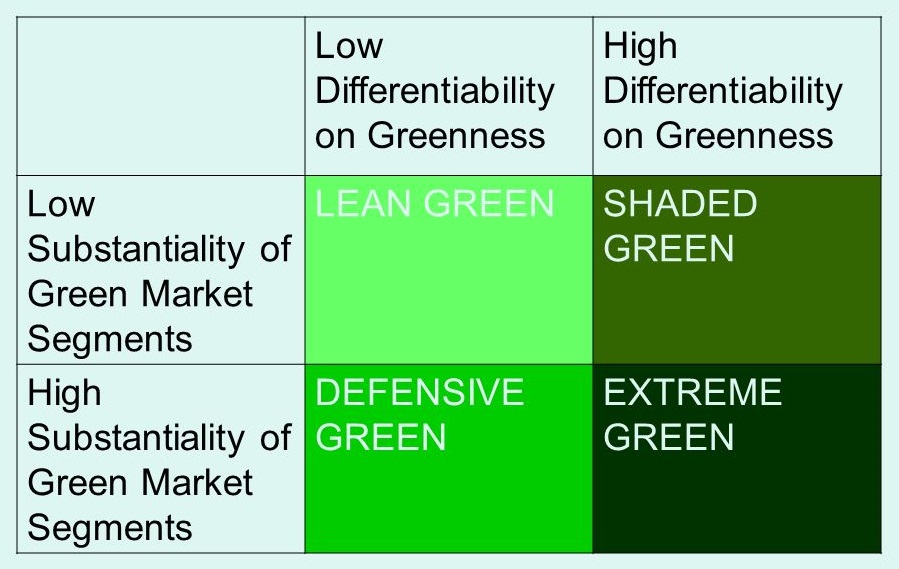
Industry green norms and potential green market size are key issues for companies looking to gain competitive advantage with green marketing. Companies should consider the likely size of green markets in its industry as well as how can they differ their green products or services from their competitor’s one’s before they take steps on going green. There are four types of green strategies: Lean Green, Defensive Green, Shaded Green and Extreme Green. Following Green Marketing Strategy Matrix illustrates the need for companies to identify their position in regards to substantiality of green market segments and differentiability of greenness in order to choose the right strategy to enter a green market. Promotions tools adopted by this strategy are rather quiet such as public relations versus mass advertising. The Shaded Green strategy puts some secondary emphasis on greenness in its more overt promotional efforts and also pursues green product development as well. Continue reading
The Importance of Brand Perception
The perception of Branding holds great significance since many years; it is the explanation to distinguish the goods and services from one to another. Customer’s simple understanding of brand is to relate and consider with simple information processing about products purchasing and being positive about the brand to construct their trust with time. Branding is a method that is utilized by the enterprises to utilize trading schemes to enhance their merchandise or service likeness in order that it is more gladly recollected by the customer. Branding assists the goods or service to make a favorable influence on the goal customers while the branding notions assist in explaining the guidelines that should be pursued throughout the branding process. Brand equity is primarily constructed by laying a base of brand perception – finally forming affirmative brand images – and is finally maximized by high grades of brand commitment. The significance of brand equity comprises Continue reading
The Transition From the Transactional Marketing to Relationship Marketing
The approach to marketing between the 1950s and 1980s changed drastically through various theories and practices, which changed the way organisations viewed marketing as a whole. The 1950s saw the influence of the marketing mix, including the 4Ps model of marketing. This model consists of; product, price, place and promotion. The idea is to help organisations understand how to satisfy their target market. A product can be seen as tangible or intangible, as it can be in the form of services or goods. For a product to create revenue there has to be a need and demand for it. Therefore, organisations must carry out research into the market, so that they have a true understanding of the product life cycle they could potentially go through. It is vital that organisations reinvent their product or service, if or when it reaches a point in time where the sales have started to Continue reading
Co-Branding – Meaning, Strategies and Benefits

Nowadays, one of the highly valued assets for a company are its brands, with branding being every company’s top priority. But it often costs the companies huge amount of money and takes them a long time to build their brand. Today’s market is suffering from a syndrome of sameness where all the products offered to the customers look very similar both in terms of sameness in the physical brand element and in the symbolic value proposition offered to the market. Thus it has become difficult to establish a unique position for new products with markets cluttered with competing brands. Even innovative differentiated products can be imitated quickly, leaving no strategic edge. As globalization phenomenon continues to elevate competition in the marketplace, product introduction has become highly fraught with risk. One reason of such risk is the incredibly high cost of building brands for a product and another is that firms Continue reading
The Engel Kollat Blackwell (EKB) Model of Consumer Behavior
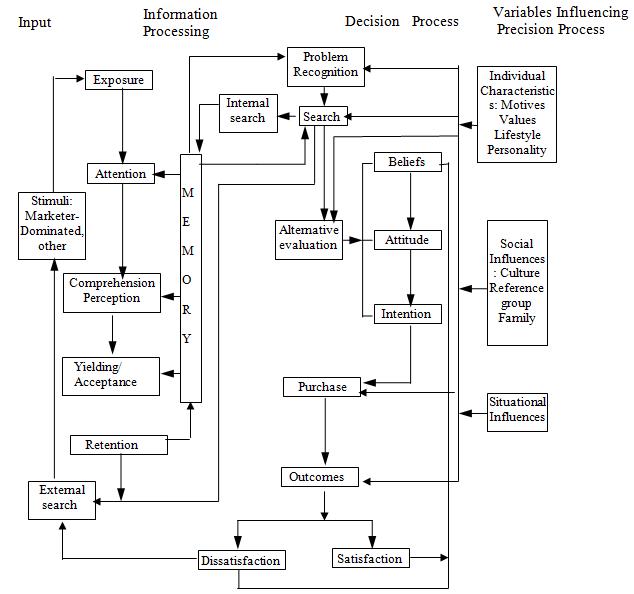
The Engel Kollat Blackwell Model of Consumer Behavior was created to describe the increasing, fast-growing body of knowledge concerning consumer behavior. This model, like in other models, has gone through many revisions to improve its descriptive ability of the basic relationships between components and sub-components. The Engel Kollat Blackwell model describes consumer behavior as a 4-step decision-making process involving problem recognition, information search, alternative evaluation, and purchase decision. The model also considers how external factors like culture, social class, and reference groups as well as internal factors like motivation, personality, and knowledge influence the consumer’s decision journey. A key feature is distinguishing between high and low involvement purchases based on perceived risk. The Engel Kollat Blackwell Model of Consumer Behavior or consists of four distinct stages; Information Input Stage: At this stage the consumer gets information from marketing and non-marketing sources, which also influence the problem recognition stage of the Continue reading