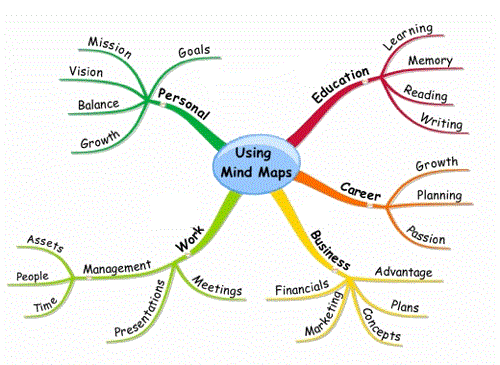
Mind mapping is a very old technique which has been used for centuries for brainstorming, visual thinking and problem solving in all subject areas. Some of the earliest examples date back to the 3rd century where these techniques have been used by the famous Greek philosopher Aristotle. A mind map is a powerful graphic technique which provides a universal key to unlock the potential of the brain. It harnesses the full range of cortical skills – word, image, number, logic, rhythm, colour and spatial awareness – in a single, uniquely powerful manner. In so doing, it gives you the freedom to roam the infinite expanses of your brain. Mind mapping was further developed by Tony Buzan following his research into note-taking techniques in the late 1960s. Mind maps are a type of diagram used to visually display information in a relational way. Typically they start with a central idea, denoted Continue reading
Modern Management Approaches
Goldratt’s Theory of Constraints – Constraint Management

An Israeli physicist, Eliyahu Goldratt wrote a book titled ‘The Goal’, about a factory manager’s quest to save his factory from being closed down for lack of profitability. It chronicles the process that the manager and his staff go through as they learn how to save their factory. What they learn is how to apply the principles of what Mr. Goldratt calls the “Theory of Constraints.” Theory of Constraints (TOC) is a logic-driven approach which focuses on system improvement. The core idea of TOC is that every organization has at least one constraint that prevents management from achieving the goal of the organization to a larger degree. A system can be defined as a collection of interrelated, interdependent components or processes that act in concert to turn inputs into defined outputs in pursuit of a particular goal. Linking systems to chains, TOC defines weakest link as a Constraint. Constraint limits Continue reading
Effectuation – New Paradigm of Entrepreneurship

The business world is permeated through and through this kind of rationality, based on what we see is happening today in the world, what are the trends? what will be the consequences? are forecasted the solutions in a business environment. However, according to Saras Sarasvathy, it is not how entrepreneurs think. The thought process is not “causal” but “effectual”. When a project is approached, the entrepreneur has three means skills: his own innate abilities, skills acquired through education and personal contacts. The entrepreneur is guided by a simple maxim: “To what extent can we control the future, we do not need to predict it.” Here lies all the difference. According to Sarasvathy, the successful entrepreneur does not try to predict what will be the most profitable markets, very opposite idea to Henry Mintzberg. In 1997 Saras Sarasvathy, professor of business and ethics at the University of Virginia but then a Continue reading
Mental Modes in Organizational Change
An important aspect of organizational culture is the mindset, influenced by the basic assumptions and core values underlying it. It is the same as in the case of individuals whose thinking and behavior is governed by certain values imbibed through their own life experiences. An organization, at any given point of time, tends to be in a particular psychological state or mental mode, which, in turn, influences its functions, activities, and processes. An organization’s psychological state arises out of its experiences in the business environment in which it operates, the basic assumptions it holds about the environment (markets, customers, technology, community) and itself (mission, strategy, capabilities/competencies), and its operative culture. “A mental mode is the peak of a particular existential/experiential state that an organization gets into over time (as do individuals, who live in their own mental modes and most often see what they want to see) and that remains Continue reading
The Pros and Cons of Outsourcing
Outsourcing involves assigning some of the business tasks or a department to another business. This is done when a business cannot handle all of its activities internally. They can also do so in search for expertise of a specific task. The businesses that are mostly involved in outsourcing include manufacturing, logistics, customer services, recruitment, web designing, information, content development and technology maintenance among others. The factors that influence decision making on outsourcing includes staff, finances, information characteristics, agreement issues, and vendor issues. Out sourcing involves two businesses which come in to a contractual agreement to exchange services for payment. A business contacts another business to carry out a particular task and in return they pay for the services provided with. Business people do outsource in order to get time to do other significant roles. This saves time and can allow a business person to do other businesses thus increasing his profits. Continue reading
What is Crisis Management?

An individual, an organization, a government, or the global economy at any point of time may face debacles. This may come in any form and can devastate the present circumstances and can lead to difficult situations. Such occurrences are often termed as crisis. It is therefore defined as a major, unpredictable and upsetting event that intimidates to harm. Even though crisis is an unpredictable form of event, but it is not unanticipated. Crisis is a threat to organizations, an unexpected element and short periods of risk. For an organization, crisis can be illustrated as an anomalous and uncharacteristic situation or perception, which is beyond the control of an organization and also threatens to impact their operation. A company has to deal with different forms of crisis. Some of the major forms of crisis are detailed below: Natural Disaster: It is about the physical demolition of the organizations assets due Continue reading