Training and Development – Meaning, Definition and Need

Meaning of Training and Development Training typically involves providing the employees the knowledge and skills needed to do a particular task or a job through attitude change. It is concerned with imparting and developing specific skills for a particular purpose. For example, Flippo has defined training as “the act of increasing the skills of an employee for doing a particular job”. Thus, training is a process of learning a sequence of programmed behavior. This behavior, being programmed, is relevant to a specific phenomenon, that is, a job. The term development refers broadly to the nature and direction of change induced in employees, particularly managerial personnel through the process of training and educative process. National Industrial Conference Board has defined development as “Managerial Development is all those activities and programmes when recognized and controlled, have substantial influence in changing the capacity of the individual to perform his assignment better and in Continue reading

Emotional Quotient (EQ) Vs. Intelligence Quotient (IQ) – Which One Is More Important?

Intelligence is a term that is difficult to define, and it can mean many different things to different people. Intelligence is often defined as the general mental ability to learn and apply knowledge to manipulate your environment, as well as the ability to reason and have abstract thought. In education, Intelligence is defined as the ability to learn or understand or to deal with new or challenging situations. In psychology, it is the ability to apply knowledge to manipulate one’s environment or to think abstractly as measured by objective criteria; for example IQ test. It is thought from deriving a combination of inherited characteristics and environmental such as developmental and social factors. General intelligence is often said to comprise various specific abilities like verbal ability, ability to apply logic in solving problems. There are two types of intelligence quotients: emotional and intelligence quotient. Emotional intelligence or emotional quotient (EQ) is Continue reading

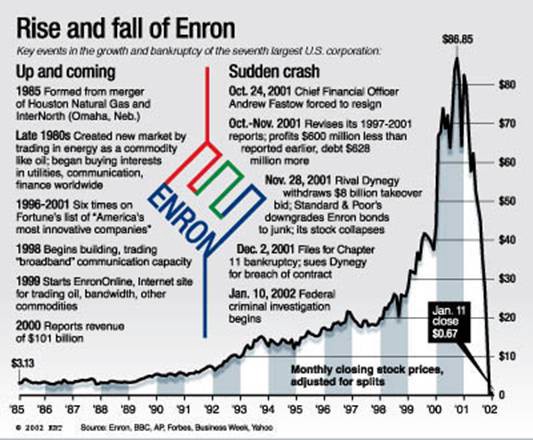
Case Study: The Rise and Fall of Enron

Background on the History of Enron Enron was an American Gas Company that was originally called Natural Gas Company in the early 1930s. InterNorth was a holding company that was located in Nebraska and in 1979 purchased Natural Gas Company. In 1985, Enron was born following the merger of InterNorth and Houston Natural Gas. Following the merger, in 1987 Enron discovered that oil traders in New York have overextended the company’s account by $1 billion dollars, which they were able to work down to $142 million. This put Enron in massive debt. For the new company to survive, Enron needed new, innovative, and strategic business plans to generate profits and improve cash flows. In 1988 Enron opened its first overseas office in England. “Come to Jesus” was a gathering by the top heads at Enron to come up with a new strategy to get the company out of debt and Continue reading

Application of Economics to Business Management

Managerial economics is the discipline, which deals with the application of economic theory to business management. Managerial Economics thus lies on the margin between economics and business management and serves as the bridge between the two disciplines. The application of economics to business management or the integration of economic theory with business practice, as Spencer and Siegelman have put it, has the following aspects : Reconciling traditional theoretical concepts of economics in relation to the actual business behavior and conditions: In economic theory, the technique of analysis is that of model building. This involves making some assumptions and, drawing conclusions on the basis of the assumptions about the behavior of the firms. The assumptions, however, make the theory of the firm unrealistic since it fails to provide a satisfactory explanation of what the firms actually do. Hence, there is need to reconcile the theoretical principles based on simplified assumptions with Continue reading

The Concept of Debt Recovery Management

Banks were never so serious in their efforts to ensure timely recovery and consequent reduction of Non-Performing Assets (NPAs) as they are today. It is important to remember that recovery management, be of fresh loans or old loans, is central to NPA management. This management process needs to start at the loan initiating stage itself. Effective management of recovery and Non-Performing Assets comprise two pronged strategy. First relates to arresting of the defaults and creation of NPA thereof and the second is to handling of loan delinquencies. The tenets of financial sector reforms were revolutionary which created a sense of urgency in the minds of staff of bank and gave them a message that either they perform or perish.   The prudential norm has forced the bank to look into the asset quality. A  debt from a loan, credit line or accounts receivable  that is recovered either in whole or Continue reading

Internal and External Factors Influencing Recruitment

Recruitment is one of the important tasks which human resources management department has to perform very carefully. They have to understand the need of the vacant position. They have to know what should be the qualification of the candidate for the required position. They have to also look after that what is the age range of the candidate because in several cases some position needs to be more that twenty five years, thirty five years and so on. There are certain reasons of age barrier, for example many company have some different kind of sales positions required. For those positions, company want to have young and enthusiastic candidate, so they prefer that if the position is for sales associate, where the person have to travel a lot, they should be not more than an age of thirty years. Another reason of the human resources management to distinguish age is hierarchy. Continue reading