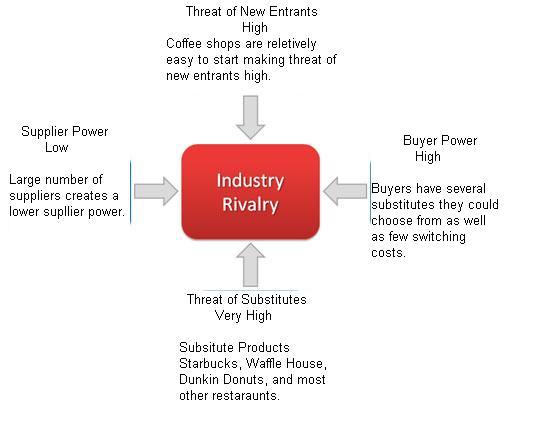
Starbucks Coffee Company’s success in the coffee business echoed resoundingly across the globe. Starbucks Corporation is an international coffee and coffeehouse chain based in Seattle, Washington, United States. Starbucks is the largest coffeehouse company in the world, with 16,635 stores in 49 countries, including 11,068 (6,764 Company Owned, 4,304 Franchised) in the United States, followed by nearly 1,000 in Canada and more than 800 in Japan. Starbucks sells drip brewed coffee, espresso-based hot drinks, other hot and cold drinks, snacks, and items such as mugs and coffee beans. Through the Starbucks Entertainment division and Hear Music brand, the company also markets books, music, and film. Many of the company’s products are seasonal or specific to the locality of the store. Starbucks-brand ice cream and coffee are also offered at grocery stores. Starbucks marketed itself as the “Third Place” — a place where people can go aside from home and the Continue reading
Company Analysis
Case Study: Dell’s Competitive Advantage

Dell Computer is a leader in the e-commerce computer hardware market. It is an established brand that leads personal computer manufacturers both in U.S. sales and overall online sales. Its trademark method of selling products to customers, corporate and individual consumers, originates from the Dell Direct model, a Web-enabled infrastructure that allows customers to customize their PCs and order other products they need or desire. This virtual integration structure eliminates the need to manufacture everything, and instead uses the power of the Internet to share and exchange information with suppliers and vendors to build a truly superior supply chain that keeps inventory turnover low and costs to a minimum. The primary method Dell uses in order to achieve and sustain their competitive advantage is a unique, direct to customer business model. The model is known as Dell Direct, referring to the relationship between the company and its customers as being Continue reading
Case Study: Turbulent History of Chrysler Corporation

In 1920, the president of Buick and Vice President of General Motors (GM) resigned his positions in the GM Corporation following political differences with founder and then-president of General Motors William Durant. This former automotive Vice President was promptly approached by a group of investors to focus his business acumen in the fledgling automotive industry on a small, financially troubled New York company called Maxwell Motor Corporation. The one-time automotive vice president was installed as president of Maxwell Motor Company. The man’s name was Walter Percy Chrysler. In short order, Walter Chrysler brought the Maxwell Motor Corporation out of bankruptcy. The financial improvement was due in large part to Mr. Chrysler introducing a new Maxwell model- the Chrysler Six. This car was very well received by the automobile buying public and went on to sell 32,000 units in its first year, generating a profit of over $4 million for the Continue reading
SWOT Analysis: Strengths, Weaknesses, Opportunities and Threats

SWOT which stands for an abbreviation of Strengths, Weaknesses, Opportunities and Threats; is an analysis that defined as method to examine organization’s internal factors dealing with strengths and weaknesses, and its environmental opportunities and also the threats. SWOT analysis usually use in the preliminary phase of decision making as a general tool which it designed for being antecedent to strategic planning in different case and applications. SWOT Analysis can be used as a model, process, technique or framework to provide information about those factors strengths, of an organization by having many applications with possibility of being used in all the levels of the organization. SWOT analysis is a part of the strategic planning process. Companies have some internal and external forces in the business environment. As a first step of a strategic planning system, the strategic factors that are related with the potential of the company, should be identified and Continue reading
Porter’s Five Forces Analysis of Red Bull
An Austrian Company created Red Bull back in 1987. Red Bull is an energy drink and is also the worlds most popular energy drink, having sold 4.6 billion cans in 2011. The drink was first sold in Thailand and then modified to suit the tastes of people in the United States. A single can of Red Bull has the same amount of as a cup of coffee. Depending on the country, the level of caffeine in a can of Red Bill can vary, as some countries have restrictions on how much caffeine is allowed in drinks. The product is marketed through advertising events such as sport team ownerships, celebrity endorsements, and music. Unfortunately, Red Bull is not market approved in France, Denmark, and Norway. But Red Bull is legal in 164 countries around the world. Due to the potential health risks associated with the drink, Red Bull has been heavily Continue reading
Written Analysis of the Case Study Problems in Management
There is a little difference between the classroom discussion and written analysis of case problem. The following steps can guide the students to analyse the case problem and arrive at best possible solution. 1. Summary of the case: The important facts in the case are pointed out in brief. It is the indication that the student has grasped the contents of the case precisely. 2. Identify the problem involved in the case: After giving a careful reading to the case, see certain apparent problems in the situation. Some are very prominent and most immediate. Whereas some may be partially indicated. The student has to mention the basic problem interwoven in the case, e.g. a case may indicate failure in delegation due to too much interference of the boss; another case may indicate the need for taking appropriate disciplinary action to set things right with regard to labor management Continue reading