
“Blue Ocean Strategy” by W. Chan Kim and Renee Mauborgne is a strategy that challenges companies to distance itself away from fierce competition by establishing uncontested market space that makes existing competition irrelevant. One of the reasons why the authors have used the colors red and blue is to describe the market. Red ocean is the market space where industry boundaries are defined and known. The red ocean contains a massive conflict between companies where they are constantly trying to outperform each other to achieve a greater share or demand. When market spaces become crowded with competitors, companies try out perform each other and profits and growth is greatly reduced due to cutthroat style competition which turns the red ocean bloody. In contrast, blue oceans is the unknown market space where it is unaffected by competition and demand is created rather than fought for. In blue oceans, competition is not Continue reading
Modern Management Approaches
Value Analysis – Definition, Mechanism and Process
Value Analysis (VA) was established by Lawrence D. Miles of General Electric in America. The basic fundamental of value analysis can be implemented in any product to optimize its value. In more details, value analysis is actually a process of systematic review that is applied to existing product designs in order to compare the function of the product required by a customer to meet their requirements at the lowest cost by eliminating unnecessary costs that consistent with the specified performance and reliability needed. First of all, value analysis (and value engineering) is a formal and organized process of analysis and evaluation which required management activities including planning, control and coordination. These analysis concerns the function of a product such as utility, guarantee, or safety performance to meet the demands needed or required by a customer. Thus, to meet this functional requirement the review process must include an understanding of the Continue reading
What are Dynamic Capabilities?
Concept of Dynamic Capabilities of a Firm A dynamic capability refers to company’s ability to integrate, build and transform internal and external competencies. They can help an organization to achieve innovative forms of competitive advantage through integration, building and transformation of internal and external competencies, as to respond to changes in the environment. This management theory was defined by David Teece, Gary Pisano, and Amy Shuen in their 1997 paper Dynamic Capabilities and Strategic Management. In the context of achieving organizational change, aligned to the external pressure: namely, these capabilities are perceived as business processes that use resources — specifically the processes of integration, restructuring, acquisition and release resources — to adapt or create market changes. Dynamic capabilities are especially helpful in explaining the sources of competitive advantage in extremely volatile markets. Dynamic capabilities are determined by organizational and managerial processes, positions and paths. The organizational and managerial processes refer Continue reading
Importance of Leadership for Organizational Excellence

A leader is someone who exercise influence over subordinate and other people without using threats or power for the only sake of the benefit or welfare of the community or groups so chosen or elected him/her as their leader. It would not be meaningless to say that a leader is someone who influences others through motivation and people likes to obey him or her willfully not in compulsion. A leader is person who represents the urges and requirements of his community or group and his all actions are only for the welfare and benefits of his groups. Generally leaders are of two kinds’ formal leaders and informal leaders. A leader who is appointed as leader and has been delegated some power under the shelter of a particular rank or position to perform the particular object. A formal leader is not a natural leader because such leaders are selected or elected Continue reading
Programme Budgeting
Programme Budgeting is mainly useful to government departments and non-profit organizations. In Programme Budgeting special emphasis is laid on formulation of different budgets for different programmes. It utilizes a planning and budgeting process in an output-oriented programme format; which is oriented to its objectives to facilitate developing and evaluating alternatives. It leads to the allocation of resources over a planning period. Programme Budgeting integrates all of the organizations planning activities and budgeting into total system. Programme Budgeting Process First, programmes are identified for achieving different goals of the organizations. Then, each programme is divided into different elements. Resources such as materials, men, machines, utilities, etc., are allocated to various programmes over the period. The emphasis is continuously placed on analysis of alternatives (including existing programmes) and estimating cost of accomplishing objectives and fulfilling purposes and needs. The steps involved in the programme budgeting may be listed as follows: Identification of Continue reading
Four Components of Emotional Intelligence
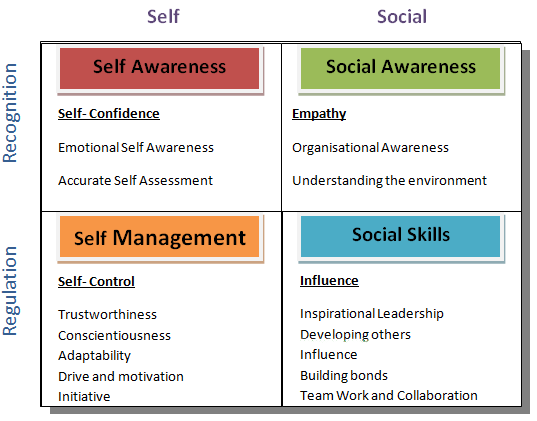
Emotional Intelligence was first described by Daniel Goleman, PhD, in the Harvard Business Review. Dr. Goleman has described many important scientific discoveries about emotions and human behavior in his book, “Emotional Intelligence.” The book organizes the information into a description of how emotion drives behavior, and describes intelligent ways of managing both. According to Goleman, people who know and monitor their own feelings and recognize and deal with the feelings of others, have advantages in all areas of life, but those who cannot get a control over their emotional lives battle constantly and this prevent them to produce continued work and clear thoughts. He has identified a set of competencies that differentiate individuals with Emotional Intelligence. Goleman’s Model: Four Components of Emotional Intelligence Emotional Intelligence consists of two kinds of abilities. The vertical axis describes awareness vs. behavior. “What You See” (left column) is the ability to recognize and understand Continue reading