
What is Internal Auditing? Internal Auditing is an independent, objective assurance and consulting activity designed to add value and improve an organization’s operations. It helps an organization accomplish its objectives by bringing a systematic, disciplined approach to evaluate and improve the effectiveness of risk management, control, and governance processes. Internal auditing is a catalyst for improving an organization’s governance, risk management and management controls by providing insight and recommendations based on analyses and assessments of data and business processes. With commitment to integrity and accountability, internal auditing provides value to governing bodies and senior management as an objective source of independent advice. The Institute of Internal Auditors has defined internal auditing as follows: “Internal auditing is the independent appraisal activity within an organization for the review of the accounting, financial and other operation as a basis for protective and constructive service to the management. It is a type of control, Continue reading
Modern Management Approaches
Forms of Corporate Entrepreneurship
Corporate entrepreneurship is one that generates and exploits new technologies, products, or businesses under the corporate umbrella of an established firm. Corporate entrepreneurship can speed up processes inside the company and helps to invent and commercialize innovative products or services. Corporate entrepreneurship is the process by which teams within an established company conceive, foster, launch and manage a new business that is distinct from the parent company but leverages the parent’s assets, market position, capabilities or other resources. Corporate entrepreneurship is also more than the development of new products; it also implies innovations to existing products or brands. Corporate entrepreneurship is also defined as the process of stimulating innovative ideas and processes. The common goal of the concept is creating wealth. This definition differs from the other two definitions above in the sense that it doesn’t mention the protection of an established firm as a characteristic of corporate entrepreneurship. Innovation Continue reading
Three Models of Emotional Intelligence

The emotional intelligence field is a very new area of study in psychological research. The definition therefore is varied and is constantly changing. It was only in 1990 that Salovey and Mayer came up with the first published attempt in trying to define the term. They defined emotional intelligence as the ability to monitors one’s own and other feelings and emotions, to discriminate among them and to use this information to guide ones thinking and actions. Emotional intelligence to a larger extent involves “emotional empathy” which is the ability to concentrate on one’s emotions and recognize mood both of themselves and others. It further describes how well one is able to adapt to various life challenges like stress and difficult incidences. It also involves the ability balance “honest expression of emotions against courtesy, consideration and respect”. This would obviously involve possession of some level of good social and communication skills. Continue reading
Discontinuous Improvement – Abernathy and Utterback Model
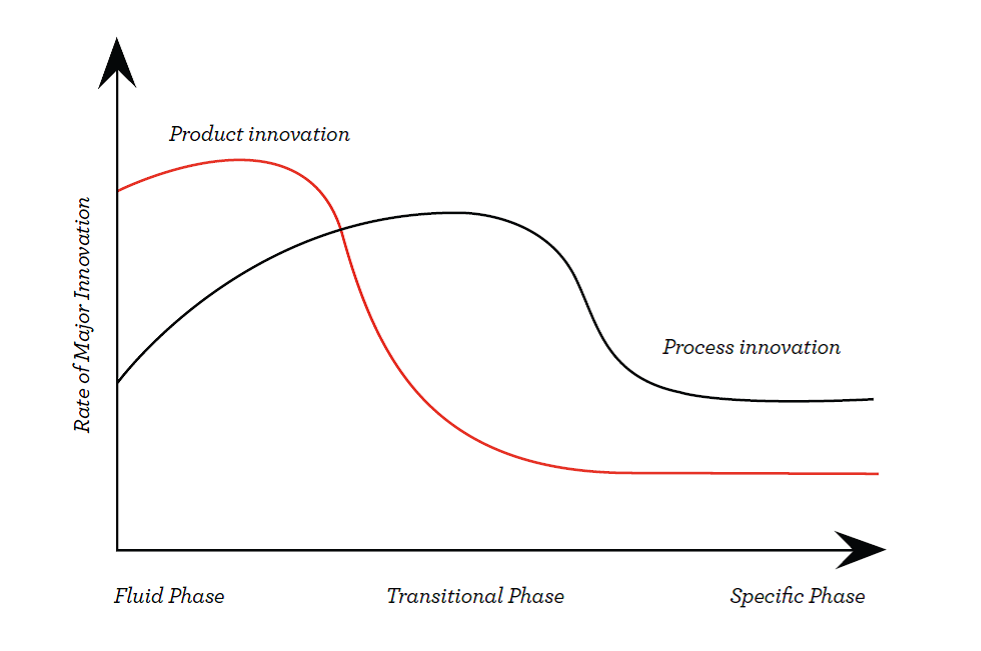
The common innovation process happens in a set frame, following certain rules and ways of thinking. This ‘game played’ by competitors is to innovate by doing what has been done before like product or process innovations or even position and paradigm innovations, but doing it better. In this competition of ‘playing the same game’ some firms manage to do better than others and can gain a competitive advantage through these innovations, but the ‘set of the game’ is accepted and do not change. Very rare something happens that breaks up this framework and changes how the game is played. This will not happen every day but when this arises the rules and boundaries of a market change rapidly. This will result in upcoming new opportunities and challenge the existing players in their way of working, thinking and doing business. A discontinues improvement occurs out of a technological and conditions stable Continue reading
Learning Organization – Meaning and Importance

Learning organization means organizations where people continually expand their capacity to create the results they truly desire, where new and expansive patterns of thinking are nurtured, where collective aspiration is set free, and where people are continually learning how to learn together. From this definition we can understand that learning organization is a team and organizational process rather than individual and it is a continuous never ending process. It is essential for a learning organization to make creative and better ways of learning and improving its performance. It becomes a part of the continuous process of sharing information with people and the environment, and exchanging and disseminating information. A learning organization is entirely different from a traditional organization as it has the capacity to make changes continuously. The theory of organizational learning stresses the importance of policies and procedures inside the organization in response to the outside consequences even though Continue reading
Social Network Analysis
Billions of people create trillions of connections through social media each day, but few of us consider how each click and key press builds relationships that, in aggregate, form a vast social network. Passionate users of social media tools such as email, blogs, microblogs, and wikis eagerly send personal or public messages, post strongly felt opinions, or contribute to community knowledge to develop partnerships, promote cultural heritage, and advance development. Devoted social networkers create and share digital media and rate or recommend resources to pool their experiences, provide help for neighbors and colleagues, and express their creativity. The results are vast, complex networks of connections that link people to other people, documents, locations, concepts, and other objects. New tools are now available to collect, analyze, visualize, and generate insights from the collections of connections formed from billions of messages, links, posts, edits, uploaded photos and videos, reviews, and recommendations. As Continue reading