
The United Nations Sustainable Development Goals (SDGs) is a program that was created by the United Nations. Its aim is to achieve an all-round development globally through having the desire to achieve such factors as; hunger and poverty reduction, having many people access both clean and affordable energy, improvement and provision of proper health services, industrialization, innovation and both economic and infrastructural development and many more objectives totaling to seventeen. In other words, it offers a sincerely comprehensive apparition of the future. These sustainable development goals were created and adopted in 2015 September, after the period for which the achievements of Millennium Development Goals (MDGs) were terminated in 2015. However, some of the objectives were substantially met. Nevertheless, some remain Continue reading
Global Business Environment
Internationalization Concept -The Uppsala Internationalization Model
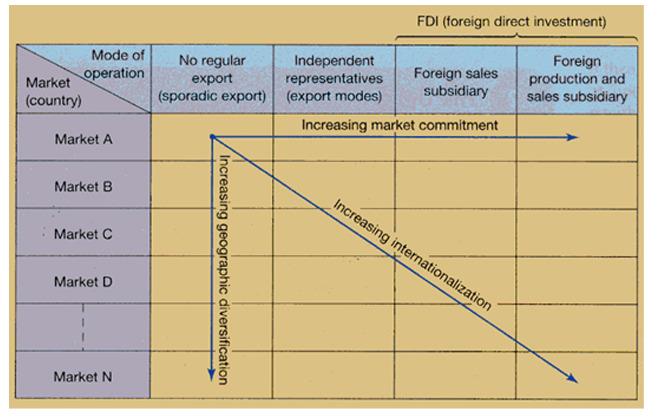
Internationalization consists of standardized products or service through globally standardized marketing and production processes that target standardized customer needs. Internationalization can be described as the process of increasing involvement in international operations. Another definition denotes internationalization as the process of adapting firms’ operations (strategy, structure, resources, etc) to international environments. Both definitions emphasize the crucial fact that internationalization needs an overall support from the organisation as it is changing the environment to expand in various manners the process mostly consists of macro factors to evolve. The Process of Internationalization Internationalization fundamentally alters the price-setting strategies of domestic economic agents. This is true for agents operating in product markets, factor markets and financial markets. At a micro level, internationalization directly alters Continue reading
Global Supply Chain Management – Drivers and Activities of Global Supply Chain

Nowadays with globalization, global supply chain management is becoming a very important issue for most of businesses. The main reasons of this trend are procurement cost reduction, purchasing risks control, revenues increasing and etc. For instance, companies may set up overseas factories to benefit from tariff and trade concessions, lower labor cost, capital subsidies, and reduced logistics costs in foreign markets. Moreover, easy access to abroad markets and close proximity to customers result better organizational learning. On the other hand, improved reliability can be obtained as a consequence of closer relationship with suppliers. There are some issues that should be considered in managing a global supply chain. First of all, the company should decide about its general outsourcing plan. For Continue reading
Social Entrepreneurship in India
Social entrepreneurship as the concept was coined long ago but has been in the corporate parlance in just the recent past. Traditionally, entrepreneurship has been associated with profit making individuals who aim high and achieve a lot for themselves in the world of tough competition. And the success of enterprise was and is being judged on parameter like return on investment and net income margins. But, with the empowerment and awareness of the citizens of the developing world, a new revolution has started, particularly among the youth of the world. This revolution is the growth of Social Entrepreneurship – the form of entrepreneurship where profits are not the end result, but just the means to achieve the end result of Continue reading
External Environment Factors Causing Uncertainty in Organizations
Businesses are bound to encounter several forces whenever they are in operation. In some cases, these forces are over and above their control. In spite of this reality, there is no single business which can exist without going through the external environmental forces. It is therefore imperative for a business establishment to put into consideration all the possible external forces which may affect its operations either positively or negatively. In this regard, opportunities and threats are worth noting because they account for the external factors which would often affect a business environment. When the external factors are considered and concurrently compared with the internal factors, it will be possible for a business management to formulate the right policies of dealing Continue reading
Global Compensation Practices

For many companies, maintaining a domestic compensation program that supports the strategic goals of the organization and meets the needs of employees is a difficult challenge. This challenge is intensified when a similar program must be designed to operate in multiple countries with different cultures. For organizations competing in a global marketplace, managing compensation requires a through understanding of the taxation of compensation and benefits, differing state social systems, differences in living standards and employee values and expectations. Some of the most challenging questions in compensation practices are following: How does a company pay expatriates from difference home countries brought together to work on a project? What about compensation packages for same country nationals sent to different regions of the Continue reading