An Overview of Depositary Receipts

Equity investment by foreign investors into a country can occur in one or  more of three ways. Foreign investors can directly purchase shares in the stock  market of the country e.g. investment by Foreign Institutional Investors  (FIIs)  in the Indian stock market. Or,  companies from that country can issue shares (or depositary receipts) in the  stock markets of other countries. Finally, indirect purchases can be made  through a mutual fund which may be a specific country fund or a multi-country  regional fund. The Depositary Receipts Mechanism The volume of new equity issues in the international markets increased  dramatically between 1983 and 1987 and again after 1989. The 90’s saw a  growing interest in the emerging markets. From the side of the issuers, the  driving force was the desire to tap low-cost sources of financing, broaden the  shareholder base, acquire a spring board for international activities such as  acquisitions and generally Continue reading

Debt recovery processes followed by Indian Banks

Banks lay down their policy and procedure for collection of past due debts in conformity with the legal and regulatory framework. The banks will in particular, abide by: The Reserve Bank of India(RBI) directives on recovery of debt, including recovery agents engaged by the bank and, The Model Policy on collection of Dues and Repossession of security framed by the Indian Banks’ Association. A bank will normally incorporate its policy and procedure for debt recovery in the arrangement entered into its recovery agents.   In terms of the recovery management agreed with the bank, the recovery agents should adhere to the policy, procedure, etc. prescribed by the bank. Debt recovery processes Debt recovery processes can be typically of following kinds, each involving different procedure: Difficult recovery process where the debtors are not willing to pay and who intentionally resist or avoid recovery efforts:     The recovery agent has to Continue reading

Capital Structure Change

What should a firm do when it finds that its desired capital structure differs significantly from its current capital structure? There are two basic choices: change its capital structure slowly or change it more quickly. A firm can alter its capital structure slowly by adjusting its future financing mix appropriately. For example, suppose a firm’s target capital structure consists of 35% long-term debt and 65% common equity, and its current capital structure consists 25% long-term debt and 75% common equity. The firm could cure the under leveraged condition by using long-term debt for all new external financing until the long-term debt ratio reached 35%. However, this means that the firm’s capital structure would continue to be “suboptimal” while the firm changed it over time. Alternatively, the firm can change its capital structure quickly through an exchange offer, recapitalization offer, debt or share repurchase, or stock-for-debt swap. Of course, such a Continue reading

The Concept of Business Growth

Meaning of  Business Growth Business growth is a natural process of adaptation and development that occurs under favorable conditions. The growth of a business firm is similar to that of a human being who passes through the stages of infancy, childhood, adulthood and maturity. Many business firms started small and have become big through continuous growth. However, business growth is not a  homogeneous process. The rate and pattern of growth varies from firm to firm. Some firms grow at a fast rate while others grow slowly. Also, not all enterprises survive to grow big. This may be due either to the nature of the firm or the entrepreneur. Some entrepreneurs do not want to grow their ventures, choosing instead to pursue other interest, spend more time with family or develop other business activities. Generally, the term ‘business growth’ is used to refer to various things such as increase in the Continue reading

Relationship between Strategic Management and Human Resource Management

Every organisation is trying to become more efficient and more productive. The key to an organisations success is to become more global and advance from a technological prospective. In order to become more efficient and to make its goals achievable, an organization should focus the most important assets of all other resources, which is the human capital or the intellectual assets. After all, none other than a person or an employee executes every achievement or any activity in an organization. Thus keeping this particular asset in good terms and managing it up to a standard is quite a challenge in terms of time and similarly finance. However, having a well organized and a well-managed human resource brings more significance to an organizations well being. This article will investigate how Strategic Management (SM) and Human Resource Management (HRM) are related, and then evaluated the role they play in providing organisations with Continue reading

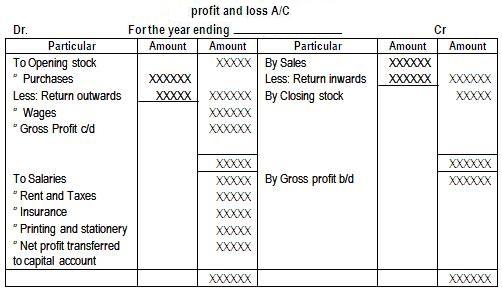
Income Statement or Profit and Loss Account – Meaning, Format and Explanation

The earning capacity and potential of the firm are reflected by the Income Statement or the Profit and Loss Account.   The profit and loss account is the “scoreboard” of the firm’s performance during a particular period of time (usually one year). Since it reflects the results of operations for a period of time, it is a flow statement.   In contrast, the balance sheet is a stock, or status statement as it shows assets, liabilities and owners’ equity at a point of time. The profit and loss account presents the summary of revenues, expenses and net income (or net loss) of a firm for a period of time. Net income is the amount by which the revenues earned during a period exceed the expenses incurred during that period.   If the firm’s operations prove to be unprofitable, total expenses will exceed total revenues and the difference is referred to Continue reading