Marine Insurance Claims

Under an ordinary marine insurance cover, if the goods have been damaged or pilfered or lost, the buyer report the fact immediately to his local agents or the local branch of the marine insurance company or to the firm of insurance assessors. They examine the goods and certify the extent of the loss. The buyer then works out his claim on the basis of the proportion which the damaged goods bear to the whole consignment. If the goods have been invoiced on F.O.B (Freight On Board) value plus the cost of marine freight, insurance, and shipping charges, the buyer is entitled to claim a proportion of such charges. The buyer would send the original insurance certificate or policy to the broker or company which issued it, with a statement of the claim and the latter would send him the money. Alternatively, the buyer may send these paper to the exporter Continue reading
Important Elements of Merger Procedure – Scheme and Valuation

Scheme of Merger The scheme of any arrangement or proposal for a merger is the heart of the process and has to be drafted with care. There is no specific form prescribed for the scheme. It is designed to suit the terms and conditions relevant to the proposal but it should generally contain the following information as per the requirements of sec. 394 of the companies Act, 1956: Particulars about transferor and transferee companies Appointed date of merger Terms of transfer of assets and liabilities from transferor company to transferee company Effective date when scheme will came into effect Treatment of specified properties or rights of transferor company Terms and conditions of carrying business by transferor company between appointed date and effective date Share capital of Transferor Company and Transferee Company specifying authorized, issued, subscribed and paid up capital. Proposed share exchange ratio, any condition attached thereto and the fractional Continue reading

Project Planning and Scheduling

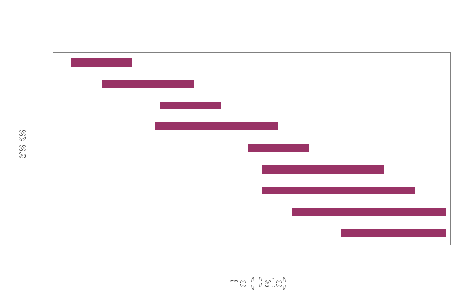
Project planning is the process of identifying all the activities necessary to successfully complete the project.   Project scheduling is the process of determining the sequential order of the planned activities, assigning realistic duration’s to each activity, and determining the start and finish dates for each activity.   Thus, project planning is a prerequisite to project scheduling because there is no way to determine the sequence or start and finish dates of activities until they are identified. Techniques for Project Planning and Scheduling The technique used for project planning and scheduling will vary depending upon the project’s size, complexity, duration, personnel, and owner requirements.   The project manager must choose a scheduling technique that is simple to use and is easily interpreted by all project participants.   There are two methods that are commonly used in project management for the purpose of project planning and scheduling: the bar chart (sometimes Continue reading

Supplier Relationship Management (SRM) – Meaning and Importance

Supplier Relationship Management (SRM) is a concept in the Supply Chain Management, which considered in the aspect of establishing and sustaining the business relationship along the supply chain. Supplier Relationship Management (SRM) concerns the practical processes to integrate the communication and coordination between organizations and their suppliers. Supplier chain relationship was considered to be one of the important factors in most business, since it can influence the potential of supply chain concept. Now, the modern business seems to be more complex with high competition. Due to the information has more valuable in the supply chain management, firms then need to re-design the ways of managing and sharing information among each others. Organizations cannot independently run the business by themselves. Not only good relationship can help companies to have more competitive advantage to survive in the market, but it can also help companies expands the market too. Supplier Relationship Management (SRM) Continue reading

Ecological Business Strategies

Ecological business strategies consist on the firm’s position vis- à-vis the natural environment; they define the firm’s relationship with nature. They describe strategies for use of environmental resources and acceptable environmental impacts of the company’s activities. Ecological strategies try to minimize long-term environmental damages by managing the company’s inputs, throughput’s, and outputs. Just as “Total Quality Management” in corporation demands attention to each stage of the design and production process, a “Total Environmental Management” perspective can optimize the performance of the total system. Every organization requires materials and energy as inputs to its production process. Primary industries such as mining, forest products, pulp and paper, and oil and gas are particularly oriented toward extraction and utilization of raw materials. Secondary (manufacturing) industries such as steel, construction, automobiles, and petrochemicals are important users of materials and energy. Service industries (e.g. health care, education, legal, consulting, etc.) maker fewer demands for materials Continue reading

What is Strategic Innovation?

Innovative thinking can be applied to the strategic planning of an organization to create new opportunities and boost market performance. Strategic Innovation is the creation of growth strategies, new product categories, services, or business models that change the market and generate significant new value for consumers, customers, and the organization. Strategic Innovation takes the road less traveled – it challenges an organization to look beyond its established business boundaries and to create possibilities in an open-minded and creative environment. It has been seen that focusing on the short-term aspects typically yields short-term results, however, firms seeking to make significant breakthroughs identify both, big and innovative ideas. Strategic Innovation calls for a holistic approach that operates on multiple levels. First, it blends non-traditional and traditional approaches to business strategy, deploying the practices of “Industry Foresight”, “Consumer/Customer Insight” and “Strategic Alignment” as a foundation, and supplementing them with more conventional approaches and Continue reading