RBI’s Role in Risk Management and Settlement of Transactions in the Foreign Exchange Market

The Indian Foreign Exchange (Forex) market is characterized by constant changes and rapid innovations in trading methods and products. While the innovative products and ways of trading create new possibilities for profit, they also pose various kinds of risks to the market. Central banks all over the world, therefore, have become increasingly concerned of the scale of foreign exchange settlement risk and the importance of risk mitigation measures. Behind this growing awareness are several events in the past in which foreign exchange settlement risk might have resulted in systemic risk in global financial markets, including the failure of Bankhaus Herstatt in 1974 and the closure of BCCI SA in 1991. The foreign exchange settlement risk arises because the delivery of the two currencies involved in a trade usually occurs in two different countries, which, in many cases are located in different time zones. This risk is of particular concern to Continue reading

Business Valuation

Business valuation is the process of assessing the worth of the enterprise which is subject to merger or takeover so that the consideration amount can be quantified and price of one enterprise for the other can be fixed. Such valuation helps in determining the  value of shares of the acquired and acquiring company to safeguard the interest of the shareholders of both the companies. The share of any member in a company is a movable property and can be transferred in the manner provided in the articles. A share represents a bundle of rights like right to elect directors, to vote on resolutions of the company, share in the surplus, if any, on liquidation etc. Valuation of shares in an amalgamation or takeover is made on a consideration of a number of relevant factors, such as stock exchange prices of the shares of the two companies, the dividends paid on Continue reading

Data storage in Management Information Systems (MIS)

Data storage is a method of operating a computer system having memory for storing and retrieving information concerning a subject, which comprises the following. (a) in the computer system memory, storing subject data concerning a plurality of subjects wherein said data includes descriptive phrases regarding various matters with which said subjects are concerned and wherein said data includes identifying information for identifying the subjects associated with said descriptive phrases; (b) assigning selected designation numbers to said descriptive phrases and storing said selected designation numbers in the computer system memory in association with the corresponding descriptive phrases and with the identifying information wherein said designation numbers correspond to a respective plurality of topics; (c) in the computer system memory, storing a plurality of topic headings with each heading being designated to include a specified range of designation numbers; (d) in the computer system, for each designation number assigned to a descriptive Continue reading

Business Model – Definition, Components, Role and Importance

Business model describes entire procedure of creation, delivery, and capturing of organizational values in both economic and social aspects. It represents core aspects of the business which include strategies, organizational structure, purpose, operational processes, policies, infrastructure, and business practices. Entire functioning of the business is based over this business model as it provides guideline to the organization to carry out all its activities. Thus there is a need to define business model of any organization at first in an explicit manner to avoid all the discrepancies at first end. Business model directly focuses over customer needs as it is this particular aspect along with product differentiation strategy, i.e. to introduce new product to make sure that company is able to capture optimum market share. This model also specifies customer groups through market segmentation to directly focus over those market sectors that will provide maximum return to the associated product. Business Continue reading

Indian Banking System: Payment and Settlement Systems

In recent years, alternate money transmission avenues, especially the development of electronic money schemes, have been gaining currency. While electronic money has the potential to take over from cash for making small-value payments, making such transactions are becoming easier and cheaper for both consumers and merchants. This raises policy issues for central banks in its role as the guardian of the payment network and implementer of the monetary policy. The emergence of peer-to-peer money transmission mechanisms poses a challenge to current role of banks as gatekeepers to traditional payment systems. Robust payment systems, therefore, are a key requirement in maintaining and promoting financial stability with technology playing both a facilitating and disruptive role in them. Reserve Bank’s initiatives for electronic payments and banking As part of its public policy objective of promoting a safe, secure, sound and efficient payment system, the Reserve Bank has taken several initiatives to develop and Continue reading

Change Kaleidoscope – Change Management Models

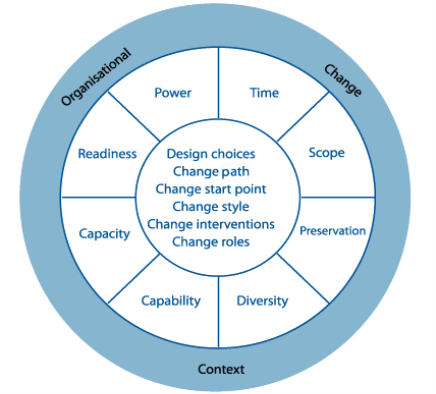
Due to growing of globalization, advance technology, and organizational consolidation, change is nowadays become a crucial part of every organization in order to survive in changing business environment. To handle the change, change management is required in transitioning for both organizational and individual level to attain future desired change. Change at organizational level is related to strategy which will indicate organizational direction and activities. In developing effective organization strategy, both internal and external environments have to be taken into consideration. When the strategy has been changed as adapting to changing internal and external environments, strategic change is necessity to be utilized in change management in order to align change with developed strategy. As individual change is pivotal part of organization change, change management need to be adopted at individual level in order to initiate the change and consequently obtain successful organization change. Change Kaleidoscope was produced by Hope Hailey & Continue reading