Change Agents in Organizational Change

Organizations and their managers must recognize that change, in itself, is  not necessarily a problem. The problem often lies in an inability to effectively  manage change : not only can the adopted process be wrong, but also the  conceptual framework may lack vision and understanding. Why is this the case?  Possibly, and many practicing managers would concur, the problem may be  traced to the managers’ growing inability to approximately develop and  reinforce their role and purpose within complex, dynamic and challenging  organizations. Change is now a way of life; organizations, and more importantly  their managers, must recognize the need to adopt strategic approaches when  facing transformation situations. Throughout the 1980s and 1990s organizations,  both national and international, strived to develop sustainable advantage in both  volatile and competitive operating environments. Those that have survived,  and/or developed, have often found that the creative and market driven  management of their human resources can Continue reading
Operating System – Meaning, Types and Functions

Operating system is the program, which usually installed into the computer by a boot program. It manages all other programs in computer. Sometimes it also called as “OS”. These programs also called applications. The application uses the operating system by making requests for services through API (Application Program Interface). Sometimes users can directly use the operating system through GUI (Graphical Users Interface) or command language. Operating system is a program that allows you to work with hardware and software on your computer. Basically, there are two ways to use operating system on your computer. The two ways are as follows: 1. for ex., DOS, you type a text commands and computer give respond to you according to your command. This is called command line operating system. 2. With a GUI (Graphical User Interface) operating system (ex., windows). You relate with the computer through graphical user interface with pictures and buttons Continue reading

Types of Costing Systems

Some costs are direct while others are indirect, direct costs can be identified to a specific products but indirect costs which are not identifiable to specific products, need to be allocated on some objective and rational basis for product costing and pricing which can be justifiable to customers. Costing systems are the systematic allocation of cost to products. It can be used for planning, decision making and control purpose as well. Budgeted figures are used for costing of products as actual prices are not known at time when prices are decided. Important Types of  Costing Systems 1. Absorption Costing System Absorption costing system is the method of allocating overheads (Fixed and variable) to products based on pre-determined absorption rate. To find the pre-determined rate total budgeted overhead cost is divided by activity level. The basis on which costs are allocated are subjective and difficult to justify. Absorption costing system gives Continue reading

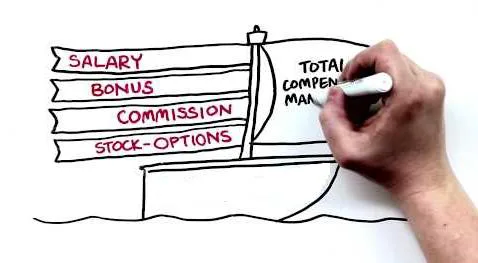
Compensation Management Process

In order to achieve the objectives of compensation management, it  should proceed as a process. The compensation management process has various sequential steps as shown: 1. Organisation’s Strategy Organisation’s overall strategy, though not a step of  compensation management is the starting point in the total human resource  management process including compensation management. Companies  operating in different types of market/product having varying level of maturity,  adopt different strategies and matching compensation strategy and blend of  different compensation methods. Thus, it can be seen that organisations follow  different strategies in different market situations and align their compensation  strategy and contents with these strategies. In a growing market, an organisation  can expand its business through internal expansion or takeover and merger of  other organisations in the same line of business or a combination of both. In  such a growing market, the inputs, particularly human resources, do not grow in  the same proportion as Continue reading

Risks of Generic Competitive Strategies

Fundamentally, the risks in pursuing the Porters generic competitive strategies are two: first, failing to attain or sustain the strategy; second, for the value of the strategic advantage provided by the strategy to erode with industry evolution. More narrowly, the three strategies are predicated on erecting differing kinds of defenses against the competitive forces, and not surprisingly they involve differing types of risks. It is important to make these risks explicit in order to improve the firm’s choice among the three alternatives. Risks of Overall Cost Leadership Strategy Cost leadership imposes severe burdens on the firm to keep up its position, which means reinvesting in modern equipment, ruthlessly scrapping obsolete assets, avoiding product line proliferation and being alert for technological improvements. Cost declines with cumulative volume are by no means automatic, nor is reaping all available economies of scale achievable without significant attention. Cost leadership strategy is vulnerable to the Continue reading

Facilities Planning – Meaning and Importance

One of the major strategy decisions that must be made by any organization is where to locate its producing and storage facilities. For manufacturers, the problem is broadly categorized into factory location and warehouse location; within this categorization, we may be interested in locating the firm’s first factory or warehouse or locating a new factory or warehouse relative to the locations of existing facilities. The general objective in choosing a location is to select that site or combination of sites that minimizes two classes or costs — regional and distribution or sites that minimizes two classes or costs — regional and distribution costs. Regional costs are those associated with a given locate and include land, construction, manpower, and state and local expenses and regulations. Distribution costs are those directly related to the shipping of supplies and products to customers and other branches of the distribution network. Since the location of Continue reading