A team can be said to be a group of people working together to achieve a goal. It can also be seen “as a limited number of people who have shared objectives at work and who co-operate, on a permanent or temporary basis, to achieve those objectives in a way that allows each individual to make a distinctive contribution”. In order team to be effective, it should have certain characteristics, listed below Sponsor: In order to have effective liaison with the quality council, there should be a sponsor. Preferably the sponsor is a member of the quality council, thereby providing organizational support. Team Charter: A team charter is a document that defines the team’s mission, boundaries, the back ground of the problem, the team’s authority and duties and resources. It also identifies the members and their assign the roles-leader, recorder, timekeeper and facilitator. The sponsor and the team negotiate the Continue reading
Human Resource Concepts
Challenges of Strategic Human Resource Management
Strategic Human Resource Management (SHRM) can be defined as a link between human resources and the strategic goals and objectives of the business. Most importantly, the aim of that is to improve business performance and to develop an organizational culture that will foster innovation, flexibility and competitive advantage. In other words, the HR function is seen as a strategic partner helping the company to implement and formulate strategies as well as reach its goals and flourish. The main activities of HR department include selecting and recruiting the right people for the job roles, training and rewarding them. Very often SHRM is being confused with HRM. SHRM has more of a long-term orientation towards objectives. It doesn’t focus on internal human resource issues; the attention is focused more on addressing and solving problems that have an effect on management programs in a long run. In other words, SHRM focuses on occurring Continue reading
Collective Bargaining and the Negotiation Process

Collective bargaining is accurately an automated relations apparatus or tool, and is an aspect of negotiation, applicable to the application relationship. As a process, the two are in essence the same, and the attempt applicative to negotiations is participation ant to aggregate bargaining as well. However, some differences charge to be noted. In aggregate bargaining the abutment consistently have an aggregate absorption back the negotiations are for the account of several employees. Area aggregate bargaining is not for one employer but for several, aggregate interests become affection for both parties to the bargaining process. In negotiations in non-employment situations, aggregate interests are less, or non-existent, except when states accommodate with anniversary other. Further, in labor relations, negotiations absorb the public absorption such as area negotiations are on accomplishment, which can papules on prices. This is around accustomed back an affair or the parties seek the abutment of the public, especially Continue reading
Sources of Stress
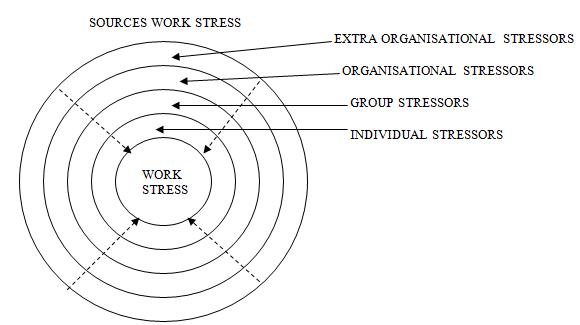
Stress is a reality of our everyday life. There are both distresses and distresses that come from our work and non work lives. It was pointed that the work and non work domains of one’s life are closely interrelated. Thus, if one experiences much distress at work, that stress will be carried over to the home, which will increase the sense of awareness of even small distresses experienced in a family sphere. Likewise, stresses experienced at home or with friends or from other non work situations can be carried over to the work place which might heighten and multiply the stresses experienced at work. Thus, we can say that stresses generate from four sources : Extra-organisational stressors Organisational stressors Group stressors Individual stressors. The following figure summarizes the sources of stress. A. Extra Organisational Stressors Job stress is not limited to things that happen inside the organisation, during the working Continue reading
Importance of Performance Appraisal Systems
Performance appraisal is the assessment of an individual’s performance in an organization in a systematic way, the performance being measured against such factors as job knowledge, quality and quantity of output, initiative, leadership abilities, supervision, dependability, co-operation, judgment, versatility etc. assessment should not be confined to the past performance alone. Potentials of the employee for the future performance must also be assessed. Performance appraisal can be defined as “the systematic evaluation of the individual with respect to his or her performance on the job and his or her potential for development”. A more comprehensive definition is, “Performance appraisal is a formal structured system of measuring and evaluating an employee’s job and how the employee can perform effectively in future so that the employee, organization all be benefited.” Performance appraisal, to common understanding, is the formal and informal assessment of the performance of the employee at work. In an informal system Continue reading
Achieving Competitive Advantage through Human Resource Development
Human resource development is defined as the framework for helping employees develops their personal and organizational skills, knowledge and abilities. Human resource development involves using a range of learning and training techniques and strategies to change the work related behavior and attitudes of an employee and it also engages in performance management in other to ensure that people can do things well or do new and better things. Human resource development is concerned with enhancing organizational performance through effective development and deployment of organizational members. To enhance performance, a human resource developer has to ensure that the individuals in the organization has the knowledge, expertise and the right attitudes to execute their work, also human resource development aims at ensuring that the organization has the skilled, committed and well-motivated employee it needs to sustain competitive advantage by focusing on processes that develop skills, knowledge and the attitude of the employee, Continue reading