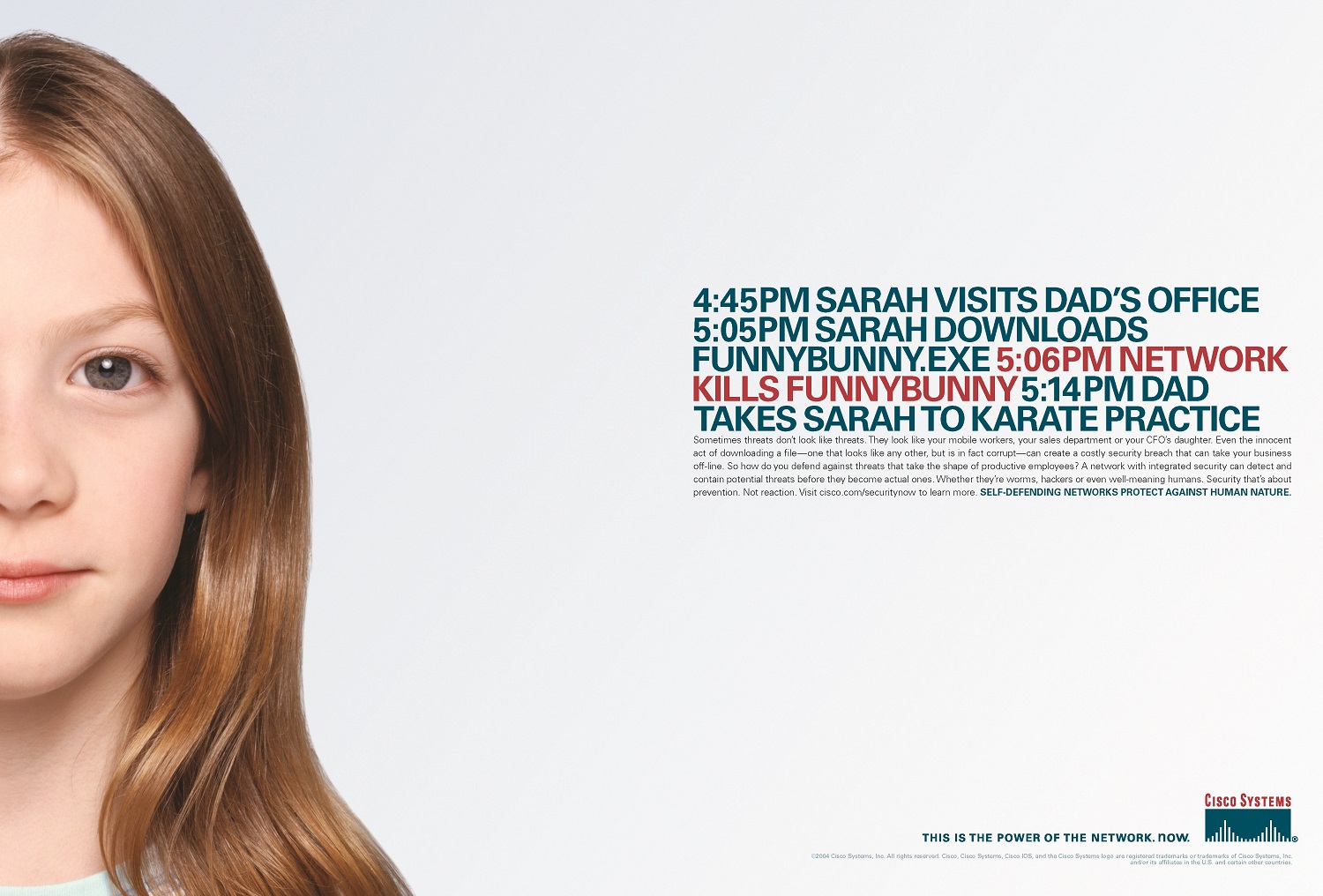
Besides being one of the NASDAQ’s fastest-growing stocks during the late 1990s, Cisco was also the world’s leading producer of switches and routers that directed traffic across the Internet. In 1998 Cisco released advertising that encouraged Internet usage, which in turn increased the demand for Cisco’s hardware. Two years later Cisco’s ad agency, Hill, Holliday, Connors, Cosmopulos, Inc., introduced a $43.8 million campaign with the tagline ‘‘Empowering the Internet generation.’’ The campaign’s television spots, including one titled ‘‘Factory,’’ featured Cisco’s hardware increasing businesses internet usage, which indirectly boosted the businesses profits. After the technology sector plummeted in late 2000, Cisco did not release a campaign for almost three years. In June 2002 Cisco awarded its advertising account to DarkGrey, the technology unit of Grey Global Group. For its first few months doing business with Cisco, DarkGrey developed a campaign with the tagline ‘‘Advancing the human network.’’ None of the DarkGrey Continue reading
Marketing Strategies
Case Study: “Intel Inside” Campaign by Intel
Initially the motivation behind the branding of Intel Inside was to establish the company by name and identify the high performance products that were used inside the computer with the company. This was in an effort to create an image for a company which often was subjected to behind the scenes and specific industry awareness, but wanted to establish it’s brand presence to the general public. Intel created a consumer brand to make sense of the rapidly changing computer cycles. The technology giant had already established a reputation as a quality brand throughout the technology world, however, their aim was to spread awareness and create a positive image for themselves in the public eye. The success of Intel can be attributed to many factors over their rise to the top of the technology world. First, they established a co-op advertising program to start attracting original equipment manufacturers and place their Continue reading
The Cultural Framework of International Marketing

Culture defines the people’s “way of life”, meaning the way they do things. Culture could be related to a specific country, a section of community or within an organization. A people’s culture includes their beliefs, rules of behavior, language, rituals, art, technology, styles of clothing, ways of producing and cooking food, religion, and political and economic systems. Culture is not inherited genetically; it must be learned and acquired. Socialization occurs when a person absorbs or learns the culture in which he or she is raised. Marketing research should take into account the local culture of the country in which you wish to market. How marketing efforts interact with a culture determines the success or failure of a product. Advertising and promotion require special attention because they play a key role in communicating product concepts and benefits to the target customer. Terpstra & Sarathy (2000) stated that Understanding the cultural environment Continue reading
Case Study of GUCCI: Transformation of Luxury Branding

Guccio Gucci opened a small shop selling leather goods on the via del Parione in Florence in 1923. He sold luggage imported from Germany and offered customers with repair services. As the luggage business prospered, he opened his own workshop to produce his own design. The business in the 1920’s created huge profit and success however in the 1930’s Gucci began to face some challenges when the sanctions imposed on Mussolini. He faced shortage of imported leather yet this challenge gave him innovated idea of using new materials such as canvas and produced small leather goods, wallets and belts that are still big part of the Gucci company. Gucci became an internationally known luxury brand after World War II and over the next two decades the company flourished. In the1970s Gucci began to fall down due to internal conflict. Most of the conflict was between Aldo and Rodolfo Gucci, the Continue reading
Case Study: Tata Salt’s Advertisement Campaign

The ‘Meine desh ka namak khaya hai’ TATA advertisement campaign in 2002 offered viewers an instant connection. In India, salt and loyalty have been associated from time immemorial. ‘Namak halal” and “Namak Haram” are commonly used terms for honest and dishonest people respectively. According to cultural connotations, after consuming salt at a person’s house the one who has consumed the salt should not cheat his/her host. The campaign connected with the consumer at an emotional level. TATA Chemicals Ltd (TCL) started manufacturing salt in 1939 after establishing a solar salt works at Mithapur, Gujarat. It pioneered the concept of iodized and vacuum-evaporated salt in India in the early 1980s and created a need that was not felt by consumers before. Interestingly, the opportunity came accidentally, when in 1983, the company needed fresh water for its boilers that produced soda ash at its Mithapur plant in Gujarat. Continue reading
Case Study of KFC: Establishment of a Successful Global Business Model

By mid 1950s, fast food franchising was still in its infancy when Harland Sanders began his cross-country travels to market “Colonel Sanders’ Recipe Kentucky Fried Chicken.” He had developed a secret chicken recipe with eleven herbs and spices. By 1963, the number of KFC franchises had crossed 300. Colonel Sanders, at 74 years of age was tired of running the daily operations and sold the business in 1964 to two Louisville businessmen — Jack Massey and John Young Brown, Jr. — for $2 million. Brown, who later became the governor of Kentucky, was named president, and Massey was named chairman. Colonel Sanders stayed in a public relations capacity. In 1966, Massey and Brown made KFC public, and the company was enlisted on New York Stock Exchange. During late 1960s, Massey and Brown turned their attention to international markets and signed a joint venture with Mitsuoishi Shoji Kaisha Ltd. in Japan. Continue reading