
With the proliferation of opinionated content on the web, this particular application of natural language processing – Sentiment Analysis (Opinion Mining) is used to determine the sentiment of the given speech or text is gaining more popularity. In layman’s term sentiment analysis aims at identifying and classifying spoken words or written text as positive, negative or neutral. What is Sentiment Analysis? In the field of Natural language processing, sentiment analysis also known as opinion mining is task of classifying a given text as positive, negative or neutral based on the opinion or subjectivity of the text. Sentiment analysis can be considered a sub filed of text classification which involves classifying a text in to predefined categories. Sentiment analysis can be used to evaluate the attitude of the people about a topic, comments of Facebook posts, tweets, product review, political agenda, review sites, etc. Once important characteristics of sentiments and opinions Continue reading
Modern Management Approaches
Carroll’s Pyramid of Corporate Social Responsibility
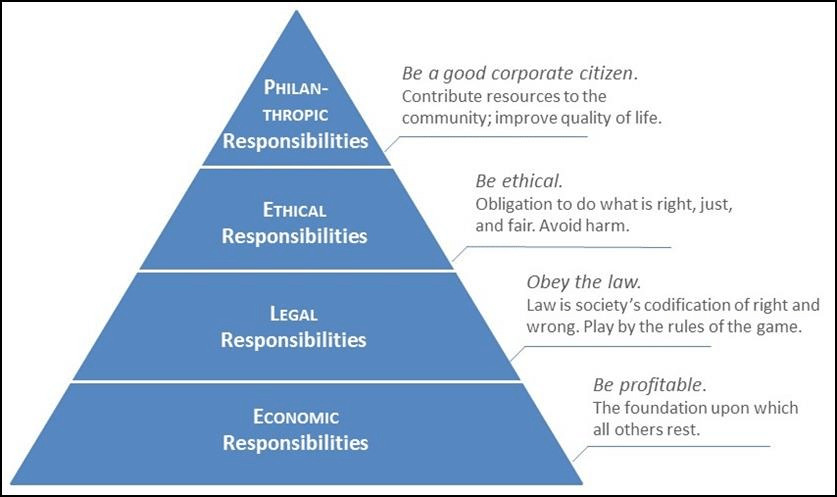
In the past, the common perception of a business responsibility was to maximize their firm’s profit. This is because businesses were perceived to always put the shareholder interests first. However, businesses are moving towards impacting the socials and environments. Several studies have found that businesses now have direct responsibilities to various other stakeholders which include preventing the harm of human rights and ensuring that there are solutions available if abuses occur. The modern view of business responsibility demands companies to help in problems relating to public welfare. As firms have no utmost responsibility for these unpleasant situations, philanthropic responsibilities are still not mandatory. However, due to a decrease of social institutions that provide help to the communities, people have higher expectations towards company and believe that they should take part in filling up the shortages. Carroll has proposed a CSR concept, Carroll’s Pyramid of Corporate Social Responsibility, which states the Continue reading
Emotional Intelligence in the Workplace
At the work place the ability to exercise clear and sound judgement in situations that the jobs role presents solely depends on the emotional intelligence employees possess. It encompasses the ability to manage their own impulses, cope with change, effectively communicate with others, and solve problems and being able to make use of humor to defuse a tense situation. Such employees have the ability to empathize with others, are optimistic in the face of down turns and are effective in resolving customer complaints. Therefore emotional intelligence plays a vital role in separating top performers from weak ones at the work place. At the work place certain emotional quotient competencies correlate with each other to make it a successful place, such competencies include; 1. Social Competencies Social competencies describe a person’s ability to handle relationships. Inherent in the person is the awareness of the feelings and concerns of others. The social Continue reading
Triple Bottom Line (TBL or 3BL)

The concept of Triple Bottom Line (TBL or 3BL) is a popular concept that has been applied in the understanding of social duties among companies that are looking forward for the incorporation of non monetary values in their businesses. Its notion has become of much fashion in management, investing and management over the last few years. It has been explained that the ultimate success of corporations ought to be measured not just by the use of traditional financial bottom line, but need also to be measured by on the ethical and environmental factors. In fact most individuals have accepted that, organizations have a lot of responsibilities to their stakeholders to have responsible behaviors. In addition, it is also true that, it is not possible for firms in the long run to be successful if they disregard key stakeholders interests. Its apparent novelty lines in the contention of its supporters that Continue reading
The Business Applications and Benefits of Business Intelligence

Business Intelligence or BI is a computer-based system which is used by organizations for decision making purpose. It consist of huge data warehouse or data marts of business data, from which it performs mining, spotting, digging or analyzing operations to produce appropriate results or reports. BI applications include a wide range of activities for statistical analysis, Data mining, querying and reporting, business performance analysis, benchmarking, Online Analytical Processing (OLAP), Decision Support System (DSS), forecasting and predictive analysis. It provides organizations with meaningful information regarding employees, customers, suppliers and other business associates, which can be used in effective decision making. Applications of Business Intelligence The implementation of business intelligence helps organizations to achieve their goals in an effective way. Its application is not restricted to limited segments. It has a wide-spread use. It has now become mandatory for organizations to implement BI to sustain and maintain their market share in the Continue reading
Salovey and Mayer’s (1990) 10 Original Facets of Emotional Intelligence

Emotion is a relatively difficult concept to clearly delineate but it is generally accepted that it is an organised mental response that includes physiological, experiential and cognitive aspects. Emotions are largely, but not exclusively, related to interpersonal relationships and specific emotions are relatively resistant to cultural and individual differences, although these can affect the way in which emotions are expressed or perceived. Personal intelligence is defined as the feelings and emotions of oneself and the ability to understand and interpret these feelings in order to guide behaviour. This can be expanded into emotional intelligence by including the application of this knowledge to other people and also to regulate actions based on it. The term emotional intelligence (EI) per se was coined in 1990 by Salovey and Mayer. The term EI applies to an ability to process emotional information in an appropriate way, with a balance being achieved between emotion and reason. Continue reading