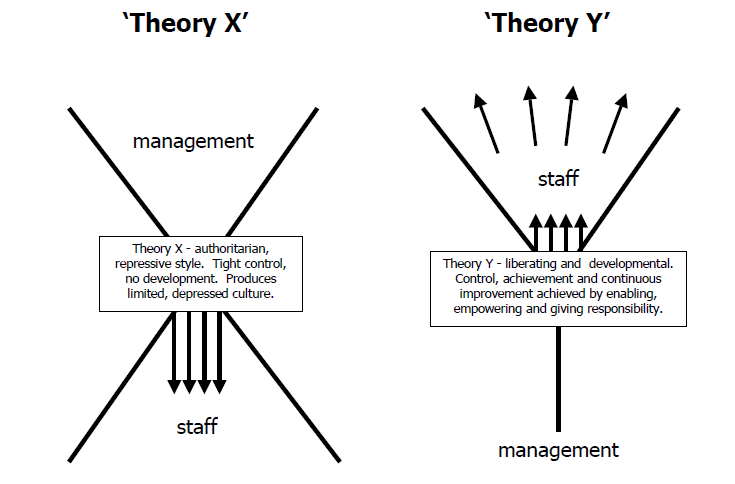
Douglas McGregor who set forth in his book “Human Side of Enterprise” two pairs of assumptions about human beings which he thought were implied by the actions of autocratic and permissive managers. The first set of assumptions is contained in “Theory X” and the second set of assumptions in “Theory Y”. It is important to note that these sets of assumptions were not based on any research, but is intuitive deductions. Theory X: Theory X’ believes that autocratic managers often make the following assumptions about their subordinates. Accordingly, the subordinate in general: Has an inherent dislike for work and will avoid it, if he can; Is lazy and avoids responsibility. Is indifferent to organisational goals; and Prefers to be directed, wishes to avoid responsibility, has relatively little ambition and wants security above all. According to McGregor, this is a traditional theory of what workers are like and what management must Continue reading
Management Concepts
Advantages and Disadvantages of Franchising Business
Franchising is a style of business which has a lot of different but same branches throughout the world. Franchising business is an arrangement for a continuing relationship in which one party – a franchisor provides an accredited opportunity to another party – the franchisee to do business using its trade name and offers assistance in organizing, training, producing, marketing and managing a good or service in adherence to certain specifications, in return for monetary exchange. The franchisee usually pays a one-time franchise fee plus a percentage of sales revenue as royalty, and in turn gains instant name and recognition, tried and tested products, standard infrastructural design and interior decor, detailed techniques in running and promoting the business, training of employees and on-going help in promoting and improving the product The advantages of franchising from the franchisee’s point of view are myriad. First, the franchisee can benefit from the widely recognized Continue reading
Tuckman’s Team-Building Model

Forming – Storming – Norming – Performing is a model of team development, first proposed by Bruce Tuckman in 1965, who maintained that these phases are all necessary and inevitable in order for the team to grow, to face up to challenges, to tackle problems, to find solutions, to plan work, and to deliver results. He added a fifth stage, Adjourning, in the 1970s. The Forming Storming Norming Performing theory is an elegant and helpful explanation of team development and behavior. Tuckman’s team-building model explains that as the team develops maturity and ability, relationships establish, and the leader changes leadership style. Beginning with a directing style, moving through coaching, then participating, finishing delegating and almost detached. According to Tuckman, all of the phases are necessary and inevitable. In order for the team to grow they most face up to challenges, problems, find solutions to problems, planning as a team, and Continue reading
Concept of Organizational Climate
Organizations are social systems. Organizations combine science and people, technology and humanity. It is not possible for every organization to have the same type of technology and people and so the organizations differ in their characteristics and internal environment. The internal environment of an organization may be called the organizational climate. Organizational climate, a guide for dealing with people serves as a major influence on motivation and productivity of individuals and total work force. Organizational climate may be noted as the ‘personality’ of an organization as conceived by its employees. The organizational climate usually has a major influence on motivation, productivity and job satisfaction. The organizational climate is the major motivating factor responsible for satisfaction and dissatisfaction of employees in an organization and affects the quantum of employees’ turnover and satisfaction. It refers to the entire social system of a working group. Campbell defines organizational climate as a “set of Continue reading
Risk Management in Business
Kaplan and Garrick (1981, p. 12) provide a simple equation for risk, which is “risk = uncertainty + damage”. They believe that it is irrelevant as to what context risk exists in, and that the same equation can always be used to identify and manage risk. However, risk can still be categorized differently depending on what facet of the organization it is affecting. Before a risk management strategy can be decided upon, the risk event must first be identified. An organization should conduct three steps before deciding on the best risk management strategy to use. As risk management can use a substantial amount of resources, clarification and direction should be decided upon before conducting risk management. The three factors are; Identification of the risk: The organization should first review all of the possible risk sources. Furthermore, they could use a risk assessment tool to identify the risk event that may Continue reading
Knowledge – Definition and Types
Knowledge is a very slippery concept with many different variations and definitions, each of which is valid in its own right. The nature of knowledge and what it means to know something are epistemological questions that have perplexed philosophers for centuries and no resolution looms on the horizon. According to Webster’s Dictionary, knowledge is “the fact or condition of knowing something with familiarity gained through experience or association”. In practice, though, there are many possible, equally plausible definitions of knowledge. A frequently used definition of knowledge is “the ideas or understandings which an entity possesses that are used to take effective action to achieve the entity’s goal(s). This knowledge is specific to the entity which created it.” There are two basic kinds of knowledge in an Organization: Explicit and Tacit. Explicit knowledge is knowledge that has been articulated and, more often than not, captured in the form of text, tables, Continue reading