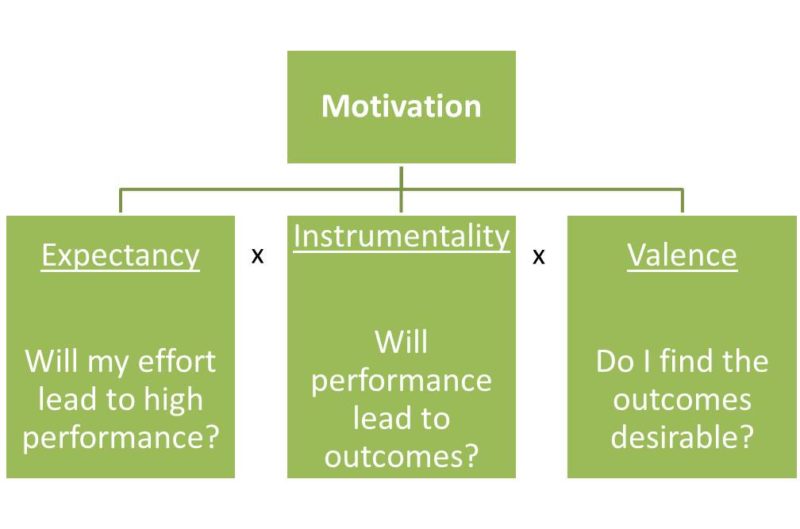
Vroom’s expectancy theory was originally developed by Victor H. Vroom, a Canadian psychologist, in 1964. Attacking Herzberg’s two-factor theory, Vroom offered an expectancy approach to the understanding of motivation. According to him, a person’s motivation towards an action at any time would be determined by an individual’s perception that a certain type of action would lead to a specific outcome and his personal preference for this outcome. Vroom’s expectancy theory consisted of two related models – the valence model and the force model. The valence model attempts to capture the perceived attractiveness, or valence, of an outcome by aggregating the attractiveness of all associated resultant outcomes. The force model of expectancy theory attempts to capture motivational force to act by associating the expectancy of resultant outcomes and their individual valences. These two models gave Vroom the opening to build his expectancy theory to the level that it is today most Continue reading
Management Concepts
3 Common Types of Organizational Structure
Organizational structure is the internal, formal framework of a business that shows the way in which management is linked together and how the authority is transmitted. It is basically a framework used to describe the hierarchy in an organisation. Every business needs to have their own organizational structure as it helps in identifying the job at each level of an individual followed by its functions and it also assists in obtaining their own goals for development. There is a need for every type of organisation to have their own structure specially when it comes to large enterprises as it becomes difficult activities of the various departments and functions. A business will opt for an organisation structure which is best suited to them and the way they would like to be working, and the chart they create will reflect this. A flat organisation is one that has eliminated most or all Continue reading
Six Elements of Organizational Design
Organizational design is a process of developing and changing the organization’s structure by its managers. It is a chart containing the reporting structure i.e. who reports to whom. Organizational structure is thus a framework on which an organization is patterned for coordinating and carrying out organizational tasks. Organizational design involves decisions about the following six elements: 1. Work Specialization: Work specialization describes to which the overall task of the organization is broken down and divided into smaller component parts. For example, one person would paint a wall and another person fixes a door. So by breaking jobs up into small tasks, it could be performed over and over every 10 seconds while using employees who had relatively limited skills. The main thought of this process is that the entire job is not done by an individual and it is broken down into steps, and a different person completes each step. Continue reading
Importance of Decision Making in Management
Decision making is a process of selecting the best course of action from among many alternatives. It is useful for the successful operation of organizational activities. All the managerial functions such as planning, organizing, directing and controlling are determined by the decision. The following points describes the importance of decision making in the organization. 1. Pervasive Function Decision making is essential in each level of management. Top level management makes strategic decisions such as planning, organizing, directing and controlling. Middle level management makes tactical decisions such as division of works, fixation of authority and responsibility, integration of efforts etc. Operating level management makes regular operating decisions such s preparation of schedule of daily works, divisions of works, delegation of authority etc. Thus, decision making function is performed in all the levels of management according to needs. This is necessary to bring uniformity and smoothness in the organizational performance. 2. Indispensable Continue reading
Management by Objectives (MBO) Derivatives
One of the pre-requisites for effective implementation of Management by Objectives (MBO) is a clear thinking at the corporate level translated into long-term plans. Many organizations have over the years, implemented MBO and improved their operations and performance. Effective implementation of MBO requires a good reporting system. This is necessary for taking timely remedial action in case of deficiency is noticed in any area. As organization grows in size, this reporting system becomes complex and time consuming. It may not be possible for top management to directly supervise each and every activity at lower interested in critical activities rather than every activity. Thus, as a bye product of MBO, large organizations introduced what is called Management By Exception (MBE). In this management technique, higher levels of management will concentrate only on exceptional situations, i.e., critical areas. Both MBO and MBE are scientific forms of management. However, they can be successful Continue reading
Management Planning and Control
The essence of the management process is decision-making. Decision making is an unavoidable and continuous management activity. It may be directed towards some specific objectives, or it may result as a reaction of environmental factors as they occur. The decision-making process should be both efficient and effective. It would be effective when management’s objectives are achieved. It is said to be efficient when objectives are realized with the minimum use of resources. The process of decision-making involves two basic management functions of planning and control. Planning Function of Management The decision-making process starts with planning. Planning is a statement of what should be done, how it should be done and when it should be done. It is the design of a desired future state of an entity and of the effective ways of bringing it about. Its basic purpose is to provide guidelines for making decisions. Continue reading