
Organizational change is described as the shift of the behavior of the whole organization, to one degree or another. One should understand that change is not that can immediately occurs, ought to be intended and planned process to maintain an organization practical and existing. Three categories of organizational change are; Development change is that change where organization try perform better what they all ready performing. Transitional change is that change in which organization implement totally new methods replacing old ones. Transformational change is that change where organization do major overhauling of its structure, vision and strategy and change bring evolution in the organization. Managing culture in the organization is very important these days when every day new technology is coming and there is so much competition in the market to stay on the top. Organizations are going through a big cycle of cultural change these days from daily tasks to Continue reading
Management Concepts
The Competing Values Framework
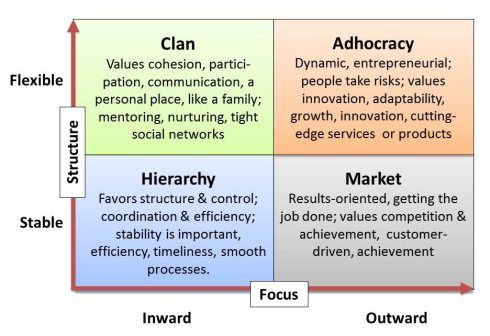
Competing models of management refer to those models that attempt to explain the competing value framework of organizational management. The organizational management sometimes faces the management challenge of balancing between two or more important processes that affect the operation of an organization. The competing values framework is a model that was developed by Robert Quinn and Kim Cameron to assess the organizational culture. The theory of competing values framework, in essence, shows the interrelationship between processes that enable the organization to focus on the internal environment or external environment. The area of focus of an organization leads to the development of the organizational culture and often results in a balancing of two or more competing value factors. This implies that the organizational competing values framework models have a role in the success of an organization. The competing values framework can be used in constructing an organizational culture profile. An organizational Continue reading
Evolution of Workplace Spirituality Concept
Spirituality at work is the recognition that employees have an inner life that nourishes and is nourished by meaningful work that takes place in the context of community. Thus spirituality at work has three components: the inner life, meaningful work, and community. Conditions for community include items that assess the extent to which necessary elements or enabling conditions for community are present. Thus, a community is a place in which people can experience personal growth, be valued for themselves as individuals, and have a sense of working together. Meaning at work includes items that capture a sense of what is important, energizing, and joyful about work. That is, it taps into work-related dimensions of human experience that are neither physical nor intellectual, but spiritual. Inner life is composed of items that capture an individual’s hopefulness, awareness of personal values, and concern for spirituality. Five societal trends have formed the basis Continue reading
Critical Evaluation of Henry Fayol’s Principles of Management
Henri Fayol was a pioneer in developing the theories of management and published the leading book, ‘14 Principles of Management’. It was one of the first books of its kind to be published about management and to this day Fayol is known as the father or modern management. Fayol was instrumental in establishing original ways for mangers to guide their employees towards being more efficient in achieving goals. He is widely considered to be one of the most important theorists of his time and some of his ideas are still applied to modern day management. The first principle hypothesized by Fayol was the one of division of labor. Fayol argued that efficiency can be maximized by distributing tasks to employees according to their specialization or by achieving specialization through repetition. This theory is applicable to businesses who have many or even few employees. The theory suggests that work should not Continue reading
Employee Resistance to Change
Change comes from anywhere, and is the only constant. Propelled by the driving force of technology and globalization, the economic landscape continuously transform in a way that has come to undermine the relevance of received wisdom on how a firm should be managed and what underlies its success. In this new millennium, it is more challenging for an organization to sustain its competency or even survive in the diversity market. When an organization is threatened by environmental changes such as crisis or competition, it results in the increasing needs for communication as technology develops rapidly and higher customer demands will be foreseen. Organizational change is not an option; it constitutes a fundamental necessity for success within the new competitive landscape. An organization need to evaluate its performance and review its business strategies, corporate structure, operational process and HR policies to identify the areas that need transformation. To maintain its competitive Continue reading
Six Elements of Organizational Structure
An organizational structure is a diagram displaying the hierarchical arrangement of lines of authority, roles and duties within an organisation and how they relate to one another. A structure is dependent upon the objectives and strategy of which the organization is focussed on. There are six basic elements of an organizational structure: Specialisation Departmentalisation Chain of Command Span of control Centralisation and Decentralisation Formalisation Work specialization gives employees specific duties and roles they are expected to perform within the company, factoring in their qualifications and skills. Having descriptions of duties for staff members helps the organisation to fully meet the workforce needs and to ensure there are no unnecessary duplications within roles. Departmentalization refers to how the organisation breaks down the functions and teams needed to run the company and carry out the essential tasks. Departments are usually made up of staff members who perform similar tasks in the same Continue reading