Importance of Customer Service in Supply Chain Management

Supply chain is basically considered as a strategic concept that involves understanding and managing the sequence of activities -from supplier to customer-that add value to the product supply pipeline. The role of customer service in the supply chain management is not incidental. Every company in this chain, irrespective of market size mainly they thankful to its customers as the fact is that in all profit of firm there are customers are in center whom to buy the goods and services produced by each one of them. This century marks the end of monopolies and therefore customers can make an array of choices. When customers decide not to buy products in a particular supply chain, then no doubt the company would collapse without earning any revenue for the expenses incurred in launching the product on the stage of saturation and decline stage. So, the supply chain should be structured in such Continue reading

Introduction to Market Segmentation

Market is composed by the customers and sellers, and different customers may have different needs, characteristics, behavior or buying attitudes. Each customer is a separate entity, they have unique wants. Therefore, sellers may divide a market into different groups of individual markets. Every consumer group is a market segment, each segment are the tendency of buyers with similar wants or needs. They divide the market into distinct groups who have distinct needs, wants, behavior or who might want different products and services. This action is known as marketing segmentation. The modern concept of market segmentation was put forward by Phillip Kotler, who states that market segmentation is the “sub dividing of a market into homogenous subsets of customers, where any subset may be conceivably be selected as a market target to be reached with a distinct marketing mix“. It is a concept in economics and marketing. Marketing segmentation is marketers Continue reading

Open Systems Interconnection (OSI) Model

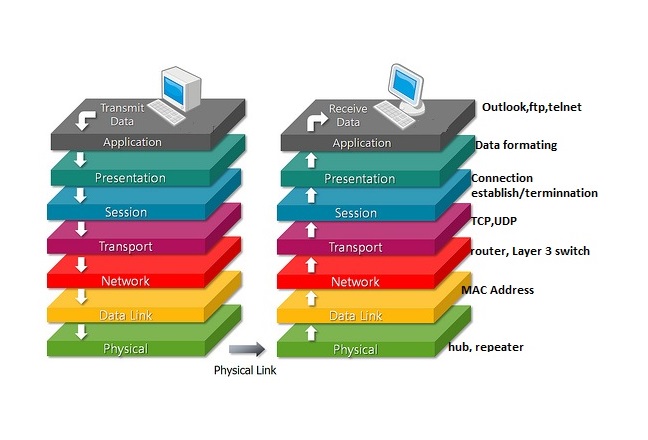
Open Systems Interconnection (OSI) model is a reference model developed by ISO (International Organization for Standardization) in 1984, as a conceptual framework of standards for communication in the network across different equipment and applications by different merchants. It is now considered the primary architectural model for inter-computing and inter-networking communications.  There are seven layers within the OSI model that serve to differentiate the various hardware and software functions that a network provides. Each layer depends on the proper functioning of the layer immediately below it to provide its raw functionality, which is enhanced and then passed to the next higher layer. Status messages may be communicated up or down the various layers, although each layer only communicates with its immediate neighbors. As each layer is solely dependent on the layer below it for lower-level services, higher layers are shielded from system, hardware, and software implementation details. This leads to the Continue reading

Planning Function of Management – Definition and Features

Planning is the process of deciding in advance what is to be done, who is to do it, how it is to be done and when it is to be done. It is the process of determining a course of action, so as to achieve the desired results. It helps to bridge the gap from where we are, to where we want to go. It makes it possible for things to occur which would not otherwise happen. Planning is a higher order mental process requiring the use of intellectual faculties, imagination, and foresight and sound judgment. Accounting to Koontz, O’Donnell and Weihrich, “planning is an intellectually demanding process; it requires the conscious determination of courses of action and the basing of decisions on purpose, knowledge and considered estimates. Planning is a process, which involves anticipation of future course of events and deciding the best course of action. It is a Continue reading

How Do You Start a Business?

The journey of establishing your own business is a whirlwind of excitement, daunting decisions, and significant rewards. The path to business ownership requires careful planning, meticulous attention to detail, and a tremendous amount of grit. Whether it’s developing a stellar idea, securing financing, or overcoming challenges, we have comprehensive insights to guide you. Keep reading to learn the strategic steps to take when starting a business. Recognizing the Need for a Business Plan Every successful business begins with a proficient business plan. A business plan encapsulates your business goals, research on potential markets, and strategies for reaching your target audience. It serves as a blueprint for your business journey. Equally critical is determining your business financing. This step could involve a variety of options, including self-financing, attracting investors, or determining how to get a loan to start a business. Remember, a well-structured business plan can make the difference between a thriving Continue reading

Major Perspectives of Information Organization

People understand information organization from four main perspectives, viz. data, relationship, operating system, and application architecture. The data perspective of information organization In the data perspective, people consider the organization of data in terms of their descriptive and graphical elements. Therefore, the two elements possess distinctive features necessitating different storage requirements as well as storage options. A person thus needs to understand the correct sequence in which entities occur and build up until they eventually form a data file. A data item that falls under descriptive data is one of the most basic elements in the organization of information. It is the smallest unit of storage in a database and it goes by the term ‘stored field’ in the database terminology. It may appear in the form of a number, date, an expression, or character string. A group of related data items forms a record and often appears in the Continue reading