Clubbing of Income Under Income Tax

An assessee may reduce his tax liability by transferring his assets in favor of a person who is related to him. As per [Sec 60] to [Sec 64], income belonging to some other person will be taxed in the hands of the assessee in certain situation for the purpose of avoiding tax evasion. This is called   clubbing of income. Transfer of income without the transfer of assets: Income arising to nay person by virtue of any transfer of any income, without transferring the assets is deemed to be the income of the transferor and is taxable in his hands. The transfer may be revocable or not. There is no exception to this rule. Revocable transfer of assets: Any income arising to any person from an asset as a result of revocable transfer of asset shall be deemed to be the income of transferor. As per [Sec62] the income revocable Continue reading
Learning Organization – Characteristics, Benefits and Limitations

The phenomenon of globalization has turned the business world into a global dynamic village for business exchanges. Indeed, competition is becoming increasingly fiercer and simultaneously using Learning Organization as a strategy has become a MUST for companies’ success and development. Adopting such strategy helps organizations to innovate and acquire knowledge in order to survive and thrive in the current rapid changing environment. Some key definitions by distinguished writers on Learning Organization are as follows: “The essence of organizational learning is the organisation’s ability to use the amazing mental capacity of all its members to create the kind of processes that will improve its own”- Nancy Dixon “A Learning Organization is one that consciously manages its learning processes through an inquiry-driven orientation among all its members”- Kim D. “A Learning company is an organization that facilitates the learning of all its members and continually transforms itself”- M. Pedley, J. Burgoyne and Continue reading

Quantitative Strategic Planning Matrix (QSPM)

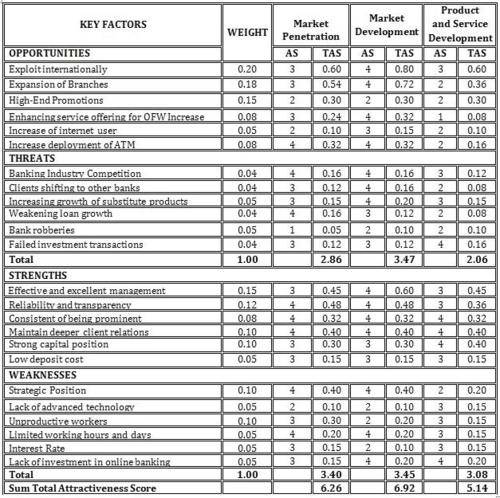
Quantitative Strategic Planning Matrix (QSPM)  is a strategic management tool used  in the evaluation of strategic options and determination of relative attractiveness of strategies.  The QSPM technique determines which of the selected strategic options is feasible, and it actually prioritizes these strategies. A basic tenet of the QSPM is that firms need to systematically assess their external and internal environments, conduct research, carefully evaluate the pros and cons of various alternatives, perform analyses, and then decide upon a particular course of action. The Quantitative Strategic Planning Matrix (QSPM)  consists of three stages that  are used in the strategies formulation process. The first step is to define key strategic factors. Then, once this has been determined, a SWOT analysis, or other similar form of analysis, is performed to objectively weigh the pros and cons of each strategic factor in numerical form. Finally, based on the information found in the analysis, a Continue reading

Project Financing – Financing Options For Projects

Project advisory services falls under one of the core branches of corporate advisory services. It deals with the decision of financing a project based on its strength of assuring the future cash inflows. In other words Project financing deals with financing a project, which can in turn generate return for its stakeholders and help in repaying the interest and loan on the proposed project. The assets used for undertaking that project are used as collateral for financing that project. The following constitute the differences between project financing and the other types. In project financing, the lenders look at the strength of the project to perform and generate sufficient returns to serve the interest and loan on that project. Even if the assets are taken as collateral, they may not be able to cover the entire loan through the sale of assets. Hence the lenders mainly look about the profitability of Continue reading

Importance of Innovation to Project Management

Project management can be defined as a process of application of the knowledge skills and different experiences of the project manager and the team members in order to achieve the objectives identified for the project. The concept of project management can therefore be defined as a systematic process of ensuring that a project is implemented according to the project plan. Proper project management is needed in an organization or a particular project is order to ensure proper project tracking and management of the associated risks of the project. There are a number of reasons why project management is needed in an organization. With the use of the project management approach, the proper project plan can be developed. The different project management methodologies ensure that a proper project schedule and a project plan is implemented. The project management further enforces and encourages team work so that a task can be completed Continue reading

Activity-Based Costing for Small and Service Industries

Activity Based Costing (ABC) is an accounting method that assigns costs to activities according to their use of resources, rather than products or services. This enables resources and other related costs to be more accurately attributed to the products and the services which they use. It does not change or eliminate any costs, in the other way; it provides detailed information on how costs are consumed. The main benefits of Activity Based Costing are providing understanding into the fastest growing and least visible element of cost-overhead. We can also improve profitability by monitoring total life-cycle cost and performance so that we can improve the effectiveness of budgeting by identifying the cost of different service levels. In addition, ABC costing does encourage continuous improvement and total quality control because control and planning are directed at the process level and it links the corporate strategy to operational decision making. By using ABC Continue reading