Planning and conducting interviews

Before meeting for an interview, both the interviewer and the interviewee have to make planning and preparation. Many job interviews are failures because either the applicants or the interviewer lack the skills of planning for them. The interviewer must have clear and detailed information about the post for which the candidates are to be interviewed. He should be in a position to tell the candidate the working conditions, details of job operations and other responsibilities. He has to make proper seating arrangement for the candidates in such a way that they may feel relaxed in the waiting room before facing the interviewer. He should know what type of candidate is required for the job. He must have the bio-data of all the candidates who might attend the interview. Similarly, the applicants too must prepare themselves for the interview situation. He has to know his own abilities in carrying out the Continue reading
What is Seed Capital?

Seed capital means the initial capital used to start a business.  Seed capital often comes from the company founders’ personal assets or from friends and family.  The amount of money is usually relatively small because the business  is still in the idea or conceptual stage.  Such a  venture  is generally  at a pre-revenue stage and  seed capital is needed for  research & development, to cover initial operating expenses  until a product or service can start generating  revenue, and to attract the attention of venture capitalists. Seed capital is needed to get most businesses off the ground. It  is considered a high-risk investment, but one that can reap major rewards if the company becomes a growth enterprise. This type of funding is often obtained in exchange for an equity stake in the enterprise, although with less formal contractual overhead than standard equity financing. Banks and venture capital investors view seed capital Continue reading

Theories of Motivation: McClelland’s Three Need Model

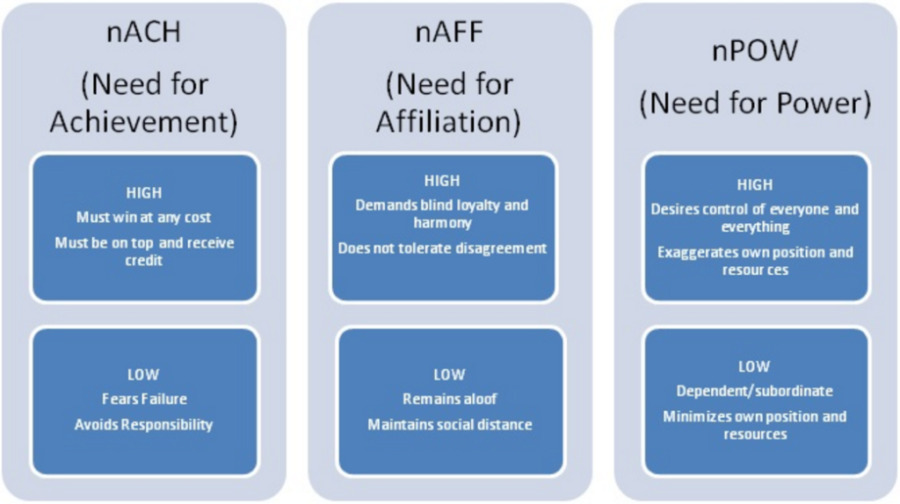
Each person tends to develop certain motivational drives as a result of his cognitive pattern and the environment in which he lives. David McClelland gave a model of motivation, which is based on three types of needs, namely, achievement, power and affiliation. They are stated below: Need for achievement (n-Ach): a drive to excel, advance and grow; Need for power (n-Pow): a drive to influence others and situations; and Need for affiliation (n-Aff): a drive for friendly and close interpersonal relationships. Achievement motivation: some people have a compelling drive to succeed and they strive for personal achievement rather than the rewards of success that accompany it. They have a desire to do something better or more efficiently than it has been done before. This drive is the achievement need. From researches into the area of achievement need, McClelland found that high achievers differentiate themselves from others by their desire to Continue reading

Case Study: The Daewoo Group and the Asian Financial Crisis

In 1999, Daewoo Group Korea’s second largest chaebol, or family-owned conglomerate, collapse under $57 billion in debt and was forced to split into independent companies. The Asian financial crisis and its aftermath finally took its toll on the expansion-minded Daewoo and forced both Daewoo and the Korean government to decide how to dissolve the chaebol. Kim Woo-Choong started Daewoo in 1967 as a small textile company with only five employees and $10,000 in capital. In just 30 years, Mr. Kim had grown Daewoo into a diversified company with 250,000 employees worldwide as well as over 30 domestic companies and 300 overseas subsidiaries that generated sales of more than $100 billion annually. However, some estimated that Daewoo and its subcontractors employed 2.5 million people in Korea. Although Daewoo started in textiles, it quickly moved into other fields, first heavy and chemical industries in the 1970s, and then technology intensive industries in Continue reading

Ansoff Matrix Analysis of Adidas

Adidas is one of the leading companies in the world that specialize in the production of wide variety and high quality sportswear and sports equipment. The head office of the company is located in Germany and has good brands through which it promotes its products. The company is carrying on its operations by using the three brands names of Adidas, TaylorMade-adidas Golf, and Reebok. The company is widely operating in Europe, North America and Asia. Adidas has a strong work force of around 39,000 employees working in different parts of the world. The company has its operations in Europe, US and Asia in more than 150 subsidiaries and are purely focused on manufacturing. Adidas focuses on sports and the brand specializes in footwear, apparel and accessories. Adidas is very popular with the sports division where the brand image of the company is promoted in sports like running, football, basketball, tennis Continue reading

Marketing Strategies Adopted by Global Companies

Marketing strategies adopted by Global Companies can be broadly classified as follows: 1. A Global Strategy It treats the world as a single market. This strategy is warranted when the forces for global integration are strong and the forces for national responsiveness are weak. This is true of the consumer electronics market, for example, where most buyers will accept a fairly standardized pocket radio, CD player, or TV. Matsushita has performed better than GE and Philips in the consumer electronics market because Matsushita operates in a more glob ­ally coordinated and standardized way. 2. A Multinational Strategy It treats the world as a portfolio of national opportunities. This strategy is warranted when the forces favoring national responsiveness are strong and the forces favoring global integration are weak. This is the situation in the branded packaged-goods business (food products, clean ­ing products). Unilever can be cited as a better performer than Continue reading