External Factor Evaluation (EFE) Matrix
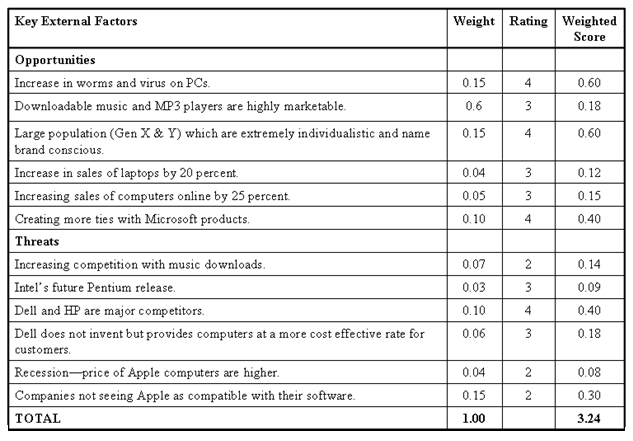
An External Factor Evaluation (EFE) Matrix allows strategists to summarize and evaluate economic, social, cultural, demographic, environmental, political, governmental, legal, technological, and competitive information. EFE Matrix indicates whether the firm is able to effectively take advantage of existing opportunities along with minimizing the external threats. Similarly, it will help the strategists to formulate new strategies and policies on the basis of existing position of the company. External factors are extracted after deep internal analysis of external environment. Obviously there are some good and some bad for the company in the external environment. That’s the reason external factors are divided into two categories opportunities and threats. Opportunities are the chances exist in the external environment, it depends firm whether the firm is willing to exploit the opportunities or may be they ignore the opportunities due to lack of resources. Threats are always evil for the firm, minimum no of threats in Continue reading
Introduction to Grid Computing

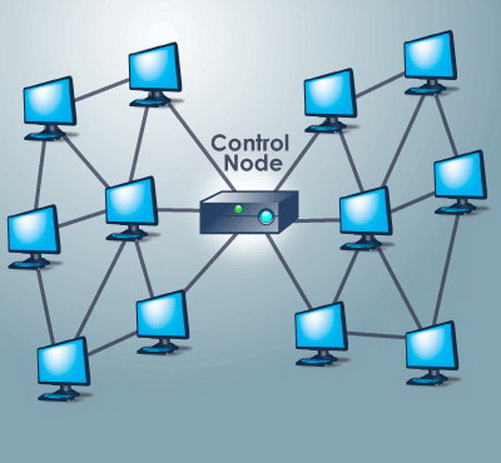
The popularity of the Internet as well as the availability of powerful computers and high-speed network technologies as low-cost commodity components is changing the way we use computers today. These technology opportunities have led to the possibility of using distributed computers as a single, unified computing resource, leading to what is popularly known as Grid computing. Grid computing is a term referring to the combination of computer resources from multiple administrative domains to reach a common goal. The grid can be thought of as a distributed system with non-interactive workloads that involve a large number of files. What distinguishes grid computing from conventional high performance computing systems such as cluster computing is that grids tend to be more loosely coupled, heterogeneous, and geographically dispersed. Although a grid can be dedicated to a specialized application, it is more common that a single grid will be used for a variety of different Continue reading

Brand Irritation – A Case of Negative Brand Image Building

There are some gaps in between a company and its customers. These gaps are due to customer expectation with the brand and that expectation is not met with the actual brand offerings including other factors, which made customer experience not only negative but at the level of irritation. This customer irritation ultimately turns into brand irritation if necessary actions are not take. Brand irritation word coined by the Mr Alison Eastwood in the year 2003 in his article named “Brand irritation”. But in this article he had discussed on the term brand integration (the  use  of  commercial  products  in  the  story  line of  a  television  show,  film,  etc.  and  involving  the development  of  specific  objectives,  strategies, plans,  and  tactics  to  drive  the  business) and connecting it with the use of brand integration in American idol and same kind of initiatives adopted by other brands. He relates it with out of Continue reading

The Cost of Equity Capital

Firms may raise equity capital internally by retaining earnings. Alternatively, they could distribute the entire earnings to equity shareholders and raise equity capital externally by issuing new shares. In both cases, shareholders are providing funds to the firms to finance their capital expenditures. Therefore, the equity shareholders required rate of return will be the same whether they supply funds by purchasing new shares or by foregoing dividends which could have been distributed to them. There is, however, a difference between retained earnings and issue of equity shares from the firm’s point of view. The firm may have to issue new shares at a price lower than the current market price. Also, it may have to incur flotation costs. Thus, external equity will cost more to the firm than, the internal equity. Is Equity Capital Free of Cost? It is sometimes argued that the equity capital is free of cost. The Continue reading

What is Enterprise Application Integration (EAI)?

Supply Chain Management (SCM) applications (for managing inventory and shipping), Customer Relationship Management (CRM) applications (for managing current and potential customers), Business Intelligence (BI) applications (for finding patterns from existing data from operations), and other types of applications (for managing data such as human resources data, health care, internal communications, etc) typically cannot communicate with one another in order to share data or business rules throughout a company. Enterprise Application Integration (EAI) is the process of linking such applications within a single organization together in order to simplify and automate business processes to the greatest extent possible, while at the same time avoiding having to make sweeping changes to the existing applications or data structures. Enterprise Application Integration (EAI) is defined as the unrestricted sharing of data and business processes among any connected applications and data source in the enterprise. It is considered as a framework that is formed of Continue reading

Case Study of Procter and Gamble (P&G): Structure and Culture

Three billion times a day, P&G brands touch the lives of people around the world. This happens because P&G provides branded products of superior quality and value to improve the lives of the world’s consumers. This results in leadership sales, profit and value creation, allowing employees, shareholders and the communities in which we operate to prosper. The Procter & Gamble Company (P&G) is a brand behemoth. The world’s first maker of household products courts market share and billion-dollar brands. Its business is divided into three global units: beauty, health and well being, and household care. It also makes pet food and water filters and produces soap operas. Some 25 of P&G’s brands are billion-dollar sellers, including Gillette Fusion, Always/Whisper, Braun, Bounty, Charmin, Crest, Downy/Lenor, Folgers (which it reportedly plans to spin off), Gillette, Iams, Olay, Pampers, Pantene, Pringles, Tide, and Wella, among others. The P&G consists of over 138,000 employees Continue reading