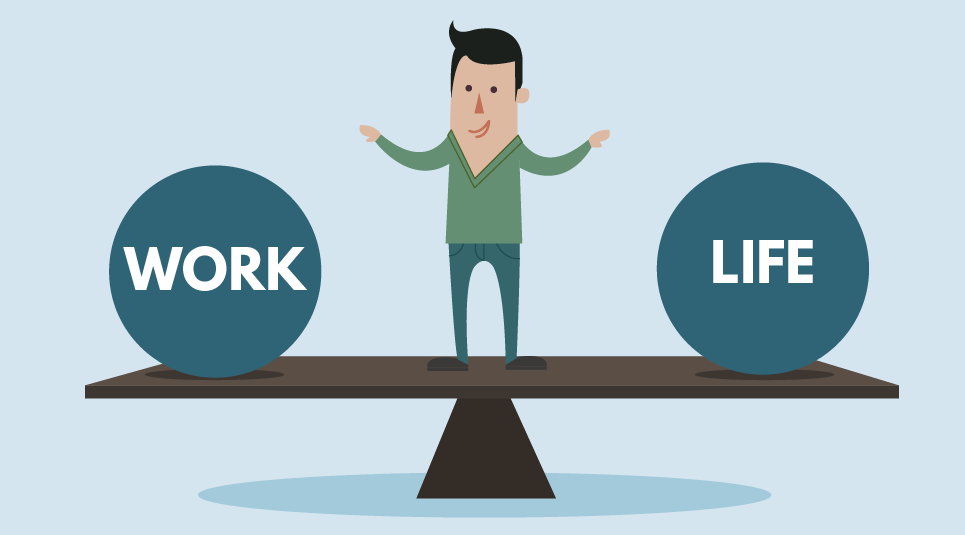
Work-life balance is a very broader term in Human Resource Management and often referred to finding the right equilibrium between the different aspects and roles in a life of a person. Although there are different views and concepts about work-life balance but it is generally coupled with maintaining an overall balance in different aspects of life. During the last decade technological revolution has stormed all aspects of life and there were different debates about the future of work. Different scenarios predicted a rising trend in un-employment and economic insecurity. Industrial restructuring and emergence of latest technology no only affected the importance of workforce but it was also felt that employees will be treated as superfluous overheads. History of Work-Life Balance In 1986, the term “Work-Life Balance” was first identified, but it’s usage in everyday language was still sporadic for a certain number of years. Although, interestingly work-life programs existed in Continue reading
HRM Functions
Cross-Cultural Preparation in Employee Training Programmes

“Cross-Cultural Preparation is the process of educating employees (and their families) who are given an assignment in a foreign country”. Cross cultural preparation educates employees (expatriates) and their families who are to be sent to a foreign country To successful conduct business in the global marketplace, employees must understand the business practices and the cultural norms of difference countries. Steps in cross-cultural preparation. To prepare employees for cross-cultural assignments, companies need to provide cross-cultural training. Most U.S companies send employees overseas without any preparation. As a result, the number of employees who return home before completing their assignments is higher for u.s. companies than for European and Japanese companies. U.S companies lose more than $2 billion a year as a result of failed overseas assignments. To succeed overseas, expatriates (employees on foreign assignments) need to be. Competent in their areas of expertise. Able to communicate verbally and non-verbally in the Continue reading
Difference Between Career Planning and Career Development
Broadly, the term career is referred to an individual’s entire work life. In a narrow sense, it can be defined as the succession of jobs and or ranks held by a person in a particular organisation. An individual’s career begins with placement in a job and ends with departure from the organisation, may be in form of retirement, resignation or death. In between, the career progression consists of changing tasks, tenure in various jobs, temporary or permanent promotions, transfers etc. Career planning and development includes all those events that is happening to or initiated by an individual affecting his/ her progress or promotion. It happens by widening and/or changing employment possibilities and is characterized by different and higher status, better conditions of service and increased satisfaction with the job. It revolves round events and occurrences an individual goes through while moving up the hierarchic ladder. Career development is the process Continue reading
Work-Life Balance Programs – Cost or Investment?

Work-life balance programs are fast gaining popularity in developed countries. Work-life balance programs can be defined as any benefits, policies or programs that help employees find ways to manage the demands of the workplace and life outside work. In other words, work-life balance programs are designed as a two pronged approach to achieve meaningful achievement and enjoyment in everyday life. There are many forms of work-life balance programs such as flex-time, child-care facilities at work, gyms and concierge services and paid vacations. Many reasons are cited for the introduction of work-life balance programs at the workplace, the most common being that it increases productivity as well as employee loyalty. While these are all valid justifications, the costs of having work-life balance programs should not be ignored. Therefore, do the benefits of work-life balance programs outweigh the costs? Going further, should these programs be considered a cost or an investment to Continue reading
3 Important Domains of Learning
The term learning means changes in our behavior, attitude, knowledge and skills. In other wards we can say that through learning we can feel permanently changes in our self. If we are not feeling any changes in our above skills then it will not be called as learning. The learning is a type of reinforcement, which may learn a change in behavior enduring by strengthening and intensifying certain aspect of an individual behavior. Learning may be described at the process of acquiring the ability to respond adequately to a situation, which may or may not have been previously an countered. The term domains of learning means classification, area and scope of learning. The classification allows the trainer to be better able to organize instruction and thereafter provides better structure and improved clarity. The main aim of domains of learning that the students will be better able to achieve success if Continue reading
Conflict in Organizations

Conflict occurs at various levels within the individuals, between the individuals in a group and between the groups in an organisation. An issue between two or more parties who have (or think they have) incompatible goals or ideas. Conflicts may involve deep-rooted moral or value differences, high stakes distributional questions, or can be about who dominates whom. Conflict is a perpetual given of life, although varying views of it may be held. Some may view conflict as being a negative situation which must be avoided at any cost. Others may see conflict as being a phenomenon which necessitates management. Still others may consider conflict as being an exciting opportunity for personal growth and so try to use it to his or her best advantage. Definitions of Organizational Conflict “Working together is not always easy”, it is because of conflict. Conflict is a part of everyday life of an individual and Continue reading