Management has been as old as the human beings and with the evolvement of humans management has also evolved. The history of management and its theories can be traced back to thousands of years. However, systematic development of the theories of management is generally viewed from the end of nineteenth century with the emergence of large industrial organizations and the ensuing problems associated with their structure and management. This is the time when work of various writers on the management has started to come into the light. These works can be clubbed together to form different approaches to the theory of management. Two of the most popular and widely accepted approaches to management are: Classical Approach to Management, and Behavioral Approach or Human Relation Approach to Management In order to be able to compare and understand the contrast of these two approaches to management, let’s understand the basics of these Continue reading
Principles of Management
12 Principles of Organization Structure

Traditional organisation theorists developed certain principles of organization structure. These principles are intended for universal application to all enterprises. The most important of these principles of organization structure can be listed under the following heads: 1. Division of Labor or Specialization The classicists viewed specialization as the basis of efficiency. A group of individuals can secure better results by having division of work. F.W. taylor applied by breaking down jobs into single repetitive tasks performed on specialized tools. At higher levels, however, grouping jobs into manageable units and their co-ordination can pose serious problems. The principle of specializations has been challenged by the behaviorists and others. Fatigue, monotony and boredom are the inevitable outcomes of division of labor. While specializations cause great function interdependency among operatives, it also depersonalizes their activities so that individuals find little meaning in the work. Moreover, functional interdependency among work activities causes strains and tensions. Continue reading
Geographical Organizational Structure
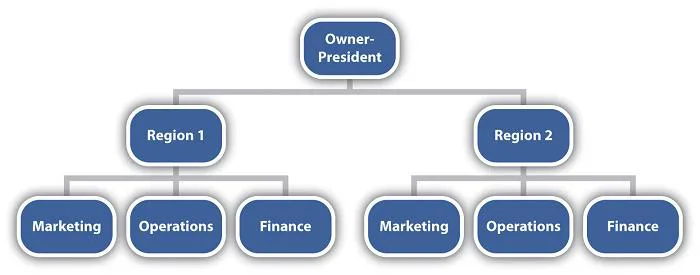
Geographical organizational structure involves grouping of the activities according to regional or geographical locations. The territorial divisions become a complete administrative unit to cater to the need of the localities. The Regional Manager will practically be the chief controller of his region. He is given full powers of managing his own region or zone. His office functions as a head office for all practical purposes. The functions pertaining to finance, marketing, personnel and production development of low-level employees are completely vested in the zonal office which has separate departments of these functions to guide and control the respective activities of the zone. The zonal office may have several divisional offices for executive functions. The area population and size of business in a zone will decide the number of divisional offices, their functional activities, and amount of authority and responsibility to be vested in the divisional managers. Continue reading
Professionalization of Management

There has been a growing trend towards professionalization of management. Professionalization imparts a certain social responsibility and dignity to management. A professional cannot be controlled or directed by the client. He has professional knowledge and judgment which he uses to make his decision. Thus, professionalization makes business more efficient, dynamic and socially responsible. The growth of management education has contributed to professionalization in the business field. The company form of business organization which has split ownership from management and the gaining popularity of the company form of business organization have increased the need for professional managers. Is Management a Profession? To answer this question, first of all we should understand what a profession is. Many authorities on the subject have attempted to define a profession. According to Abraham Flexner, A profession is; A body of specialized knowledge and recognized educational process of acquiring it. A standard of qualifications governing admission Continue reading
Concept of Power in Management

Power in Management Power is easy to feel but difficult to define. It is the potential ability of a person or group to influence another person or group. It is the ability to get things done the way one wants them to be done.Both formal and informal groups and individuals may have power; it does not need an official position or the backing of an institution to have power. Influence can take many forms. One person has influenced another if the second person’s opinions, behavior or perspectives have changed as a result of their interaction. Power is a factor at all levels of most organizations. It can be a factor in almost any organizational decision. Power and Authority Sometimes power and authority is used synonymously because of their objective of influencing the behavior of others. However, there is difference between the two. Power does not have any legal sanctity while Continue reading
Relationship Between Organizational Behavior and Management Control System
Organizational Behavior and Management Control There is a close relationship between organizational behavior and management control system. A management control system seek to evaluate and regulate the performance of responsibility centers. The manager in charge of a responsible center is rewarded for good performance. At the same time when the performance of a responsibility center is dismal, the manager in charge is punished. Thus, a management control system acts as a double-edged sword. That is why manager are afraid of a control system and, may resist it. In order to make a control system successful, it is necessary to understand the factors that motivate, managers to achieve the results. Behavioral sciences have given several concepts that are relevant to management control. Some of these concepts at described below. 1. Perception. Whether a management control system is accepted and implemented successfully does not depend on the system. It depends largely on Continue reading