Stress Management: Evaluating Stress

Feeling the effects of stress is a normal part of life, especially when you are facing major challenges. But each person responds to stress differently. What causes a lot of stress for one person may not cause stress for someone else. That’s because a large part of stress is a matter of perception-how you view a situation determines how much stress it causes you. Therefore, only you can best evaluate the amount of stress in your life and learn better ways to cope with it. Ask yourself the following questions to learn what is causing you stress and how you respond: What job, family, or personal stress do I have? Chronic stress can be caused by an ongoing stressful situation such as: Family or relationship problems. Caring for a family member who is elderly, has chronic health problems, or is disabled. Care giving is a major source of stress. For Continue reading
Industrial Distribution Channel

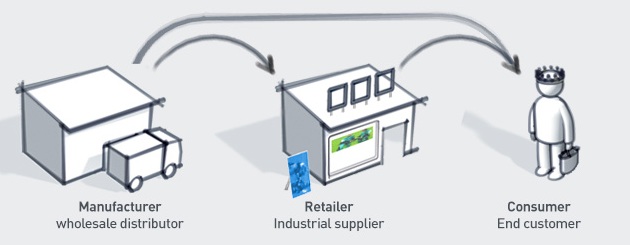
When a company or a manufacturer produces goods or services, it has the  immediate responsibility to distribute and sell them to the industrial and  institutional customers. The industrial customers generally constitute of  wholesalers, retailers, manufacturers, educational institutions, governments,  hospitals, public utilities, and other formal organizations. There are various  intermediaries who are involved in a distribution and selling process helping the  manufacturers to make their goods reach the end users. Thus, a network or  channel that helps to flow the goods from the producer to the consumer through  a set of interdependent organizations (intermediaries) is called distribution  channel or trade channel or marketing channel. Channels are the tools used by  management to move the goods from the place of production to the place of  consumption. In the progression, the title of goods gets transferred from sellers  to buyers. Industrial distribution is unique as there are several different methods of  channeling the Continue reading

Consumer Decision Making Process

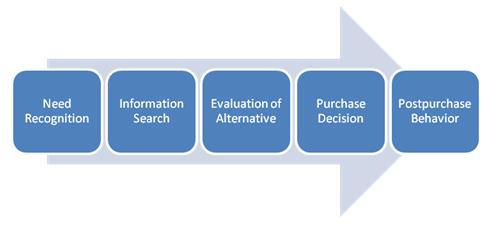
The five stages of the consumer decision making process include; Problem recognition, information search, information evaluation, purchase decision, and evaluation after purchase. This is just a general model of the consumer decision making process and it emphasizes that the buying decision making process starts before the actual purchase and continues even after the purchase. It also encourages the marketer to focus on the complete buying process and not just on the purchase decision. 1. Problem Recognition Consumers  recognize a problem as a need or want. Of course, the most frequent problem  occurs  when consumers realize they are out of the product. For example, when the gas tank gets near empty, or you run out of lunch meat for your  sandwiches, or when your car is due for  maintenance. Problem recognition also occurs when a consumer  receives  new information about a good,  service, or business. New fashions, for example, can make Continue reading

Demutualization of stock exchanges

Demutualization refers to the conversion of an existing non-profit organization into a profits-oriented company. In other words, an association that is mutually owned by members converts itself into an organization that is owned by shareholders. The company can take different shapes and forms, that is, it could be either a listed or unlisted company which may be closely held or publicly held. Demutualization of stock exchanges involves the segregation of members’ right into distinct segments, viz. ownership rights and trading rights. It changes the relationship between members and the stock exchange. Members while retaining their trading rights acquire ownership rights in the stock exchange, which have a market value, and they also acquire the benefits of limited liability. The shareholders in a corporatized stock exchange may be a diverse group, as members may decide to retain their shares or to sell them. Demutualization however, does not insulate them from competition. Continue reading

Introduction to Income Tax

The word tax was derived from the Latin word ‘taxore’ meaning to estimate, appreciate or value. Tax is a price which each citizen pays to the state to cover his share of the cost of the general public services which he will consume. It indirectly provides employment opportunities. Taxes are compulsory contributions imposed by the government on its citizens to meet its general expenses incurred for the common good, without any corresponding benefit to the tax payer. In 1860, the British government firstly introduced tax in India. The present law of income tax is contained in the income tax Act,1961 as amended up to date; the income tax rules 1962 as amended up to date and finance Act passed by the parliament every year. Income Tax Act came into force with effect from 1-4-1962 and extends to the whole of India. Assessee [Sec 2(7)] Assessee means a person by whom Continue reading

Ethics of Whistleblowing in Business

Whistleblowing refers to the act of organization members, either former or current, disclosing information on illegal and unethical practices within the organization to parties internal or external to the organization, who can take action. It is becoming increasingly common as more and more employees speak out about their ethical concerns. It cannot be denied that whistleblowing is accompanied by a range of problems, for both the whistleblower and the organization. However, it can be argued that whistleblowing is an important and valid method of endeavoring to control possible unethical behavior by organizations, as well as helping to establish a level of social responsibility. For these reasons, it is important for society to maintain a level of support and encouragement towards whistleblowers, so that their often valuable contribution towards eliminating corporate wrongdoings can continue. Employees who discover apparent wrongdoing within an organization are faced with several options, each of which comprises Continue reading