Systems approach to management developed after 1950. Many pioneers during as E.L Trist, AK Ria, F.E. Kast, and R.A Johnsm have made significant contributions to this approach. This systems approach looks upon the management as a ‘System’ of as an organized whole make up of sub-systems integrated into a unity or orderly totality. The attention should be given so overall effectiveness of the system rather than effectiveness of any sub-system if isolation. It took where management process school left off in attempting to unify management theory. It emphasizes the inter-relatedness and inter-dependence of all activities within an organisation. It is based on system analysis. It attempts to identify the nature of relationships of various parts of the system. A system is a set of inter-connected elements or component parts to achieve certain goals. An organisation is viewed by the modern authors as an open system. An organisation as a system Continue reading
Management Principles
Compare and Contrast Herzberg’s Two Factor Theory with Vroom’s Expectancy Theory of Motivation
Herzberg’s Theory of motivation suggests that there are two factors that affect human behavior and motivation at work; these are called hygiene and motivating factors. Hygiene factors are those that de-motivate staff if they are not in place, whereas motivators are those that are used to motivate staff. The five main attributes that Herzberg suggested were motivators are, recognition, achievement, responsibility, advancement and the nature of work itself. Hygiene factors include, supervision, salary, the work environment, company policies and relationships with colleagues. Vroom’s theory of motivation suggests that there is a link between effort and reward. His theory is based on an employee’s perception of their job, underlined against valence, instrumentality and expectancy. There are two types of theories concerning motivation of employees. There are content theories which assume that people have the same needs and process theories which suggest people are motivated by different things. Herzberg’s two factor theory Continue reading
Decentralization of Authority
By decentralization of authority we mean dispersal of decision-making authority at various levels in the organization. In a centralized set-up, decision-making authority is concentrated at the top-level of the management, whereas in the decentralized set-up, many important decisions are made at the lower level also. The most significant feature of decentralization of authority is that most of the decisions made at the lower level do not need approval of the seniors. This means greater freedom is given in decision-making to lower level managers and supervisors in the organization. Factors Determining the Degree of Decentralization Importance and significance of the decision: One of the important factors determining the degree of decentralization of authority is costliness of the decision. Normally, decisions which are costly in terms of money value involved or in terms of factors like goodwill and image of the establishment, employee morale or motivation tend to be centralized at the Continue reading
The Impact of Bureaucratic Structure in Organizations

A bureaucracy is a form of organisation based on logic, order, and the legitimate use of formal authority. Bureaucracies are meant to be orderly, fair, and highly efficient. Max Weber, a German theorist, was the first person to introduce many of the concepts of bureaucracy. During the 18th and 19th century period many employees worked only for themselves and in a workplace environment that was primarily focused on getting the job done in whichever way possible unconcerned with efficiency. Weber’s idea was to use regulation by rules, policies, supervision, reward systems and other mechanisms to make sure that the behavior and standards of the employees are always met and making the contemporary workplace more organized. The six key principles of bureaucracy that Weber identified were; division of work, hierarchy, promotions, record-keeping, business as a separate legal entity and rules and regulations. Many businesses today have benefited from Weber’s work. Division Continue reading
Control in Multinational Enterprises (MNEs)
There are various methods of classification of management control in Multinational Enterprises (MNEs). By levels of control here it is meant whether the parent / corporate level managers or subsidiary/country-level managers are involved. The former might be called higher level and the later lower level control. Depending on the sphere of focus we have two types of control called Strategic control and Operational control. In the MNE’s context, strategic control is the responsibility of parent and operational control is the preserve of the subsidiary. Another way puts ‘management control, tactical control and transactional control’ as the 3 levels of control respectively carried out by the corporate top management, collectively by corporate & subsidiary management and subsidiary management in the case of MNEs. Of course, whether an MNE’s structure is ethno-centric, geo-centric, multi-domestic/poly-centric or region-centric is another factor that influences the exact distribution of responsibility. The forward looking information is provided Continue reading
Learning Curve in an Organizational Context
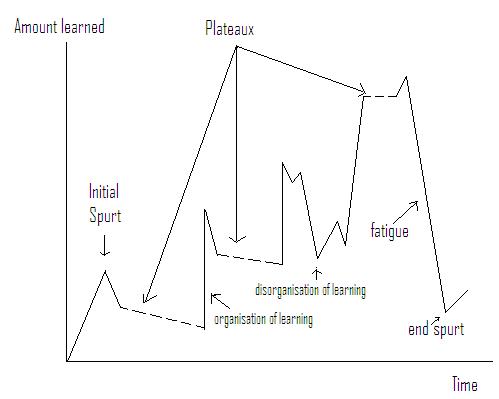
A highly useful learning concept which is valid for a wide range of situation is the organizational learning curve, a diagrammatic presentation of the amount learned in relation to time. A typical learning curve will show on the Y-axis the amount learnt and the X-axis the passage of time. Characteristics of the Organizational Learning Curve Certain characteristics are common to all learning curves. One such feature is the initial spurt. At the beginning, it is natural that the rate of learning exhibits spurt. Usually, the graph levels off at some stage, indicating that maximum performance has been achieved. Apparently at the beginning of the learning process, the subject is highly motivated and seems to exhibit a significant surge of effort. Many experienced trainers exploit this initial spurt by selecting the most important items to be communicated and presenting them as a package to the students at the beginning of the Continue reading