Inventory Management Concepts in Supply Chain Management

Inventory management aims to handle all function correctly with tracking and management of material. Inventory management is very wide definition like to replenishment lead time, carrying costs of inventory, asset management, forecasting, valuation, visibility, future inventory cost, space, quality etc. The ultimate aim of supply chain management is how well you manage your inventory. Manufacturers face a number of challenges which require not just exceptional planning but also an effective communication setup that keeps you updated at the spur of a moment. From rapid changes of customer demands, globalization or even natural calamities can cause your inventory to be stuck up paving way for no wages to the employees. Therefore there should be a quick information system to discuss the inbound and outbound issues affecting the demand and supply. For this there should be a well managed supply chain inventory management in order to keep the business running without any Continue reading

Analysis of Problems in Management Case Studies

The case can be analysed from different points of view. Usually there are four parties involved in the case, viz., the proprietor or top management, the middle management departmental heads, the employees or workers and finally the society in general (it includes consumers, distributors, investors, potential employees and those who are directly or indirectly affected by the organization), which is mostly disguised. While analysing and suggesting solutions, the student should try to look at the case from these different points of view and try to pin point violation of rules, regulations, code of conduct or precedents in vogue. The solution to be suggested must be in the larger interests of safeguarding the provisions of laws, code of conduct, rules and regulations to restore the normal positron. The solution should be in the interests of the organization, the weaker sections of the organization and society in general. While analyzing the case, Continue reading

European Economic and Monetary Union (EMU)

The basis of the European Economic and Monetary Union (EMU)  was the American desire to see a united Western Europe after the World War II. This desire started taking shape when the Europeans created the European Coal and Steel Community, with a view to freeing trade in these two sectors. The pricing policies and commercial practices of the member nations of this community were regulated by a supranational agency. In 1957, the Treaty of Rome was signed by Belgium, France, Germany, Italy, Luxembourg and the Netherlands to form the European Economic Community (EEC), whereby they agreed to make Europe a common market. While they agreed to lift restrictions on movements of all factors of production and to harmonize domestic policies (economic, social and other policies which were likely to have an effect on the said integration), the ultimate aim was economic integration. The European countries desired to make their firms Continue reading

The Fundamental and Enhancing Qualitative Characteristics of Financial Information

The purpose of financial statements is to give financial statements information about the change in financial position, financial performance and financial position of the organization. These can provide data use in decision making such as investment, credit and economic decision making which are useful for various users. There are seven main groups of users which are public, investors, lenders, employees, customers, supplies, government and other agencies and the needs of information is different for each group, for instance, employee will interest on the profitability, retirement benefits and employment opportunities and so on. The qualitative characteristics can be categorized as fundamental (relevance and faithful representation) or enhancing (comparability, verifiability, timeliness and understandability) based on how they influence the usefulness of financial information. However, it can limited by two pervasive constraints which is cost and materiality in providing useful financial information. Fundamental Qualitative Characteristics of Financial Information Relevance: Relevant financial reporting information Continue reading

Portfolio Selection and Revision in Investment Portfolio Management

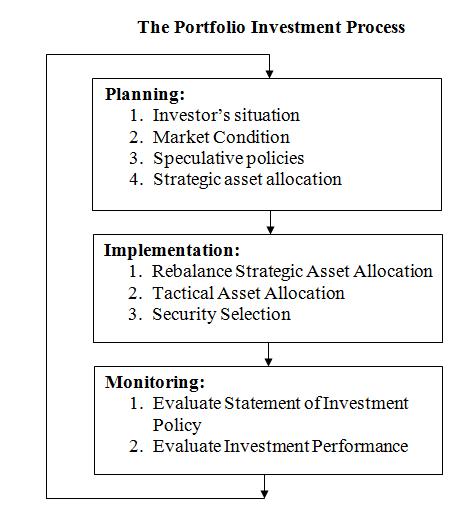
Portfolio Selection Portfolio analysis provides the input for the next phase in portfolio management, which is portfolio selection. The proper goal of portfolio construction is to generate a portfolio that provides the highest returns at a given level of risk. A portfolio having this characteristic is known as an efficient portfolio. The inputs from portfolio analysis can be used to identify the set of efficient portfolios. From this set of efficient portfolios the optimum portfolio has to be selected for investment. Harry Markowitz portfolio theory provides both the conceptual framework and analytical tools for determining the optimal portfolio in a disciplined and objective way. Portfolio Revision Once the portfolio is constructed, it undergoes changes due to changes in market prices and reassessment of companies. Portfolio revision means alteration of the composition of debt/equity instruments, shifting from the one industry to another industry, changing from one company to another company. Any Continue reading

Principles of Management Control

Management Control Principles The basic principles of management control can be grouped into three categories reflecting their purpose and nature, structure and process. These principles of management control are given below. Principle of Assurance of Objective. The basic purpose of management control is the attainment of objectives does this by detecting failures, in plans. Potential or actual, deviations from plans should be detected enough to permit effective corrective action. Principle of Efficiency of Controls. A management control system should detect and highlight the causes of deviations from plans with minimum possible costs and unwanted consequences. The principle of efficiency is particularly important in control because techniques tend to become costly and burdensome. A manager may become so engrossed in control that he spends more than it is to detect a deviation. Controls which seriously interfere with authority of subordinates or morale of those who execute plans, is inefficient. Principle of Continue reading