Organizational Design and Structure – Meaning and Importance

Organizational Design and Structure Organizational design  is defined as a process of reshaping organization  structure  and roles, or it can be more effectively defined as the alignment of the structure, process, rewards and talent with the strategy of the business. Amy Kates and Jay Galbraith have found (building on years of work by Galbraith) that attention to all of these organizational elements is necessary to create new capabilities to compete in the given market. This systemic view is referred to as the “star model” approach and is more likely to lead to better performance . Organization design may involve strategic decisions, but is properly viewed as the path to execute strategies effectively . Many companies fall into the trap of making repeated changes in the organizational structure, with a little benefit to the business. This often occurs because the changes in the structure are relatively easy to execute while creating Continue reading

Case Study: Credit Card Attitudes and Behaviors of College Students

Credit cards have been very big business for several decades. The cards have made the life easier for many people because they do not need to carry large amount of cash for most purchases. However, the credit card industry is intensely competitive, highly fragmented, and growing at the rate of 3 to 4 percent. Many college students are living on the verge of a financial crisis. For this purpose many banks are interested to consider this assertion by examining college students’ credit card use behavior and attitudes. A concurrent purpose was to test the factors associated with students’ attitude toward credit cards. College students’ use of credit cards has recently received increased visibility throughout the media concluded that in addition to credit problems many students do not have a written budget, and of those who do have a budget few young people actually use it. They determined that university students Continue reading

A New Business Strategy: Familiarity Matrix

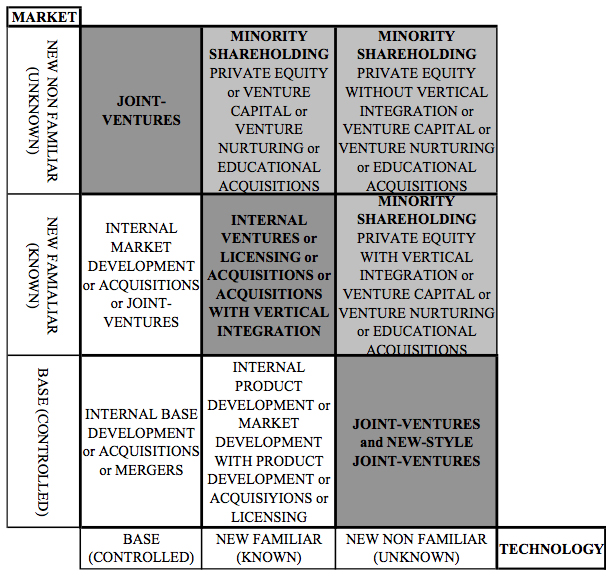
Roberts and Berry devised a technique for selecting optimum diversification action plans for firms wishing to enter new product-markets called the familiarity matrix. It helps strategists decide which product-markets to enter and how. Its two axes, familiarity with market factors and technology or service, are both divided into three values: Base, new familiar, and new unfamiliar. The market dimension refers to the amount of knowledge possessed by the diversifying company of various characteristics of the market and the competitors within it. The authors distinguish between the newness of, and the familiarity with, the market for a product-service. Newness of a market is the extent to which the company has previously targeted it. Markets with which the company has prior experience, conceivably by selling old or existing products in it, are called base markets. Markets with which no such prior exposure exists are called new. Whether a new product is base Continue reading

Characteristics of Project Financing

Project financing involves non-recourse financing of the development and construction  of a particular project in which the lender looks principally to the revenues expected to  be generated by the project for the repayment of its loan and to the assets of the project  as collateral for its loan rather than to the general credit of the project sponsor. Project financing is commonly used as a financing method in capital-intensive industries  for projects requiring large investments of funds, such as the construction of power  plants, pipelines, transportation systems, mining facilities, industrial facilities, and heavy  manufacturing plants. The sponsors (the sponsor(s) or developer(s) of a project financing is the party that organizes all of the  other parties and typically controls, and makes an equity investment in, the company or  other entity that owns the project)  of such projects frequently are not sufficiently  creditworthy to obtain traditional financing or are unwilling to take Continue reading

Organisation Structure – Meaning and Types

An organisation structure is a set of planned relationships between groups of related functions and between physical factors and personnel required for the performance of the functions. The organisation structure is generally shown on the organisation chart. It shows authority and responsibility between various positions in the enterprises by showing who reports to whom. Organisation structure lays down the pattern of communication and coordination in the enterprises. Though organisation structure is very important, it is not an end in itself. According to Peter F. Drucker, “Organisation is not an end itself, but a means to end of business performances and business results. Organisation structure is an indispensable means; and the wrong structure will seriously impair business performance and may even destroy it. Organisation structure must be designed so as to make possible the attainment of the objectives of the business for five, ten, fifteen years hence.” Process of Organizing Organisation Continue reading

Compliance or Legal Risk in E-Banking

This is the risk to earnings or capital arising from violations of, or nonconformance with, laws, regulations and ethical standards. Compliance risk may lead to diminished reputation, actual monetary losses and reduced business opportunities. Banks need to carefully understand and interpret existing laws as they apply to Internet banking and ensure consistency with other channels such as branch banking. This risk is amplified when the customer, the bank and the transaction are in more than one country. Conflicting laws, tax procedures and reporting requirements across different jurisdictions add to the risk. The need to keep customer data private and seek customers’ consent before sharing the data also adds to compliance risk. Customers are very concerned about the privacy of their data and banks need to be seen as reliable guardians of such data. Finally, the need to consummate transactions immediately (straight-through processing) may lead to banks relaxing traditional controls, which Continue reading