Foreign Exchange Exposure – Meaning and Types

Meaning of Foreign Exchange Exposure Foreign exchange risk is related to the variability of the domestic currency values of assets, liabilities or operating income due to unanticipated changes in exchange rates, whereas foreign exchange exposure is what is at risk. Foreign currency exposures and the attendant risk arise whenever a company has an income or expenditure or an asset or liability in a currency other than that of the balance sheet currency. Indeed exposures can arise even for companies with no income, expenditure, asset or liability in a currency different from the balance sheet currency. When there is a condition prevalent where the exchange rates become extremely volatile the exchange rate movements destabilize the cash flows of a business significantly. Such destabilization of cash flows that affects the profitability of the business is the risk from foreign currency exposures. Classification of Exposures Financial economists distinguish between three types of currency Continue reading
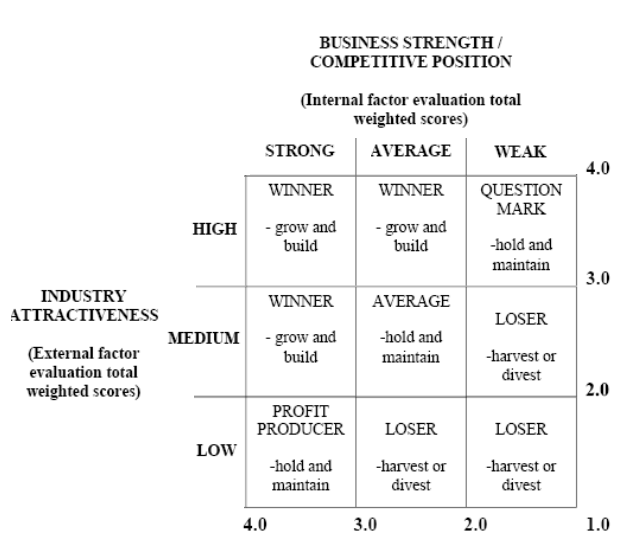
Internal-External (IE) Matrix

The Internal-External (IE) Matrix positions an organization’s various divisions in a nine cell matrix. The IE Matrix is a strategic management tool which is used to analyze the current position of the divisions and suggest the strategies for the future. The  Internal-External (IE) Matrix  is based on an analysis of internal and external business factors which are combined into one suggestive model.  The IE matrix is a continuation of the  EFE matrix  and  IFE matrix  models. The  Internal-External (IE) Matrix  is based on two key dimensions: the IFE total weighted scores on the x €‘axis and the EFE total weighted scores on the y axis. Recall that each division of an organization should construct an IFE Matrix and an EFE Matrix for its part of the organization. The total weighted scores derived from the divisions allow construction of the corporate-level IE Matrix. On the x €‘axis of the IE Matrix, an Continue reading

Role of Business Ethics in Modern Organizations

Business ethics are becoming more and more prevalent in today’s business world. Business ethics is a form of applied ethics that studies ethical principles and moral or ethical problems that arise in a business environment. There are an array of issues that have come under scrutiny, including community responsibility, pollution, whistle blowing, and sustainability. Business ethics is the conduct that a business adheres to in its daily transactions with the world. The ethics of a particular business can be different. They pertain not only to how the business interacts with the world at large, but also to their one-on-one transactions with a consumer. Many businesses have obtained a bad reputation just by being in business. To most people, businesses are only concerned with making money, and that is the bottom line. Making money is not wrong in itself. It is the behavior in which some businesses conduct themselves that brings Continue reading

Location Analysis in Logistics Management

Plant and distribution center location is a common problem faced by logistics managers. Increased production economics of scale and reduced transportation cost have focused attention on distribution centers. In recent years, location analysis has been further extended to include logistics channel design as a result of global sourcing and marketing decisions. Global operations increase logistics channel decision complexity, design alternatives and related logistics cost. Location Decisions Location decision stage of location analysis in logistics management,  focus on selecting the number and location of distribution centers. Typical management questions:- How many distribution centers should the firm use and where should they be located? What customers or market areas should be serviced from each distribution center? Which product lines should be produced or stopped at each plant or distribution center? What logistics channels should be used to source material and serve international markets? What combination of public and private distribution facilities should Continue reading

What is Financial Restructuring?

Financial restructuring is the process of reshuffling or reorganizing the financial structure, which primarily comprises of equity capital and debt capital. Financial restructuring can be done because of either compulsion or as part of the financial strategy of the company. This financial restructuring can be either from the assets side or the liabilities side of the balance sheet. If one is changed, accordingly the other will be adjusted. The two components of financial restructuring are; Debt Restructuring Equity Restructuring 1. Debt Restructuring Debt restructuring is the process of reorganizing the whole debt capital of the company. It involves reshuffling of the balance sheet items as it contains the debt obligations of the company. Debt restructuring is more commonly used as a financial tool than compared to equity restructuring. This is because a company’s financial manager needs to always look at the options to minimize the cost of capital and improving Continue reading

Investments when entire Stock Market is Under or Over Valued

Should management proceed with investing in a project with a satisfactory NPV (Net Present Value) if it has sufficient funds to do so, and if (a) the entire stock market is significantly undervalued and may well rise by 25 or 30% over the next year, or (b) the entire stock market is significantly overvalued and may well fall by 25 or 30% over the next year? In case (a), it could be argued that management should postpone the investment for a year, and invest the cash in a general portfolio of shares, realize them after a year, then take up the postponed investment, and use the capital gain either for future investment or a special dividend payment to shareholders. However, most shareholders do not expect or want the company to use their money for speculative share investments since most companies are unlikely to possess the appropriate skills to do so. Continue reading