Advantages and disadvantages of the Depository System

Advantages of the Depository System The advantages of dematerialization of securities are as follows: Share certificates, on dematerialization, are cancelled and the same will not be sent back to the investor. The shares, represented by dematerialized share certificates are fungible and, therefore, certificate numbers and distinctive numbers are cancelled and become non-operative. It enables processing of share trading and transfers electronically without involving share certificates and transfer deeds, thus eliminating the paper work involved in scrip-based trading and share transfer system. Transfer of dematerialized securities is immediate and unlike in the case of physical transfer where the change of ownership has to be informed to the company in order to be registered as such, in case of transfer in dematerialized form, beneficial ownership will be transferred as soon as the shares are transferred from one account to another. The investor is also relieved of problems like bad delivery, fake certificates, Continue reading

Introduction to International Financial Reporting Standards (IFRS)

Background of  International Financial Reporting Standards (IFRS) Users of financial statements have always demanded transparency in financial reporting and disclosures. However, the willingness and need for better disclosure practices have intensified only in recent times. Globalization has helped Indian Companies raise funds from offshore capital markets. This has required Indian companies, desirous of raising funds, to follow the Generally Accepted Accounting Principles (GAAP) of the investing country. The different disclosure requirements for listing purposes have hindered the free flow of capital. This has also made comparison of financial statements across the globe impossible. An International body called International Organization of Securities Commissions (IOSCO), to harmonize diverse disclosure practices followed in different countries initiated a movement. The capital market regulators have now agreed to accept IFRS (International Financial Reporting Standards) compliant financial statements as admissible for raising capital. This would ease free flow of capital and reduce costs of raising capital Continue reading

Logistics – Definition and Meaning

According to Council of logistics management: “Logistics is the process of planning, implementing and controlling the efficient, effective flow and storage of goods, services and related information from point of origin to point of consumption for the purpose of conforming the customer requirement”. This definition clearly points out the inherent nature of logistics and it conveys that Logistics is concerned with getting products and services where they are needed whenever they are desired. In trade Logistics has been performed since the beginning of civilization: it’s hardly new. However implementing best practice of logistics has become one of the most exciting and challenging operational areas of business and public sector management. Logistics is unique, it never stops! Logistics is happening around the globe 24 hours a day’s Seven days a week during fifty-two weeks a year. Few areas of business involve the complexity or span the geography typical of logistics. Word, Continue reading

Discontinuous Improvement – Abernathy and Utterback Model

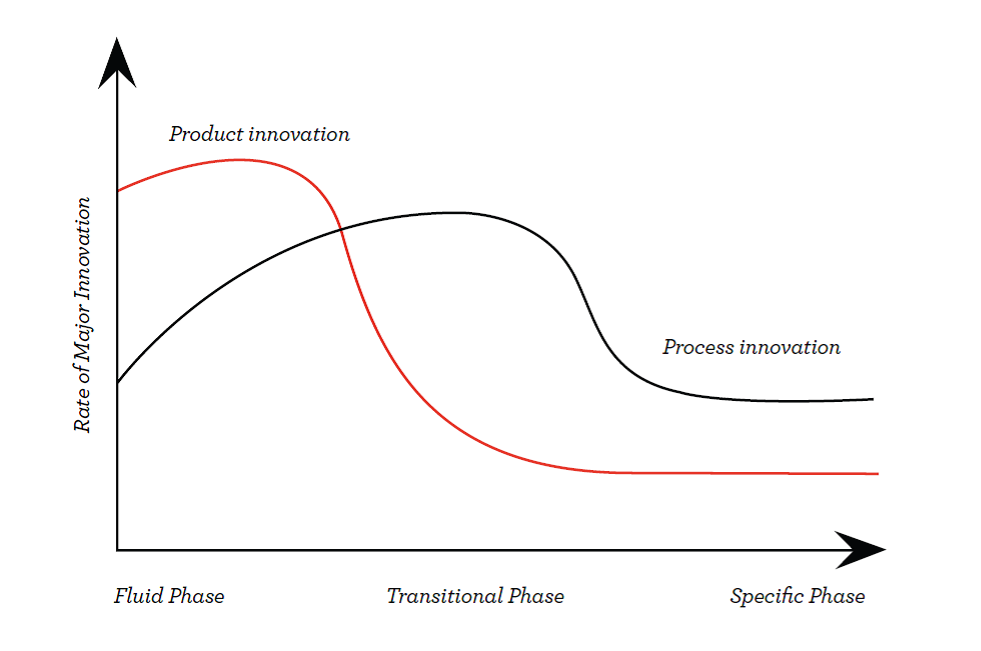
The common innovation process happens in a set frame, following certain rules and ways of thinking. This ‘game played’ by competitors is to innovate by doing what has been done before like product or process innovations or even position and paradigm innovations, but doing it better. In this competition of ‘playing the same game’ some firms manage to do better than others and can gain a competitive advantage through these innovations, but the ‘set of the game’ is accepted and do not change. Very rare something happens that breaks up this framework and changes how the game is played. This will not happen every day but when this arises the rules and boundaries of a market change rapidly. This will result in upcoming new opportunities and challenge the existing players in their way of working, thinking and doing business. A discontinues improvement occurs out of a technological and conditions stable Continue reading

Capital Sources for Business: Retained Earnings

Like an individual, companies also set aside a part of their profits to meet future requirements of capital. Companies keep these savings in various accounts such as General Reserve, Debenture Redemption Reserve and Dividend Equalization Reserve etc. These reserves can be used to meet long term financial requirements. The portion of the profits which is not distributed among the shareholders but is retained and is used in business is called retained earnings or ploughing back of profits. As per Indian Companies Act., companies are required to transfer a part of their profits in reserves. The amount so kept in reserve may be used to buy fixed assets. This is called internal financing. Retained Earnings = Beginning Retained Earnings + Net Income – Dividends A company that has experienced more losses than gains to date, or which has distributed more dividends than it had in the retained earnings balance, will have Continue reading

Case Study: Marketing Strategy of Walt Disney Company

What started out to be nothing more than a dream of Walter Elias Disney, with the release of Alice in Wonderland, a series of short film comedies, the beginning of a world renowned global corporation Walt Disney had evolved. Walter and his brother Roy were equal partners in what was originally the Disney Brothers Cartoon Studio in 1923 and with the suggestion of Roy, it soon was renamed The Walt Disney Studio. After four years of success and profit, Walter and Roy experienced a business set back when they found their film distributor M.J. Winkler had stolen their cartoon characters and animators in attempt to undercut them. With the help from their chief and loyal animator, Ub Iwerks, Walt created Mortimer Mouse, which was renamed Mickey Mouse by his wife. The first cartoon with synchronized sound was released at the Colony Theater in New York, November 18, 1928. Walt Disney Continue reading