Definition of Forfaiting
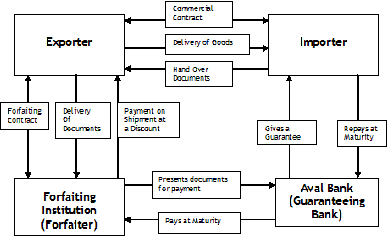
Forfaiting is a specialized form of trade finance that allows the exporter to offer  extended credit to the importer. Under forfaiting  , the importer gives the  exporter a bundle of bills of exchange or promissory notes covering the principal  amount as well as the interest. Each tranche of the notes fall due at different points of  time in the future, e.g. every six months, extending up to several years. The notes are  backed by an aval or guarantee provided by a reputed bank in the importer’s country.  The exporter can then discount these notes without recourse with banks who  specialize in the forfaiting business to generate an immediate cash flow. This means  that if either the importer or the guaranteeing bank fails to pay when notes fall due,  the forfaiter cannot ask the exporter for reimbursement. The credit risk is assumed  entirely by the forfaiter. The forfaiter in turn, may Continue reading

Cost Accounting Information System

Cost Accounting Information System (CAIS) is an accounting information system which determines the costs of products manufactured or services provided and record these costs in the accounting records. It is the key to management’s assessment of the company’s efforts to achieve profit. Since it is so important, the CAIS must be carefully designed and properly maintained. Functions of Cost Accounting Information System (CAIS) Generally the purposes or functions of cost accounting information system fall into four categories. These include providing information for: External financial statements, Planning and controlling activities or processes, Short term strategic decisions and Long term strategic decisions. These four functions relate to different audiences, emphasize different types of information, require different reporting intervals and involve different types of decisions. Cost Accounting Information System (CAIS) Technology Input: The input devices commonly associated with CAIS include: standard personal computers or workstations running applications; scanning devices for standardized data entry; Continue reading

Case Study: Why Did Euro Disney Fail?

Until 1992, the Walt Disney Company had experienced nothing but success in the theme park business. Its first park, Disneyland, opened in Anaheim, California, in 1955. Its theme song, “It’s a Small World After All,” promoted an idealized vision of America spiced with reassuring glimpses of exotic cultures all calculated to promote heartwarming feelings about living together as one happy family. There were dark tunnels and bumpy rides to scare the children a little but none of the terrors of the real world. The Disney characters that everyone knew from the cartoons and comic books were on hand to shepherd the guests and to direct them to the Mickey Mouse watches and Little Mermaid records. The Anaheim park was an instant success. In the 1970s, the triumph was repeated in Florida, and in 1983, Disney proved the Japanese also have an affinity for Mickey Mouse with the successful opening of Continue reading

Introduction to Group Communication

Group communication is an extension of interpersonal communication where more than two individuals are involved in exchange of ideas, skills and interests. A group is a number of people with a common goal who interact with one another to accomplish their goals, recognize one another’s existence and see themselves as part of the group. Groups provide an opportunity for people to come together to discuss and exchange views of common interest. There could be many different groups for as many different reasons. For instance, casually formed groups with friends over a drink, coffee break, games, dances or religious gatherings have a different purpose than that of groups attending a meeting or seminar to help fight AIDS or interacting with committee members to draft a proposal. Communication in a group, small or big, serves many goals including collective decision-making, self-expression, increasing one’s effect, elevating one’s status and relaxation. Group communication is Continue reading

History of Forex Market in India

Until the early seventies, given the fixed rate regime, the foreign exchange market was perceived as a mechanism merely to put through merchant transactions. With the collapse of the Breton Woods agreement and the floatation of major currencies, the conduct of exchange rate policy posed a great challenge to central banks as currency fluctuations opened up tremendous opportunities for market players to trade in currency volatilities in a borderless market. The market in Indian, however, remained insulated as exchange rate controls inhibited capital movements and the banks were required to undertake cover operations and maintain a square position at all times. Slowly a demand began to build up that banks in India be permitted to trade in FOREX. In response to this demand the RBI, as a first step, permitted banks to undertake intra-day trade in FOREX in 1978. As a consequence, the stipulation of maintaining square or near square Continue reading

Top Reasons for Mergers and Acquisitions in Global Scenario

Mergers and acquisitions are considered as one of the routes by which organisations can expand their presence into new markets across geographies or product segments. Essentially these forms of expansion are external in nature in that they all have an element of foreign presence attached to them. These methods of expansion of business have the advantages of reducing risks as there is a new local knowledge or expertise which is added onto the organisation. There are potential for the acquired organisation to bring in new knowledge and synergies to the total organisation which may be valuable in operating in the new market conditions. But along with the advantages to the organisation there are also associated disadvantages also of falling into debt due to the leveraged nature of the acquisition and higher risk of bankruptcy of the organisation. These factors are analysed below. Too much Debt and Risk of Bankruptcy Mergers Continue reading