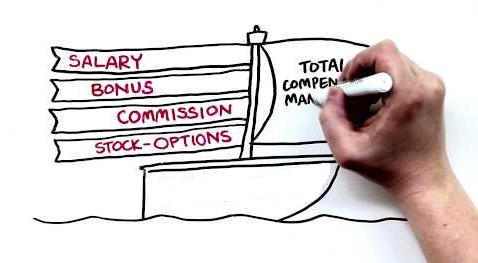
In order to achieve the objectives of compensation management, it should proceed as a process. The compensation management process has various sequential steps as shown: 1. Organisation’s Strategy Organisation’s overall strategy, though not a step of compensation management is the starting point in the total human resource management process including compensation management. Companies operating in different types of market/product having varying level of maturity, adopt different strategies and matching compensation strategy and blend of different compensation methods. Thus, it can be seen that organisations follow different strategies in different market situations and align their compensation strategy and contents with these strategies. In a growing market, an organisation can expand its business through internal expansion or takeover and merger of other organisations in the same line of business or a combination of both. In such a growing market, the inputs, particularly human resources, do not grow in the same proportion as Continue reading
HRM Functions
Process of Salary and Wage Fixation

Steps involved in determining wage and salary rates are as follows : 1. Job Analysis: A job analysis describes the duties, responsibilities, working conditions and interrelationships between the job as it is and the other jobs with which it is associated. Job descriptions are crucial in designing pay systems, for they help to identify important job characteristics. They also help determine, define and weigh compensate factors (factors for which an organization is willing to pay-skill, experience, effort and working environment). After determining the job specifications, the actual process of grading, rating or evaluating the job occurs. A job is rated in order to determine its value in relation to all the other jobs in the organization which are subject to evaluation. The next step is that of providing the job with a price. This involves converting the relative job values into specific monetary values or translating the job classes into Continue reading
Reasons for Employee Turnover
For employers, a challenge to deal with, in order to improve retention, are the common reasons for which the employees tend to migrate towards better positions. Here are some of them: Expectations not Met Expectations play a large part in determining whether an employee is satisfied or dissatisfied with the current state of affairs. On joining the firm the individual will have a range of expectations covering areas such as the style of management, the working hours, holidays, pay, and bonus and so on. It is not unusual for employees to leave within the first six months when they discover that things aren’t quite as they imagined they would be. Their expectations may have been unrealistic from day one, but each departure is yet more disruption, harming productivity, adding extra unnecessary costs and making it more difficult to reach goals for sales, revenue and profitability. Few firms seem to appreciate Continue reading
An Overview of Performance Management
Performance Management is a method for creating a collective understanding regarding what is to be accomplished and how it is to be accomplished. It is an approach to supervising people that raise the likelihood of reaching success. The performance management process helps the managers and supervisors to provide feedback to the employees regarding their current performance at job and expected level of performance. It provides clear direction to the employees about management expectations regarding their performance. The compensation and rewarding system is also established based on the performance of the employees over the period of time. It also assists the organizational leadership to identify the training needs of the organization and resolve the performance related issues. It provides opportunity to the managers to set the performance expectations and keep proper tracking of the employee’s performance. The supervisors and managers can measure the performance outcomes by comparing it with the performance Continue reading
360 Degree Performance Appraisal
Traditional performance appraisals, can be both subjective and simplistic. At times, they can also be deemed to be “political”. In an attempt to improve this methodology, some companies have turned to 360 degree performance appraisals. 360 degree performance appraisals pool feedback from a department’s internal and external customers to ensure a broader, more accurate perspective of an employee’s performance. 360 degree performance appraisal is an attempt to answer the question: “How can a supervisor evaluate an employee he or she sees only a few hours each week?” Using internal and external clients 360 degree performance appraisal offer an alternative by which organizations may gain more useful performance information about employees. Because all clients/customers an employee comes into contact with can conceivably have input into the performance appraisal, this methodology can also makes them more accountable to their customers. Using a courtroom metaphor, one could say that, rather than having a Continue reading
Activities Involved in Human Resource Planning
The Human Resource Planning includes managerial activities that contribute to set the company’s future objectives. It also determines appropriate means and ways for achieving those objectives. Where as organizational planning facilitates the realization of the company’s future objectives and determines appropriate means for achieving those objectives. Human resource planning determines the determinants of changing job requirement. Technological advancement that requires introduction of new equipment, product, and process and invariably resulting in changes in jobs and job structure in an organization can be dealt with proper manpower planning. It is therefore, manpower planning is essential for the organization to meet the demands of future job requirements in order to survive and remain competitive. Otherwise, the organizations experiencing the effect of rapid technological change will face the shortages of skilled employees in the absence of effective human resource planning. Activities in Human Resource Planning Forecasting future human resource needs/ Demand forecasting: Demand Continue reading