
This case focuses on the managerial and leadership philosophies, policies and behaviors of the leadership triumvirate at Google. Sergey Brin and Larry Page, the founders of Google, along with Eric Schmidt, constitute the leadership triumvirate. Brin is president of technology and assumes responsibility for advertising initiatives. Page is president for products and is acknowledged as the company’s thought leader. Together, Brin and Page provide the engineering, technological, and product development leadership for Google. Eric Schmidt is Google’s chairman and chief executive officer, and he is charged with providing the organizational and operational expertise and leadership for the company. Triumvirate Leadership at Google In 1998, while they were doctoral students at Stanford University, Sergey Brin and Larry Page founded Google. In 2001, Brin and Page recruited Eric Schmidt to be Google’s chief executive officer. Schmidt was charged with providing the organizational and operational expertise and leadership for Google, while Brin and Continue reading
Human Resource Concepts
Wage Differentials – Definition, Causes and Types
Wage differentials have a great economic and social significance; they are directly related to the allocation of the economic resources of a country, including manpower growth of the national income, and the pace of economic development. Social welfare activity depends, in a large measure, on such wage differentials as will: Cause labor to be allocated among different occupations, industries and, geographical areas in the economy in such a manner as to maximize the national product. Enable full employment of the resources of the economy to be attained; and Facilitate the most desirable rate of economic progress. Wage differentials reflect difference in the physical and mental abilities of workers, differences in productivity, in the efficiency of management and in consumer preferences, and act as sign posts for labor mobility. By providing an important incentive for labour mobility, they bring about a re-allocation of the labor force under changing circumstances. Under competitive Continue reading
Impacts of Rewards on Employee Turnover Intentions
Employee Turnover Intentions can be defined as a measurement of whether a business or organisation’s employees plan to leave their positions or whether that organisation plans to remove employees from positions. The pay level has an enormous impact on turnover intentions considering that people start seeking new job opportunities with higher salaries to satisfy their life needs. The pay level is more influential for employees than pay raises. Therefore, those workers content with their salary amount are less likely to search for a new workplace. When the payment decreases, the turnover intention increases vice-versa. As for the financial incentives, they are crucial for employees of the young age groups more than for older staff. Therefore, it is vital to cater to workers needs in the incentives scheme according to their age groups as this factor is not the most influential for the turnover intentions. As stated previously, the turnover rates rise Continue reading
Human Resource Planning (HRP) – Meaning, Definition, Features, Purpose, Need, Significance and Objectives

Human Resource is the most vital factor for the survival and prosperity of the organization. The human resource asset in a firm has the potential to appreciate the value of the firm. Though all the firms buy the same material and machines, the people in a firm make the difference in the final product. So the success of any organization mainly depends upon the quality of its human resource and their performance. Any forward looking management will be concerned with the problem of procuring or developing adequate talent for manning various positions in the organization. The success of a human resource planning process not only helps the organization itself, but also helps the society’s prosperity. The losses a firm suffers from inadequate human resource planning and utilization, is a loss to the nation. When these individual losses are added up the total losses may be very significant to the economy Continue reading
The Cultural Web – Johnson and Scholes’s Model of Organizational Culture
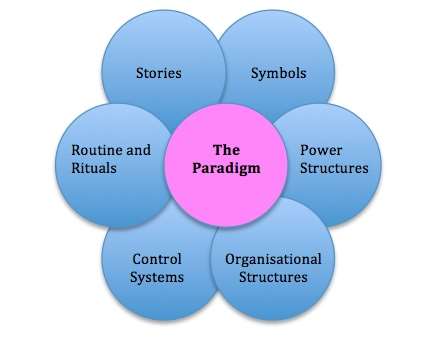
Organizational culture can be simply identified as the own unique personality that the respective organization practices. The group of people who works for the organization shares a system of Assumptions, Beliefs, and Values which governs them both individually and with the organizational needs. The cultural web model developed by Johnson and Scholes in 1993 is an important one, in which six dimensions of the organization culture are defined. The corporate culture consists of six major components, as structure, power structure, symbols, stories, rituals and control systems. They provide clear guidelines for the employees, about how things are performed within the organizational context; providing influences for the better change management. Cultural elements can be organized in the company to achieve productivity is described accordingly. Structure – Mainly refers to the structure of the company, in terms of the management layers and supervisory control. Modern organizations is thereby advised in adjusting to more flat type organization, Continue reading
Effect of Job Satisfaction and Organizational Commitment on Individuals Behavior
Job satisfaction and organizational commitment are the two of the prominent work attitudes that seen in the work environment. Job satisfaction is an emotional response to a job situation while organizational commitment is the strong feeling of responsibility an employee has towards the mission of the organization. Job satisfaction is simply how people feel about their jobs and different aspects of their job. People can either like (satisfaction) and dislike (dissatisfaction) their job. According to Frederick Herzberg, he believed that employees can like their job because various contributions it has. These contribution involves the work itself, pay, promotions, job achievement, co-worker, supervision and benefits contribute to employees satisfy with their job. He called it motivators. If employees are not satisfied with their job then the productions of the organization with not grow. Manager will see their employees as lazy and they will assume that they don’t want to work. This Continue reading