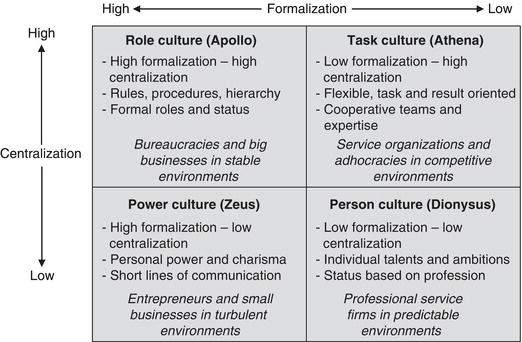
Organizational culture influences the behavior of organisations but as it is intangible it is difficult to define and understand. Organisational culture introduces unspoken rituals and tacit rules and addresses the actions, values, and behaviors, which, in combination, contribute to the overall philosophy and environment of the organisation. It shapes the way in which employees behave and make decisions and is formed over time as a result of the experiences and values of the organisation and the way in which it reacts to internal and external circumstances. A key role of organizational culture is to differentiate the organisation from others and provide a sense of identity for its members. Cultures do not have to be logical or consistent, in fact they seldom are and can appear quite haphazard and chaotic to the outsider. A strong culture is one that is internally consistent, is widely shared, and makes it clear what it Continue reading
Management Basics
Planning Function of Management – Definition and Features
Planning is the process of deciding in advance what is to be done, who is to do it, how it is to be done and when it is to be done. It is the process of determining a course of action, so as to achieve the desired results. It helps to bridge the gap from where we are, to where we want to go. It makes it possible for things to occur which would not otherwise happen. Planning is a higher order mental process requiring the use of intellectual faculties, imagination, and foresight and sound judgment. Accounting to Koontz, O’Donnell and Weihrich, “planning is an intellectually demanding process; it requires the conscious determination of courses of action and the basing of decisions on purpose, knowledge and considered estimates. Planning is a process, which involves anticipation of future course of events and deciding the best course of action. It is a Continue reading
Comparison of Classical and Behavioral Approaches to Management
Management has been as old as the human beings and with the evolvement of humans management has also evolved. The history of management and its theories can be traced back to thousands of years. However, systematic development of the theories of management is generally viewed from the end of nineteenth century with the emergence of large industrial organizations and the ensuing problems associated with their structure and management. This is the time when work of various writers on the management has started to come into the light. These works can be clubbed together to form different approaches to the theory of management. Two of the most popular and widely accepted approaches to management are: Classical Approach to Management, and Behavioral Approach or Human Relation Approach to Management In order to be able to compare and understand the contrast of these two approaches to management, let’s understand the basics of these Continue reading
12 Principles of Organization Structure

Traditional organisation theorists developed certain principles of organization structure. These principles are intended for universal application to all enterprises. The most important of these principles of organization structure can be listed under the following heads: 1. Division of Labor or Specialization The classicists viewed specialization as the basis of efficiency. A group of individuals can secure better results by having division of work. F.W. taylor applied by breaking down jobs into single repetitive tasks performed on specialized tools. At higher levels, however, grouping jobs into manageable units and their co-ordination can pose serious problems. The principle of specializations has been challenged by the behaviorists and others. Fatigue, monotony and boredom are the inevitable outcomes of division of labor. While specializations cause great function interdependency among operatives, it also depersonalizes their activities so that individuals find little meaning in the work. Moreover, functional interdependency among work activities causes strains and tensions. Continue reading
Geographical Organizational Structure
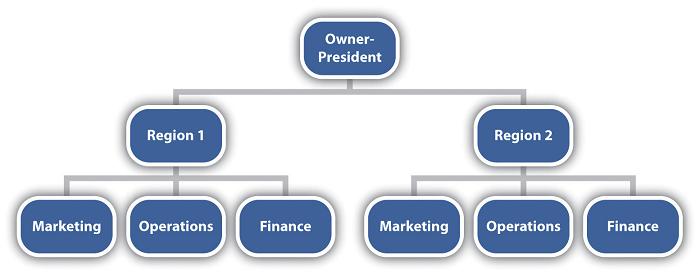
Geographical organizational structure involves grouping of the activities according to regional or geographical locations. The territorial divisions become a complete administrative unit to cater to the need of the localities. The Regional Manager will practically be the chief controller of his region. He is given full powers of managing his own region or zone. His office functions as a head office for all practical purposes. The functions pertaining to finance, marketing, personnel and production development of low-level employees are completely vested in the zonal office which has separate departments of these functions to guide and control the respective activities of the zone. The zonal office may have several divisional offices for executive functions. The area population and size of business in a zone will decide the number of divisional offices, their functional activities, and amount of authority and responsibility to be vested in the divisional managers. Continue reading
Management and Social Responsibility
There are many thinkers who have supported this, but there are others who have expressed their opinion both sides are given as under: Arguments for social responsibility: Manager should have social responsibility for the people. Because manager is a person who is very skilled, if he will take interest in the social functions or problem, it will create a good impression on other people living or working under him it will motivate the sub-ordinates working under him. Thus, it creates a favorable impression on the society, which will ultimately helps the business. Managers have a creative and also communicative skill. As their main task is to have the cordial relations with people inside the organization or outside the organization. The had to interact with his subordinates, superiors and other members relating to business. So, the managers are very creative and if they will take part in social problems, the society Continue reading