
There has been a growing trend towards professionalization of management. Professionalization imparts a certain social responsibility and dignity to management. A professional cannot be controlled or directed by the client. He has professional knowledge and judgment which he uses to make his decision. Thus, professionalization makes business more efficient, dynamic and socially responsible. The growth of management education has contributed to professionalization in the business field. The company form of business organization which has split ownership from management and the gaining popularity of the company form of business organization have increased the need for professional managers. Is Management a Profession? To answer this question, first of all we should understand what a profession is. Many authorities on the subject have attempted to define a profession. According to Abraham Flexner, A profession is; A body of specialized knowledge and recognized educational process of acquiring it. A standard of qualifications governing admission Continue reading
Management Basics
Limitations of Planning
The planning function of management is the most crucial function as it pertains to plan about the future and designing several future courses of actions. It is a preliminary move in the functioning of a firm. It is an organized activity that defines when, how and who is going to execute an explicit task. Planning function of management is also recognized as a detailed programme concerning future courses of action. With the help of planning, it becomes easy for a firm to consider all its available & potential human and physical resources. This consideration facilitate in getting an effective co-ordination, involvement & ideal balance. Although planning is an important function of management. However, the planning may fail if the following limitations. Lack of accuracy: planning relates to future and future is always uncertain and so prediction about future is so much difficult. Moreover planning are based on data/information relating to Continue reading
Boundaryless Organization – Definition and Types
Organizations, by definition, are entities with boundaries. External boundaries separate a company from its suppliers and customers and define its geographic reach. Internal boundaries separate the departments between each other, management from employees. Such lines of differentiation have been necessary. Different departments in the organization work towards the common goal the overall success of the business. However, companies that thrive within the new environment of global competition, rapidly changing technologies, and shifting markets are characterized by not having many boundaries. The new model of success is defined as “boundaryless organization”, a term created by Jack Welch during his term as CEO of GE. A boundaryless organization is a contemporary approach in organizational design. In a boundaryless organization, the boundaries that divide employees such as hierarchy, job function, and geography as well as those that distance companies from suppliers and customers are broken down. A boundaryless organization seeks to remove vertical, Continue reading
Concept of Power in Management

Power in Management Power is easy to feel but difficult to define. It is the potential ability of a person or group to influence another person or group. It is the ability to get things done the way one wants them to be done.Both formal and informal groups and individuals may have power; it does not need an official position or the backing of an institution to have power. Influence can take many forms. One person has influenced another if the second person’s opinions, behavior or perspectives have changed as a result of their interaction. Power is a factor at all levels of most organizations. It can be a factor in almost any organizational decision. Power and Authority Sometimes power and authority is used synonymously because of their objective of influencing the behavior of others. However, there is difference between the two. Power does not have any legal sanctity while Continue reading
What is Research and Development (R&D)?
For a new business initiative it is essential to recognize the development stages through which the enterprise is likely to pass, and prepare for the issues and challenges which will be faced. For a business unit within a corporate it is important to recognize that the same development process applies — often with the same challenges! However, these challenges are sometimes eased by the protection of an established corporate parent able to soften the impact of negative cash flow and poor profitability at the relevant stages. Creativity becomes the responsibility of Research and Development (R&D), which is staffed by specialists in visualizing and realizing marginal or major product changes. Ever since companies such as Dupont and Bell Labs first took, and successfully traveled along, this road, setting up a separate R&D group has been a popular way to enhance value at the concept stage. There are many ways of distinguishing Continue reading
Organizational Architecture
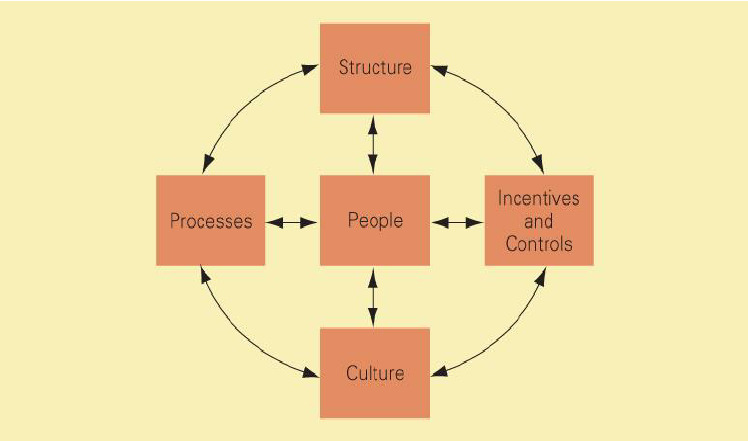
By organizational architecture, we mean the entire organization, including organizational structure, control systems and incentives, processes, organizational culture and people. In this case, there are three conditions to be fulfilled by an organization to make the organization profitable. First, various elements of the organization shall be parallel to each other. Second, organizational strategy should always be consistent with the organizational structure, and finally, strategies and organizational structure must be consistent with the competitive conditions prevailing in the firm’s market that are the strategy, architecture and competitive environment. As noted above, the organizational architecture is the totality of the organization itself which consists of various components. The components are the structure, control systems and incentives, processes, organizational culture and people. The organizational structure is a formal organizational structure used to manage a firm. Control system is the system used to measure the performance of managers and units while the incentives Continue reading