
Management requires that all organizations and businesses get the available resources together to enable them to accomplish their goals, objectives, and aims effectively and efficiently. This means that there must be the act of planning, staffing, controlling, and directing the organization’s manpower for the realization of these purposes as set by the organization. The act of developing human resources is cited as an opportunity through which the employees can develop their own personal skills and other organizational skills needed for the successful operation of the business. Strategic Human Resource Development (SHRD) is the linkage between the strategic goals and objects with the resources available in the organization. This is the trend that most companies are adopting in the recent past. Human resource development has become a strategic application of policies and practices that will ensure a company reaches the peak of its performance by utilizing what it has, for its Continue reading
Human Resource Concepts
Internal Hiring – Meaning, Methods, Advantages and Disadvantages

Internal hiring refer to recruiting employees from within the organization. In deciding requirement of employees, initial consideration should be given to a company’s current employees, which is concerned with internal hiring. They include those who are already available on the pay roll of the company. This is important source of recruitment as it provides opportunities for better development and utilization of existing human resources in the organization. There are two aspects of hiring under internal sources. They are as follows: Promotions – It refers to promoting or upgrading an employee who is already existed in the pay roll and contributed for organizational performance. It is done by shifting an employee to a higher position with high responsibilities, facilities, status and pay. Usually, many companies fill higher job vacancies by promoting employees who are considered fit for such positions. This is due to fact that it has a great psychological impact Continue reading
Concepts of Job Description and Job Specification

Job Analysis is the systematic process of collecting and making judgments about all the important information related to a job. Job Analysis is the procedure through which one determines the duties and nature of the jobs. It also determines the kinds of people who should be hired for those jobs. General purpose of job Analysis is to document the requirements of a job and the work performed. Moreover job Analysis is fundamental to the preparation of job specification and description. Job Description Job description is a broad statement of the purpose, duties and responsibilities of a job or position. A job description is based on a detailed job analysis and usually summarizes the essential information gathered through job analysis. It describes the main tasks and responsibilities of the job clearly and concisely in order to facilitate the systematic comparison of jobs for evaluation purposes. The kind of information and amount Continue reading
Competitive Imperatives of Compensation

Compensation is what employees receive in exchange for their contribution to the organisation. Generally, employees offer their services for three types of rewards. Pay refers to the base wages and salaries employees normally receive. Compensation forms such as bonuses, commissions and profit sharing plans are incentives designed to encourage employees to produce results beyond normal expectation. Benefits such as insurance, medical, recreational, retirement, etc., represent a more indirect type of compensation. So, the term compensation is a comprehensive one including pay, incentives, and benefits offered by employers for hiring the services of employees. In addition to these, managers have to observe legal formalities that offer physical as well as financial security to employees. All these issues play an important role in any HR departments efforts to obtain, maintain and retain an effective work force. So, the employers are, therefore are required to know that what are competitive imperatives which can Continue reading
Selection Criteria for International Assignments

Making an effective selection decision for an overseas assignment can prove to be a major problem. Typically, this decision is based on international selection criteria, which are factors used to choose international managers. These selections are influenced by the Multinational Corporations experience and often are culturally based. Sometimes as many as a dozen criteria are used, although most Multinational Corporations give serious consideration to only five or six. 1. Adaptability to Cultural Change Overseas managers must be able to adapt to change. They also need a degree of cultural toughness. Research shows that many managers are exhilarated at the beginning of their overseas assignment. After a few months, however, a form of culture shock creeps in, and they begin to encounter frustration and feel confused in their new environment. One analysis noted that many of the most effective international managers suffer this cultural shock. Organizations examine a number of characteristics Continue reading
Leader-Member Exchange Theory (LMX)
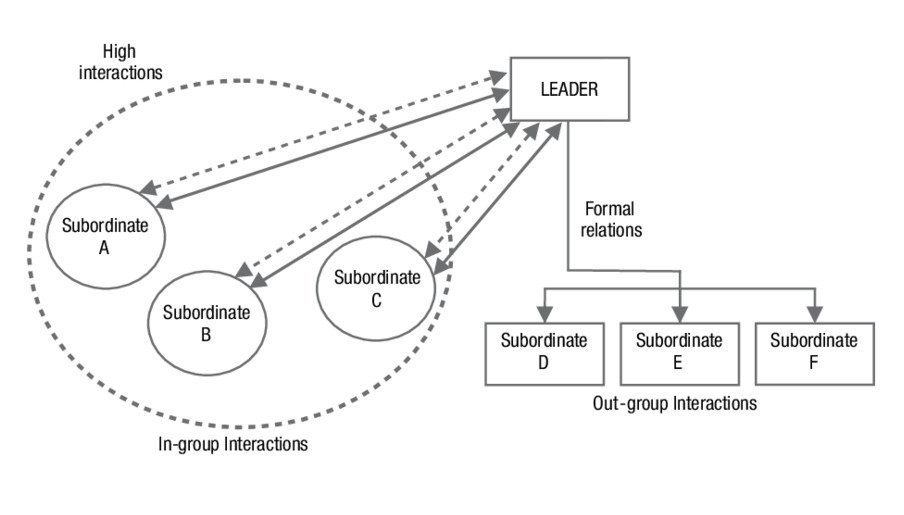
Several leadership theories including trait, behavioral, and contingency theories assume that the leader-member relations are consistent, with the leaders interacting with all subordinates homogeneously. But, Leader-Member Exchange Theory (LMX) asserts that leader-member relations are heterogeneous as leaders cannot distribute their limited resources and time to all the subordinates equally. Hence the leader develops unique dyadic relations with each member over a series of exchanges i.e. Vertical Dyadic Linkage Approach (VDL). Leader-Member Exchange Theory (LMX), also called the Vertical Dyad Linkage Theory developed by Graen and his colleagues suggests that leaders cultivate qualitatively different types of relations with different employees. The theory dictates that effective leadership processes takes place when leaders and followers develop mature partnerships and thus gain access to the mutual benefits of this relationship. Leader-Member Exchange Theory (LMX) suggests that the leader develops different types of exchange relationships with the subordinates. This phenomenon is called ‘LMX differentiation’. LMX Continue reading