Case Study: Nestle’s Growth Strategy

Nestle is one of the oldest of all multinational businesses. The company was founded in Switzerland in 1866 by Heinrich Nestle, who established Nestle to distribute “milk food,” a type of infant food he had invented that was made from powdered milk, baked food, and sugar. From its very early days, the company looked to other countries for growth opportunities, establishing its first foreign offices in London in 1868. In 1905, the company merged with the Anglo-Swiss Condensed Milk, thereby broadening the company’s product line to include both condensed milk and infant formulas. Forced by Switzer ­land’s small size to look outside’ its borders for growth opportunities, Nestle established condensed milk and infant food processing plants in the United States and Britain in the late 19th century and in Australia, South America, Africa, and Asia in the first three decades of the 20th century. In 1929, Nestle moved into the Continue reading

What is CounterTrade?

Countertrade constitutes an estimated 5 to 30 percent of total world trade. Countertrade greatly proliferated in the 1980s. Perhaps, the single most important contributing factor is  Least Developed Countries (LDC’s) decreasing ability to finance their import needs through bank loans. Countertrade, one of the oldest forms of trade, is a government mandate to pay for goods and services with something other than cash. It is a practice, which requires a seller as a condition of sale, to commit contractually to reciprocate and undertake certain business initiatives that compensate and benefit the buyer. In short, a goods-for-goods deal is countertrade. Unlike monetary trade, suppliers are required to take customers products for their use or for resale. In most cases, there are multiple deals that are separate yet related, and a contract links these separable transactions. Countertrade may involve several products, and such products may move at different points in time while Continue reading

Building Effective Teams

An effective team is one which contributes to the achievement of organizational objectives by performing the task assigned to it and providing satisfaction to its members. Team effectiveness depends on the complementary of team members, other factors remaining the same. From this statement, it appears that there are many factors in  effective teams. These factors are skills and role clarity, supportive environment, super-ordinate goals and team rewards. Let us see how these factors make effective teams. Skills and Role Clarity: For an effective team, two things are required from its members; skills which are complementary to the team requirement and understanding of one’s own role as well as roles of other members. While skills are relevant for job performance, understanding of roles helps members to meet the requirement of one another thereby solving the problems which the team faces. Thus, team members may tend to contribute positively to the teamwork. Continue reading

Adoption of Blue Ocean Strategies in Business

Strategy involves standing out from the competition and making choices that give the company a unique and valuable position by offering distinctive products and services. Competitive advantage and profitability can be achieved simultaneously by approaches that create consistent internal synergies and combine a company’s operational activities efficiently. Strategies are formed at various levels of the organization. However, a typical organizational structure incorporates strategies at 3 specific levels: corporate, business and functional.  Corporate strategy defines a company’s holistic growth and management direction pertaining to its various businesses, products and services. Business strategies, on the other hand, are established at the divisional levels and typically focus on enhancing the strategic business unit’s competitive position in its industry. Functional strategies aim to maximize resource productivity and are typically set by functional departments within each SBU to improve competencies and performance. Blue Ocean strategies are a form of business level strategies that enable firms Continue reading

Case Study: General Electrics “Imagination At Work” Ad Campaign

Throughout its history General Electric Co. enjoyed the benefits of a consistent marketing message. From the 1930s to the 1950s the company relied on the slogan ‘‘Live better electrically,’’ which was followed by two decades of variations on the word ‘‘progress,’’ such as ‘‘Progress is our most important product.’’ In 1979 GE unveiled ‘‘We bring good things to life,’’ a cornerstone to one of the most successful corporate branding campaigns in history, backed by about $1 billion in advertising. The company also had consistent leadership in the form of John F. ‘‘Jack’’ Welch, who became chairman and CEO in 1981. The charismatic leader sought to build up GE’s status in all of the technology, service, and manufacturing areas that the company participated in. By the time Welch announced that he would retiring in 2001, GE, fast growing and profitable, had a market capitalization of $505 billion, making it second only Continue reading

Innovator’s Dilemma – Sustaining vs Disruptive Technologies

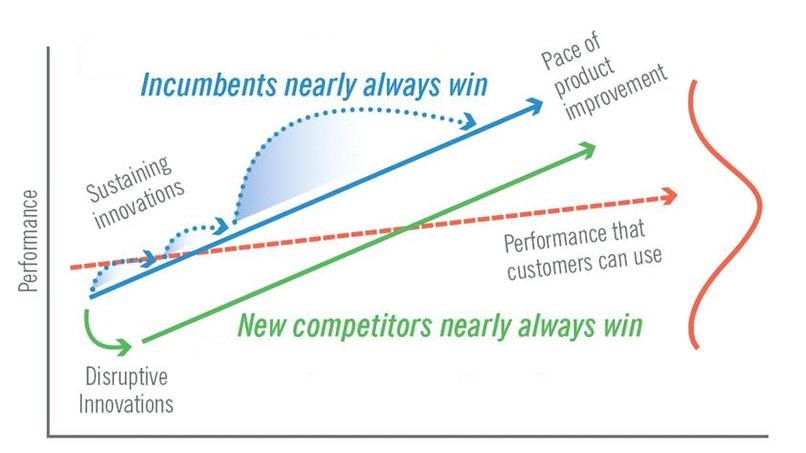
The Innovator’s Dilemma, the strategic term first articulated in a classic business book, The Innovator’s Dilemma,  by the innovation guru, Clayton Christensen of Harvard Business School.  It states that a company’s successes and strengths can actually become obstacles when faced with changing markets and technologies. “The innovator’s dilemma [is] that ‘good’ companies often begin their descent into failure by aggressively investing in the products and services that their most profitable customers want.” –  Clayton Christensen, The Innovator’s Dilemma. The innovator’s dilemma is the dilemma of recognizing when to respond to technological change in a way that is fundamentally different from that which usually works for large, successful businesses. The dilemma is that of recognizing which of two types of technological innovations are looming on the horizon for a particular industry. The two types of technological innovations are sustaining technologies and disruptive technologies. For each of these, the “threats” posed to Continue reading