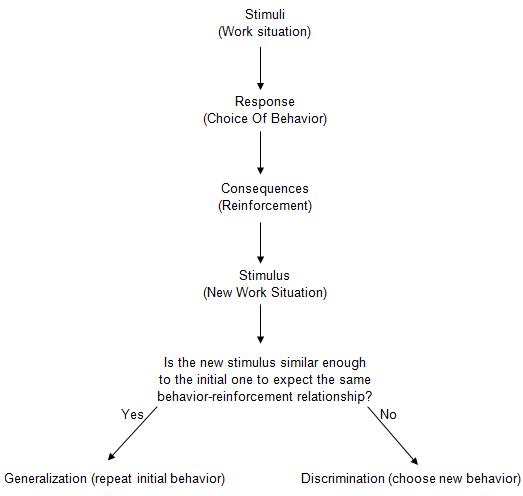
Stimulus Generalization in Organizations Stimulus generalization refers to how people recognize the same or similar stimuli in different settings. In other words, it is the process by which they can generalize a contingent reinforcement from one setting to another. Consider the plant manager of a manufacturing company who has a history of effective troubleshooting. Over the years he has been assigned to several plants, each with a serious operating problem. After successfully dealing with the difficulties, he has always received an extended vacation, a bonus and an increase in his base salary. He has learned the basic contingencies or requirements of reinforcement for his job. The stimulus is the assignment, the response is correcting problems and the consequences are several positive reinforcers. When the manager gets his next assignment, he will probably generalize from his past experiences even though he will be in a different plant with different problems and Continue reading
Management Concepts
Scope of Management Control System

A management control system refers to the framework by which managers can ensure control over the actions of their subordinates as well as control over the organization as a whole. It is a total system in the sense that it embraces all aspects of the firm’s operations so that the different parts of the organization are in balance with one another. According to Anthony, “A management control system is an explicit set of activities, policies, procedures and reports intended to institutionalize the, formal aspects of the management control process.” This definition reveals that the scope of management control system is not necessarily restricted to measuring, the performance of a subordinate manager toward the achievement of an objective established for, his function. Performance evaluation is only a part of management control. Control system should not be confused with a control method, which is merely one of the many elements of control Continue reading
Role of Service Industries in Economic Growth
The pursuit of service economy, which dictates the specialization in the service industries, is one of the newest economic concepts that ensure the realization of the economic growth. The adoption of this form of economy will allow countries to transform the dimensions of their economic standards in a positive way. In this regard, countries would need to develop more service industries rather than manufacturing industries due to flexibility in the international trade. Similarly, the concept of service economy incorporates the need for improvement of services and product provision. Based on these factors, service industries should mainly focus on financial services, health, education, tourism, and distribution. The degree of mobility of these services is high, and they can be cheaply transferred from one location to another. Additionally, geographical factors do not hinder the performance of these services. As a result, industries should focus on service delivery to their customers, which increases their Continue reading
Span of Management -Meaning and Factors Determining

An organization is characterized by the presence of a number of levels and departments. But more the levels are created, more will be the administrative cost due to additional staff required and more will be the difficulties to be encountered in communication and controlling. If this is so, why create departments and levels? Answer to this question is provided by the principle of span of management. This is basically the problem of deciding the number of subordinates to report directly to each manager. The principle states that there is a limit to the number of subordinates that each manager can effectively supervise. The term “span of management” is often referred to as span of control, span of supervisions, span of responsibility or span of authority. But the term “span of management” should preferably be used since span is one of management and not merely or control which is just important Continue reading
Transfer Pricing Methods
In a simple terms the term Transfer pricing refers to the prices that related parties charge one another for goods and services passing between them. The most common application of the Transfer pricing rules is the determination of the correct price for sales between subsidiaries of a multinational corporation. These prices can be used to shift profits to tax-favored jurisdictions, If in a transaction between a subsidiary in a high-tax jurisdiction and another in a low-tax jurisdiction, the high-tax subsidiary charges a price below the “true” price, some of the group’s economic profit is shifted to the low-tax subsidiary. Obviously taxpayers would want to engage in this sort of behavior because it can significantly reduce their taxes. If there were no limitations on this behavior, the entire income of multinational corporations would be taxed at the lowest tax rate in the world to zero rate of taxation. Consequently most countries Continue reading
Henri Fayol – Father of Modern Management Theory
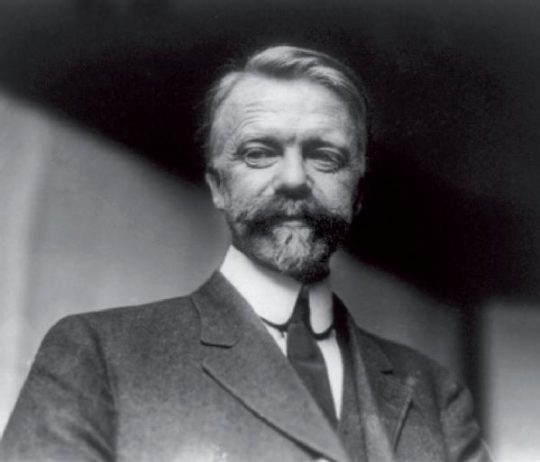
Henri Fayol was a French industrialist and manager, working in the mine industry and looking for applicable solution to business management. He went to school in Lyon (the second largest city of France) and enrolled at the engineering school of Saint-Etienne (Ecole Nationale des Mines). He received an education as a mine engineer and graduated in 1860 from this school at the age of 19. He was first employed as an engineer at Boigues, Rambourg and Co. In 1874, this company became Commentry-Fourchambault SA or Comambault). It is important to notice he spend all his professional life in the same company experiencing its expansion and knowing well its structure and production methods. Fayol was first remarked as an engineer when he wrote a paper proposing a solution to fire hazard, fire fitting and spontaneous combustion in mine, destructing men and installations. In 1866, he was appointed director of a single Continue reading